Skip to content
Welcome, thoughtbot's Giant Robots listeners!Start here
Autonomous Systems: Land & Sea
12AUG

Latvia puts drone hunters on the road

2 min read
14:17UTC

Latvia deployed mobile drone-intercept teams to its Russian border, four-soldier 4x4 units carrying domestic Origin Robotics and Eraser interceptors, after two UAVs crashed on its soil in May.

TechnologyDeveloping

Latvia deployed mobile drone-intercept teams to its Russian border in late May and early June, four-soldier 4x4 units carrying Origin Robotics and Eraser interceptors, backed by a border sound-sensor network, Defense News reports⁠1. The trigger came on Thursday 7 May, when two UAVs (unmanned aerial vehicles) crashed on Latvian soil, one striking an empty fuel depot.

This is the first fielded Baltic counter-drone unit since a Romanian F-16 shot a drone down over Estonia, and the EU's subsequent call for unified Baltic air-defence alerts. Sweden's Saab GUTE II award bought a system; Latvia has put crews and interceptors on the border running one.

Latvia's sound-sensor network, paired with optics and tactical radar, targets the low-signature FPV (first-person-view) drones that radio-frequency detection misses, the gap that has defined cheap-drone incursions. Using its own Origin Robotics and Eraser systems keeps the supply loop domestic, which counts when the threat across the border is scaling. Other Baltic states can copy the fielded model quickly using their own manufacturers, the likely second-order effect.

Deep Analysis

In plain English

On 7 May 2026, two drones from across the Russian border crashed on Latvian soil. One hit an empty fuel depot. Latvia's response was to send small military teams, four soldiers in 4x4 vehicles, to patrol the border area with equipment that can intercept and destroy incoming drones. These teams use interceptor drones from Latvian companies Origin Robotics and Eraser to knock hostile drones out of the air. Latvia is a small country that shares a 214-kilometre land border with Russia and is a NATO member. The drone incursions, most likely caused by Russian jamming disrupting Ukrainian drones' navigation systems, have become a security concern for the Baltic states as the war in Ukraine continues.

First Reported In

Update #11 · Ukraine starts exporting the factory

Defense News· 7 Jun 2026
Read original →
Different Perspectives
Conservative opposition
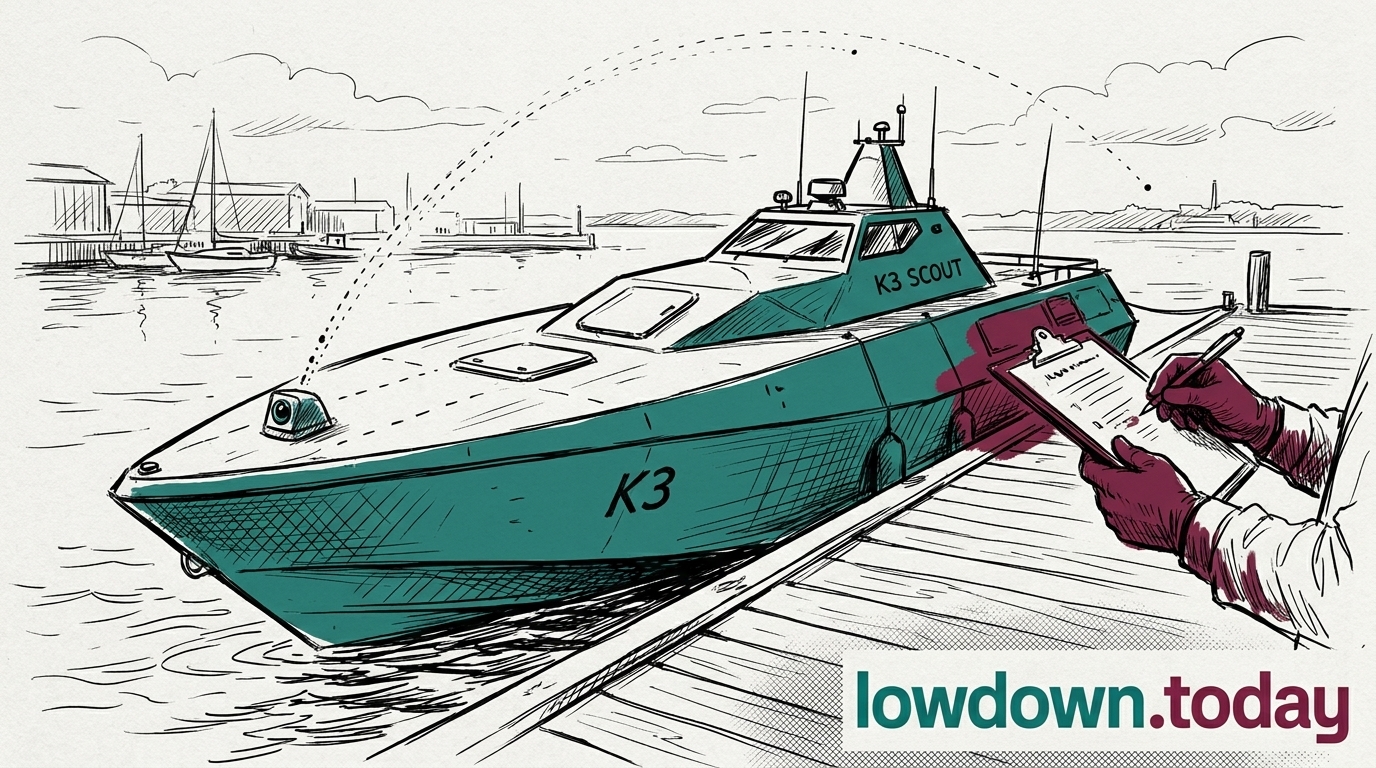
The Conservative opposition called on the Government on 9 August to 'urgently audit' equipment for hidden Chinese components, after the Telegraph's K3 SCOUT report. No named MP has been quoted on the record; the call came at party level, alongside the Ministry of Defence's own 10 August statement that no data had been compromised.
Kraken Technology Group
Kraken Technology Group is a UK maritime-defence company based in Portsmouth that builds the K3 SCOUT, and crossed a $1bn valuation in July on a single-sourced $175m raise. The camera components reached the fleet under a third party's written security assurance, which the Platform Authority, which does not yet exist, was never positioned to check.
Navy Commercial
Navy Commercial
Navy Commercial at Whale Island published two notices on 5 August: 074032-2026, asking industry how to build a Platform Authority to certify uncrewed vessels, and 074351-2026, a GBP10m multi-role USV testbed for the Defence Chief Technology Officer. Responses on the Platform Authority close 19 August, ten days after the cameras were found transmitting to China.
HUMAIN
HUMAIN
HUMAIN and Applied Intuition stated a 2030 target for thousands of autonomous trucks on Saudi logistics corridors. The announcement disclosed no order, fleet baseline or contract value.
Saildrone
Saildrone
Saildrone and Lockheed Martin demonstrated two JAGM launches from a Surveyor-class vessel at RIMPAC. The accepted record identifies no requirement, customer or production configuration behind the demonstration.
Taiwan Legislative Yuan
Taiwan's Legislative Yuan passed the Act at third reading with a small suicide uncrewed boat on the named development list. The NT$240 billion ceiling covers all unmanned domains, and the Act was not promulgated by 4 September.
