Skip to content
Briefings are running a touch slower this week while we rebuild the foundations.See roadmap
Drones: Industry & Defence
7JUN

Ukraine starts exporting the factory

3 min read
11:27UTC

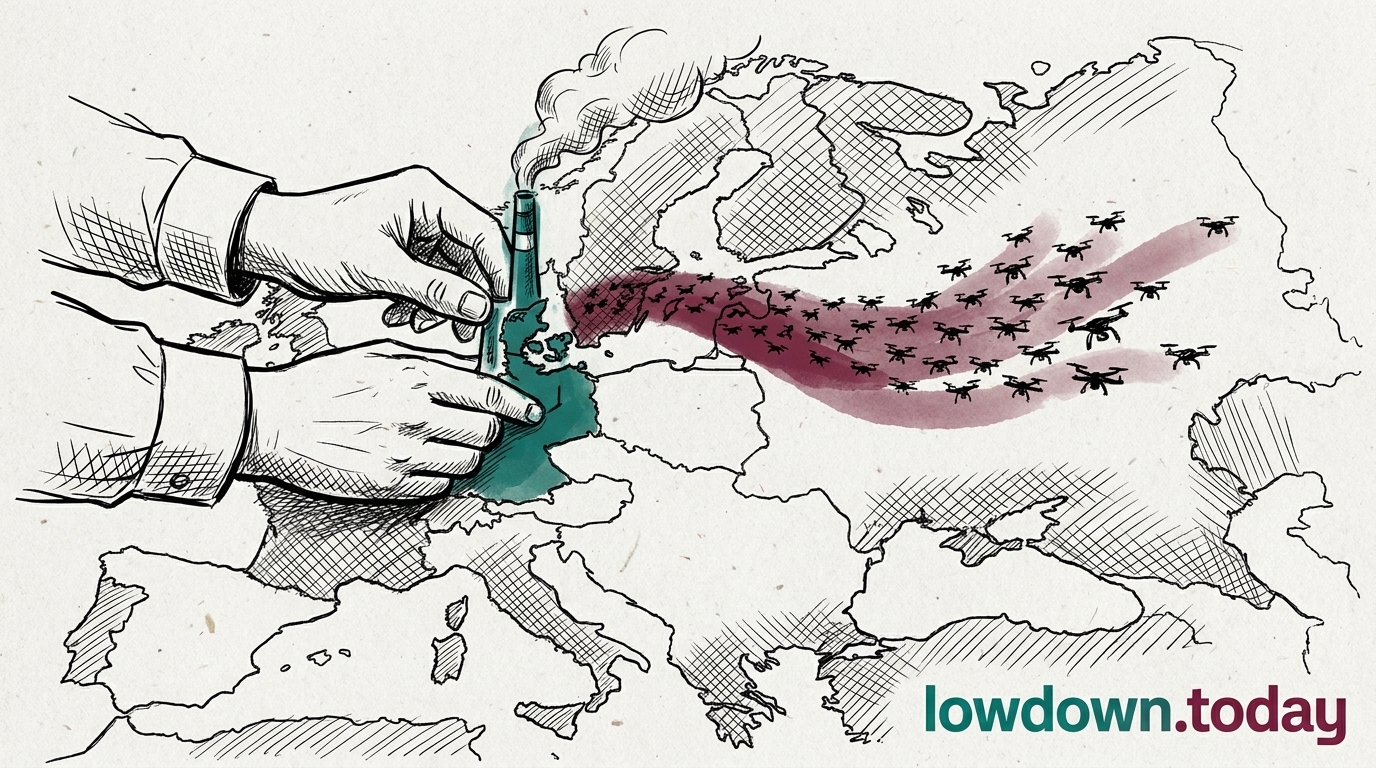
Ukraine has flipped from the drone war's biggest recipient of Western kit to an exporter embedded in NATO supply chains: a weapons plant on Danish soil, ten EU export offices, two firms inside the Pentagon's drone gauntlet. Generalist venture capital crossed into attack-drone equity, Latvia fielded its first roadside intercept teams, and a heritage prime walked into the startup arena.

Key takeaway

Ukraine's drone-war production surplus is now embedded inside allied procurement chains at four layers simultaneously.

This briefing mapped
Loading map…
Military
Diplomatic
Competitive
Economic

Fire Point, the Ukrainian maker of the 3,000km Flamingo cruise missile, has begun building a rocket-fuel plant beside a Danish F-35 base, the first Ukrainian weapons production on NATO ground.

Sources profile:This story draws on neutral-leaning sources

Fire Point, Ukraine's maker of the Flamingo missile, broke ground on a rocket-fuel plant at Skrydstrup, Denmark, in June 2026. The site sits next to a Danish F-35 air base. It is the first Ukrainian weapons factory on NATO soil.

Ukraine has shifted from weapons recipient to weapons manufacturer inside the Alliance. That raises unresolved legal questions about whether Denmark now shares co-belligerent status. 

Sources:Militarnyi

Volodymyr Zelensky announced ten EU weapons export offices, concentrated in the Baltics and Northern Europe, to open by the end of 2026, building a state apparatus to sell Ukrainian drones into allied supply chains.

Sources profile:This story draws on neutral-leaning sources

Zelensky announced plans in June 2026 to open ten Ukrainian weapons export offices across the EU, concentrated in Baltic and Northern European states, by end-2026. Ukraine now has 450 drone producers, giving it a genuine commercial base.

Spetstechnoexport, the Ukrainian state arms exporter, will anchor the network. The move puts Ukrainian combat-tested drones into direct competition with Western suppliers for allied procurement budgets. 

Sources:Militarnyi

Red Cat Holdings disclosed via an SEC filing a formal partnership with Spetstechnoexport, Ukraine's Ministry of Defence arms exporter, to build next-generation unmanned and robotic systems.

Sources profile:This story draws on neutral-leaning sources

Red Cat Holdings filed a stock-exchange disclosure on 7 May 2026 to confirm a formal partnership with Spetstechnoexport. Spetstechnoexport is Ukraine's defence ministry arms export company. Together they will build next-generation drone and robotic systems.

Red Cat's 849% quarterly revenue growth gave it the credibility to formalise what had been an informal arrangement. Most foreign military partnerships stay out of public filings; Red Cat's Nasdaq listing made this one visible. 

Mach Industries closed a $300M Series C at a $1.8B valuation, quadrupling its value in a year, with a fintech fund and mainstream tech investors crossing into attack-drone equity.

Mach Industries closed a $300 million funding round on 1 June 2026, valuing the autonomous weapons startup at $1.8 billion, a fourfold increase in twelve months. Ribbit Capital, a fintech-specialist fund, co-led the round alongside Infinite Capital.

Mach simultaneously acquired solid-rocket-motor firm Exquadrum for $50 million, bringing a critical propulsion component in-house and positioning itself for US military production contracts. 

Two Ukrainian drone makers joined the Pentagon's Drone Dominance Phase 2 field, one partnering Phase 1 leader Skycutter, as Stage 1 opens at Camp Grayling, Michigan.

Two Ukrainian drone firms entered the Pentagon's Drone Dominance Phase 2 Gauntlet in early June 2026. One is a confirmed partner of Phase 1 winner Skycutter. Stage 1 runs 8-20 June at Camp Grayling, Michigan.

Ukrainian firms now appear as direct entrants, not just subcontractors. That extends Skycutter's Phase 1 result, where allied startups outscored established US defence contractors. 

Global counter-drone procurement was logged at $29bn for Q1 2026, but $20bn of that is an Anduril contract ceiling, not cash; the honest read is roughly $9bn in a single quarter.

Sources profile:This story draws on neutral-leaning sources from United States
United States

Global spending commitments on counter-drone systems reached $29 billion in the first quarter of 2026, compared with $12.6 billion for all of 2025. Around $20 billion of that is a contract ceiling for Anduril, not actual orders placed.

Stripping out the Anduril ceiling leaves roughly $9 billion in real Q1 commitments. That is near 70% of all 2025 spending in a single quarter. New state buyers, including Poland, drove the underlying surge. 

Sources:Defense News

Latvia deployed mobile drone-intercept teams to its Russian border, four-soldier 4x4 units carrying domestic Origin Robotics and Eraser interceptors, after two UAVs crashed on its soil in May.

Sources profile:This story draws on centre-left-leaning sources from Netherlands
Netherlands

Latvia sent mobile four-soldier drone-intercept teams to its Russian border in late May 2026. Each team uses Origin Robotics and Eraser interceptors, backed by a border sound-sensor network. The deployment followed two drones crashing on Latvian soil on 7 May, one hitting a fuel depot.

The mobile-team model is operationally distinct from static radar defences: it trades coverage continuity for rapid response. Latvia's kinetic-first posture is more aggressive than Estonia and Finland's identification-first protocols. 

Sources:Moscow Times

Russian combined aircraft and drone output rose 117% year-on-year in April, per Rosstat data analysed by Bloomberg, with cheap FPV mass production named as the driver.

Russian combined aircraft and drone output rose 117% year-on-year in April 2026, according to Rosstat data analysed by Bloomberg. The January-April average was 78%, accelerating from a 68% full-year rate in 2025.

Rosstat publishes no absolute unit counts, making the baseline invisible. Cheap first-person-view (FPV) drone mass production is the assessed primary driver, consistent with the record 947-drone salvo Russia launched in March 2026. 

The Pentagon's Drone Dominance Phase 2 Gauntlet Stage 1 runs from Monday 8 June to Saturday 20 June at Camp Grayling, Michigan, pitting startups, FPV racers and two Ukrainian firms against a programme a heritage prime now shapes.

Pentagon Drone Dominance Phase 2 Gauntlet Stage 1 opened on 8 June 2026 at Camp Grayling, Michigan. It runs until 20 June. Competitors include Skycutter, two Ukrainian firms, and first-person-view (FPV) racing veterans.

Northrop Grumman holds a payload-standard contract for 200,000 drones at roughly $5,000 each. The heritage prime earns from volume regardless of which startups win the platform competition. 

DroneShield shareholders delivered a first strike at the 29 May AGM, with 50.51% voting against the remuneration report, even as the CEO's options package passed and a new chair was elected.

At DroneShield's annual general meeting (AGM) on 29 May 2026, 50.51% of shareholders voted against the remuneration report. That is a formal first strike under Australian corporate law. CEO Angus Bean's option package passed more narrowly at 55.8%.

New chairman Hamish McLennan won 82.43% support. Under Australian rules, a second consecutive first strike at the 2027 AGM could force all directors to stand for re-election. 

1 DroneShield (ASX disclosure)2 DroneShield (ASX disclosure)

Kratos raised its full-year 2026 revenue guidance to $1.7-1.76bn and opened negotiations on a Valkyrie production contract targeting 40 aircraft a year by early 2028.

Kratos raised its full-year 2026 revenue guidance to $1.7-1.76 billion in May 2026. It also opened negotiations for a Valkyrie production contract, targeting 40 aircraft per year by early 2028.

The Valkyrie is Kratos's unmanned jet that flies alongside manned fighters. Anduril's Arsenal-1 factory targets 150 rival aircraft per year. The two firms are bidding different programme lines, so the production gap is not a direct competition. 

Closing comments

Up, driven by two concurrent mechanisms. Russia's April output acceleration (117% YoY, steepening from 78% average January-April and 68% full-year 2025) puts rising salvo volumes into the Baltic corridor where Latvia has now committed kinetic intercept units, raising the probability of a misdirected engagement incident. The decision point that would tip from operational friction to formal escalation is a kinetic Latvian intercept that causes secondary damage on Russian-registered airspace or territory, triggering Article 4 consultations at NATO. On the procurement side, the tipping mechanism is a NATO legal directorate opinion on whether hosting Fire Point's Skrydstrup plant converts Denmark into a co-belligerent; silence sustains ambiguity that Russian information operations will exploit through Baltic domestic politics.

Different Perspectives
Ukrainian defence industry (Fire Point / Spetstechnoexport)
Fire Point's Skrydstrup construction start and Spetstechnoexport's Red Cat partnership execute Zelensky's 13 May Bucharest proposal: converting wartime production surplus into a state export apparatus, independent of US approval chains. For Ukraine, embedded manufacturing on NATO soil protects propellant supply from Russian strikes while generating hard currency the war effort needs.
Pentagon / Joint Interagency Task Force 401
Two Ukrainian entrants in Drone Dominance Phase 2 and Red Cat's SEC-filed STE partnership bring combat-iterated Ukrainian designs into US procurement without triggering Foreign Military Sale approvals; the programme's performance-scoring methodology does not require US-origin hardware. Northrop holding the Common UAS Payload standard means a heritage prime captures interface revenue regardless of which startup airframe wins.
Baltic NATO states (Latvia, Estonia, Lithuania)
Latvia deployed mobile drone-intercept teams on 29 May using domestic Origin Robotics and Eraser interceptors, the first kinetic Baltic border response to Russia's 117% output surge. The Baltic states are the primary target market for Ukraine's ten EU export offices, giving them direct commercial access to combat-tested interceptors their own manufacturers have not yet matched.
Russian Ministry of Defence
Russia's 117% YoY drone-output rise in April, accelerating from a 68% full-year 2025 baseline, validates the FPV mass-production doctrine and hands Moscow a cleaner targeting argument for the Skrydstrup plant than any hidden production line offered; a Ukrainian weapons facility on NATO sovereign territory is a legitimate military target under the laws of armed conflict.
Denmark (host nation)
Denmark accepted Fire Point's Skrydstrup plant after committing to bilateral defence co-production at the B9 Nordic summit in May; the facility sits beside a Danish F-35 base, sharing security perimeters. NATO has published no legal guidance on whether hosting Ukrainian weapons production converts Denmark into a co-belligerent, leaving the host-state obligation unresolved.