Skip to content
You can now search across every topic, entity and event.What's new
Autonomous Systems: Land & Sea
12AUG

EU pushes for unified Baltic drone alert

2 min read
14:17UTC

The EU called on 26 May for unified alert systems and cross-border coordination across Baltic air defences, responding to what Bloomberg described as critical gaps in the region's airspace management.

TechnologyDeveloping
Key takeaway

The EU wants Baltic drone coordination it has no power to compel.

The European Union called on 26 May for unified alert systems and cross-border coordination to fill gaps in Baltic air defences exposed by the drone incursion series. The call responds to a pattern of national emergency purchases that share nothing beyond the threat that triggered them.

The EU AGILE programme at EUR 115 million was the intended coordination mechanism. It is now one-seventieth of Sweden's GUTE II budget alone, a ratio that captures the mismatch between EU ambition and national spending reality. The same fragmentation plagued NATO 155mm ammunition standardisation for two decades after the Cold War; without enforcement mechanisms, Brussels is asking governments to slow procurement cycles that domestic politics, following Spruds's resignation, now demand they accelerate.

Sweden, France, the Netherlands, and Lithuania have each chosen different systems, different vendors, and different command architectures in the past six weeks. The EU's call for coordination arrives after each country has already signed contracts, not before.

Deep Analysis

In plain English

The EU asked Baltic countries to share information about drone threats and build a common warning system. Unlike NATO, the EU has no treaty power to compel defence coordination: Baltic states are already NATO members who route their drone decisions through the alliance. Countries under procurement pressure tend to buy fast and coordinate later; the EU's EUR 115 million AGILE programme is the only financial lever it can apply, one-seventieth the size of Sweden's counter-drone contract alone.

Deep Analysis
Root Causes

The EU has no treaty competence over collective defence, which sits with NATO; its call for Baltic air-defence coordination therefore carries no binding authority over the member states it is addressing.

Member-state defence budgets are nationally controlled, not EU-allocated, so the EUR 115 million AGILE programme is the only financial lever the EU can apply, equating to roughly one-seventieth of Sweden's GUTE II budget alone.

The urgency of the Baltic threat drives states to buy what is available fast, compressing the procurement timelines that interoperability discussions require, so the EU call arrives at exactly the moment when member states are least able to act on it.

What could happen next?
  • Consequence

    The EU call will produce a working group, possibly a standards body, and eventually a coordination framework that national procurement offices will ignore when it conflicts with speed. The substantive effect will be determined by whether AGILE funding is made conditional on interoperability. If it is not, the call is decorative.

First Reported In

Update #10 · NATO shoots down drone over Estonia

Bloomberg· 29 May 2026
Read original
Different Perspectives
Conservative opposition
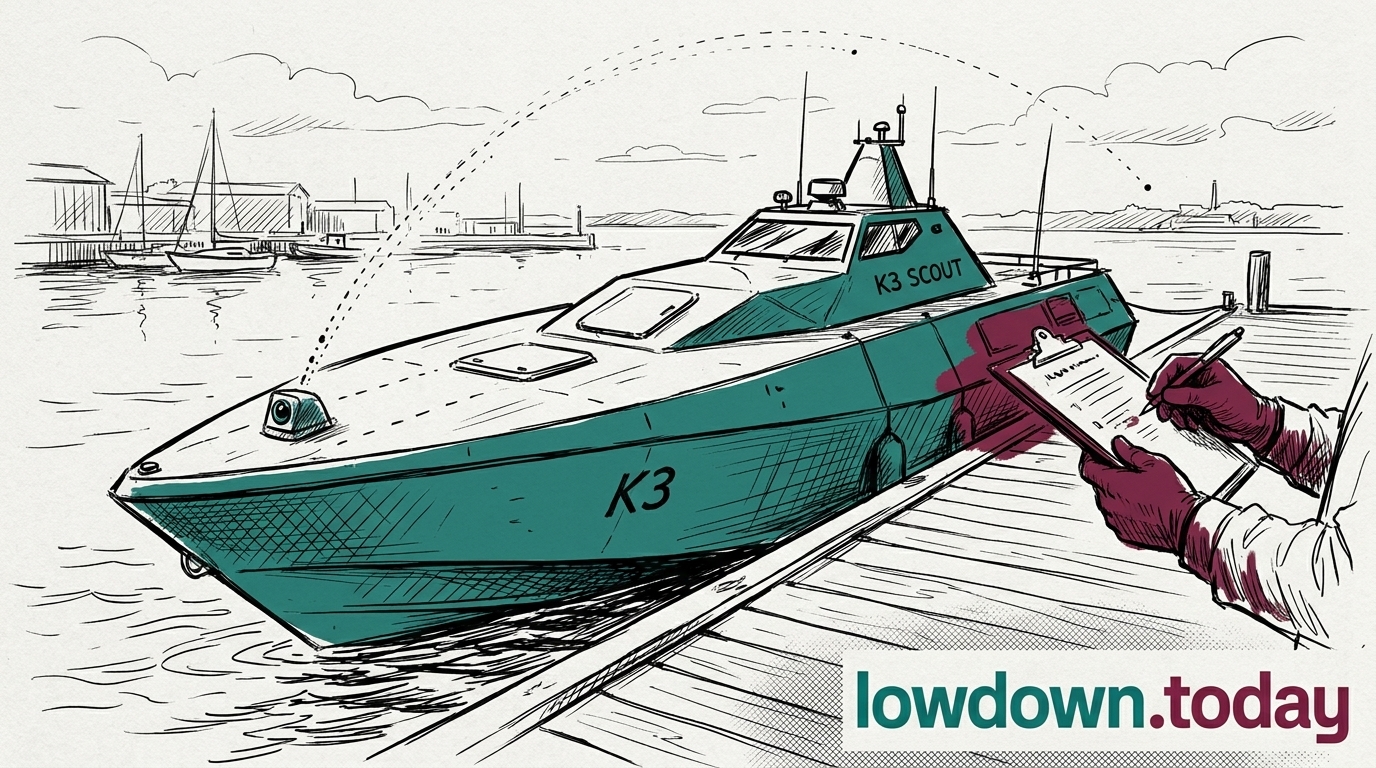
The Conservative opposition called on the Government on 9 August to 'urgently audit' equipment for hidden Chinese components, after the Telegraph's K3 SCOUT report. No named MP has been quoted on the record; the call came at party level, alongside the Ministry of Defence's own 10 August statement that no data had been compromised.
Netherlands Ministry of Defence
The Netherlands Ministry of Defence authorised Dutch Naval Design on 4 August to design 12-metre anti-submarine warfare uncrewed vessels for the Dutch-Belgian frigate programme, and to buy an adapted Compact FLASH dipping sonar from Thales Underwater Systems France. The order commits money and a named supplier while Britain's own certification body remains at the market-engagement stage.
Kraken Technology Group
Kraken Technology Group is a UK maritime-defence company based in Portsmouth that builds the K3 SCOUT, and crossed a $1bn valuation in July on a single-sourced $175m raise. The camera components reached the fleet under a third party's written security assurance, which the Platform Authority, which does not yet exist, was never positioned to check.
Navy Commercial
Navy Commercial
Navy Commercial at Whale Island published two notices on 5 August: 074032-2026, asking industry how to build a Platform Authority to certify uncrewed vessels, and 074351-2026, a GBP10m multi-role USV testbed for the Defence Chief Technology Officer. Responses on the Platform Authority close 19 August, ten days after the cameras were found transmitting to China.
Ministry of Defence
Ministry of Defence
The Ministry of Defence said on 10 August that a routine cyber vulnerability assessment found the camera fault, and a thorough investigation found no evidence that MoD data or systems had been accessed, compromised or transmitted externally. It stripped the cameras of internet connectivity but did not say whether it acted against the supplier.
Thales
Thales
Thales converted its 6 July engaging accord with Exail into a definitive combination agreement on 30-31 July, but the tender offer for Exail's remaining shares now closes by early 2028, later than July's timetable implied. Thales integrates its new undersea prime while still bidding against Kongsberg and DRASS's 2027 target for the AUKUS Pillar II contest.
