THAAD
US anti-Ballistic missile system defending against medium- and long-range ballistic threats.
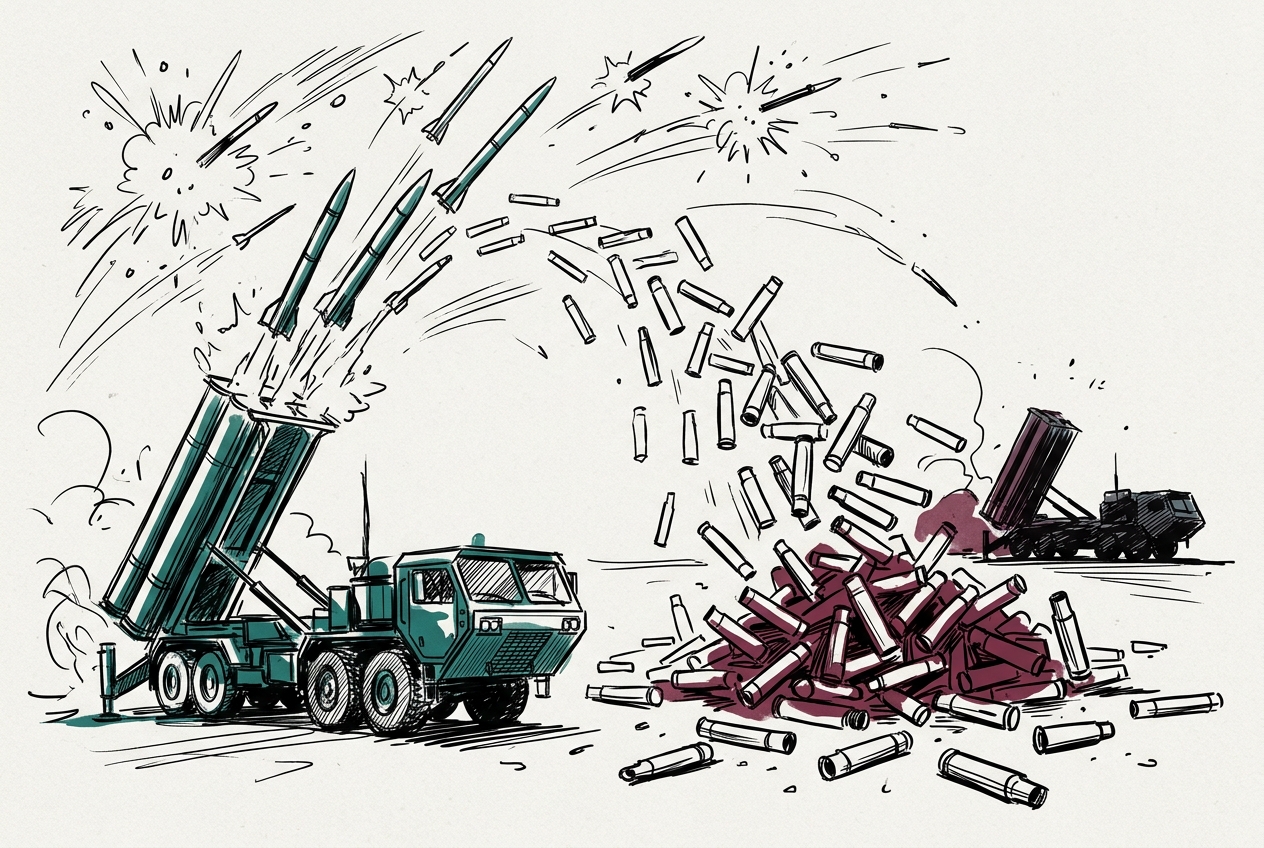
On 5 March, estimates put THAAD expenditure in the Iran war at 100 to 150 interceptors, about a quarter of global inventory.
Last refreshed: 22 September 2026 · Appears in 2 active topics
Can THAAD absorb a sustained Iranian missile campaign without gutting Ukraine's air defences?
Timeline for THAAD
Mentioned in: Riyadh's drones now come from Iraq
Iran Conflict 2026Mentioned in: The Pentagon names two of the dead
Iran Conflict 2026Mentioned in: Saudi Arabia left off the Patriot list
Iran Conflict 2026Mentioned in: Bahrain's missile shield runs near empty
Iran Conflict 2026Mentioned in: Bahrain runs low on Patriot interceptors
Iran Conflict 2026Background
THAAD is a US anti-Ballistic missile system for defending against medium- and long-range ballistic threats. It intercepts missiles in their terminal phase at high altitude with a hit-to-kill kinetic warhead rather than an explosive charge.
Developed by Lockheed Martin and fielded by the US Army, THAAD sits in the upper tier of layered missile defence. Its role is distinct from systems designed chiefly for lower-altitude or shorter-range threats: it is intended to destroy an incoming Ballistic missile before it reaches its target area.
The system matters because its interceptor supply links combat operations to industrial capacity. On 5 March, reported wartime expenditure and planned output expansion showed that even a sophisticated defensive system depends on a replenishment cycle measured in months, not days.
THAAD stocks face a production gap
On 5 March, estimates put THAAD expenditure in the first week of US operations against Iran at 100 to 150 interceptors, about a quarter of global inventory. Lockheed Martin had agreed by that date to raise annual output from 96 to 400 interceptors, but the planned production line did not yet exist.
On 26 March, President Volodymyr Zelenskyy said 800 US-made interceptors had been used in three days of the Iran war, against 700 received by Ukraine over a winter. For THAAD, the issue is not only the size of its magazine but the time needed to replace rounds used in a concentrated campaign.
What is THAAD?
How much does a THAAD interceptor cost?
How many THAAD interceptors were used in the Iran war?
What is the difference between THAAD and Patriot?
Did THAAD fail to intercept missiles at Dimona?
How much of the THAAD stockpile has the Iran war used up?


