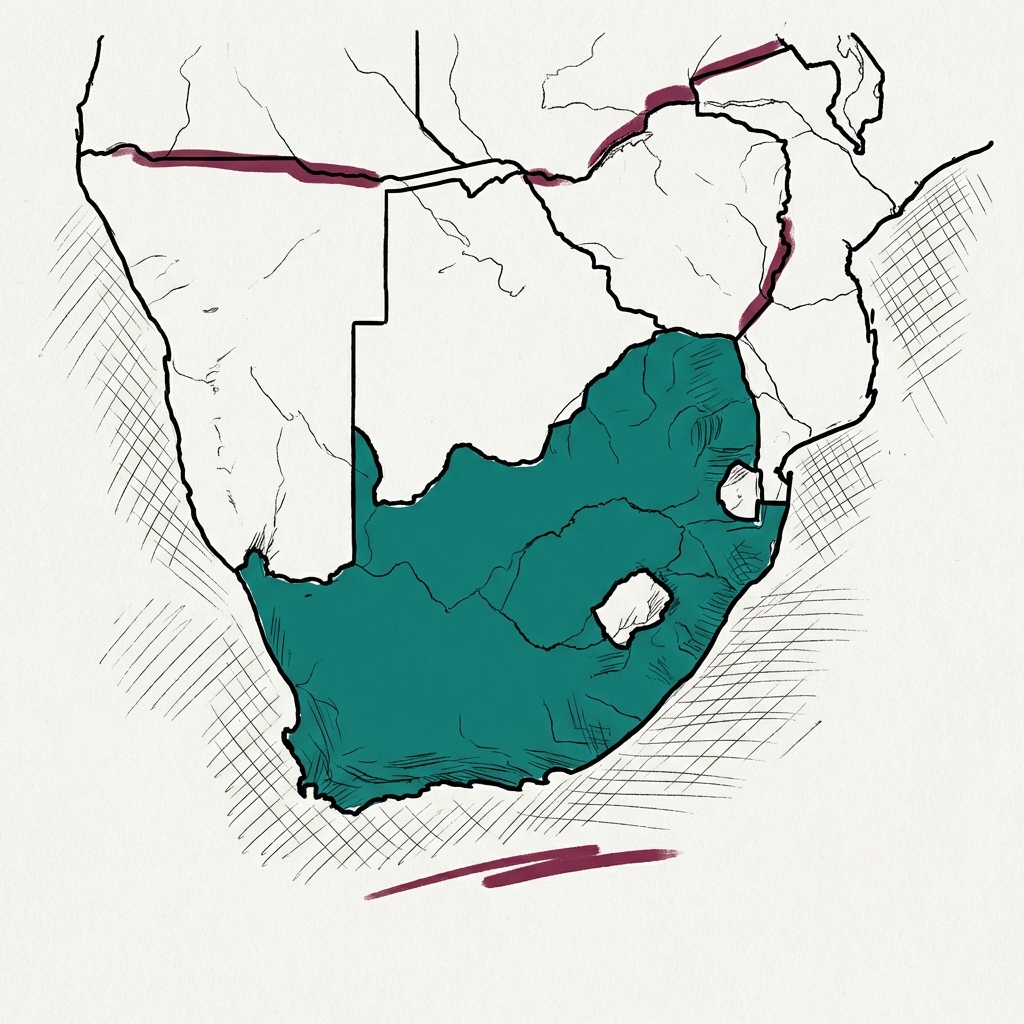
South Africa
Africa's most industrialised economy; 2026 World Cup openers, Cape route shipping hub, and strategic ambiguity on Iran.
South Africa began the biggest rewrite of its immigration law in two decades on 3 April 2026, when cabinet approved a Revised White Paper proposing a points-based migration system alongside the existing 2024 Digital Nomad Visa lane.
Last refreshed: 8 September 2026 · Appears in 6 active topics
How did Bafana Bafana perform on their return to the World Cup after a 16-year absence?
Timeline for South Africa
Mentioned in: Cape Town approves five, names none
Data Centres: Boom and BacklashRaided seven Johannesburg locations and arrested 39 people
Cybersecurity: Threats and Defences: Jackal IV produced 58 arrests in 23 countriesMentioned in: Mexico's four totals for one tournament
2026 FIFA World CupMentioned in: Spain meet Argentina at MetLife with Golden Boot live
2026 FIFA World CupBackground
South Africa is Africa's most industrialised economy, a BRICS and G20 member of around 60 million people. Pretoria is the executive capital, Cape Town the legislative seat, and Johannesburg the largest city. Ports at Cape Town, Durban and Richards Bay anchor its place in global shipping, and it is a founding member of the African Union.
Pretoria's silence on the Iran war fits a pattern set since 2024, when South Africa adopted a formal stance of strategic Non-alignment, expressed most clearly through the ICJ genocide case it brought against Israel over Gaza. The Iran calculation cuts in both directions at once: openly criticising Washington would cost Pretoria trade access, while endorsing the strikes would sit awkwardly beside its own Gaza case, and BRICS partners Russia and China have condemned the strikes without South Africa following suit .
South Africa's own harbours are absorbing a side effect of that same war: Cape Town, Durban and Richards Bay have become unplanned bunkering stops for tankers detouring around the Hormuz and Red Sea conflict zones, a traffic increase that lifts harbour revenue while adding wear to infrastructure and spill risk along the ecologically fragile Cape coastline.
South Africa overhauls its immigration system
South Africa's Department of Home Affairs issued Immigration Directive 7 on 1 April 2026, extending pending visa applications to 30 June 2027 . Two days later cabinet approved a Revised White Paper on Citizenship, Immigration and Refugee Protection, proposing a points-based migration system, a remote-work Visa lane and an Electronic Travel Authorisation, the biggest rewrite of the country's immigration law in two decades.
The reforms leave the existing 2024 Digital Nomad Visa untouched for now . Immigration practitioners note past White Papers have taken five to seven years to reach operational reality, so the backlog concession is the only change applicants can bank on today.