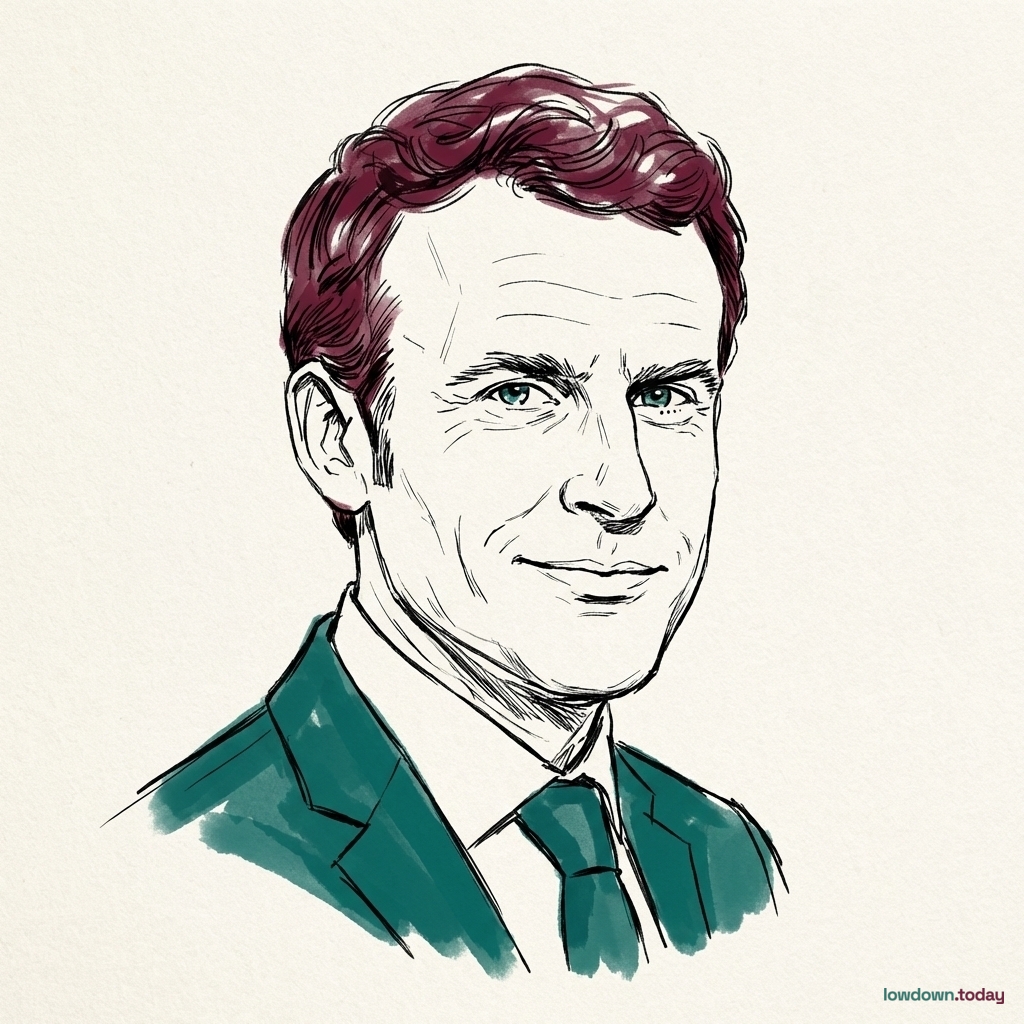
Emmanuel Macron
President of France since 2017; leading European voice on Ukraine and architect of the post-Iran Coalition.
Emmanuel Macron co-leads with Keir Starmer the 51-nation Hormuz maritime Coalition, which the two leaders declared established on 20 April 2026 with a headquarters at Northwood and a mandate to escort merchant ships and clear mines.
Last refreshed: 18 October 2026 · Appears in 2 active topics
Can Macron hold European solidarity when France is committed to two wars at once?
Timeline for Emmanuel Macron
Co-chaired the April Hormuz mission Iran later excluded
Iran Conflict 2026: Mentioned in: No Europeans on the guest listHosted the 2026 G7 summit at Évian-les-Bains
Iran Conflict 2026: G7 ends with no joint statementStated the right format is Ukraine and Russia at the table with Europeans and Americans present
Russia-Ukraine War 2026: G7 opens at Evian as Trump pivots backPutin says no as Europe draws a line
Russia-Ukraine War 2026Russia fires first dual Oreshnik salvo
Russia-Ukraine War 2026Background
Emmanuel Macron has been President of France since 2017 and leads the centrist Renaissance party. European Strategic autonomy is the organising idea of his Foreign Policy, and France is the only EU state to have invoked the treaty's Article 42.7 mutual-defence clause, after the 2015 Paris attacks.
In the Iran war he made France the largest Western military contributor outside the US-Israeli axis. In early March 2026 he opened French bases to US forces and ordered the carrier Charles de Gaulle to the Mediterranean. He confirmed France's first death of the war on 11 March, when Chief Warrant Officer Arnaud Frion was killed by a drone in Iraqi Kurdistan. That record bought little in Tehran: on 1 July Iran shut every European government, France included, out of Ali Khamenei's funeral.
On Ukraine he has held that the Iran war must not drain Western support. On 26 March he warned against diverting aid as the Pentagon moved $750m out of a Ukraine arms fund. France has committed eight SAMP/T NG air defence systems to Ukraine, and Macron condemned Russia's 24 May dual Oreshnik barrage on Kyiv.
Macron built the Hormuz coalition
On 17 April Macron and Starmer chaired a video conference from Paris to launch a defensive mission for the strait of Hormuz, with the United States absent. Their joint statement that day put the Coalition at 51 nations, not the 40 first reported, and called military chiefs to Northwood to draft rules of engagement.
On 20 April the two leaders moved the Coalition from planning to established. Its mandate covers protecting merchant ships, reassuring commercial operators and clearing mines, run from Northwood in north-west London. For Macron it turned France from a supporter of US operations into a co-author of the post-war rules for the strait, written without Washington.
Macron backs a contact-line framework
On 7 June Macron joined Starmer and Germany's Friedrich Merz in backing a five-point framework that takes the current front line, not Ukraine's 1991 borders, as the starting point for talks. It came two days after Putin rejected Zelenskyy's summit proposal.
On 15 June Macron hosted G7 leaders at Évian-les-Bains, where Ukraine topped the agenda once the Iran deal was done. He argued that any negotiating format must seat Ukraine and Russia together with both Europeans and Americans in the room, and the G7 tied further Russia sanctions to progress in peace talks.
What is Macron doing about the Strait of Hormuz?
What is France's role in the Iran war?
Is Macron supporting Ukraine in 2026?
Has France lost soldiers in the Iran conflict?
What is Macron's European strategic autonomy doctrine?
What is Macron's position on the Ukraine war in 2026?
What is European strategic autonomy and why does Macron keep talking about it?
Did Macron condemn the Oreshnik missile attack on Kyiv in May 2026?
What is Article 42.7 of the EU Treaty?
Why was France in both the Iran war and the Ukraine conflict simultaneously?
Did Iran invite France to Khamenei's funeral?
Did the G7 summit help end the Iran war?



Written with AI from Lowdown's published reporting. Not individually reviewed by an editor. Updated 18 October 2026. Editorial standards.