Skip to content
You can now search across every topic, entity and event.What's new
Russia-Ukraine War 2026
24APR

Aramco warns of a 17.5% shock

4 min read
11:21UTC

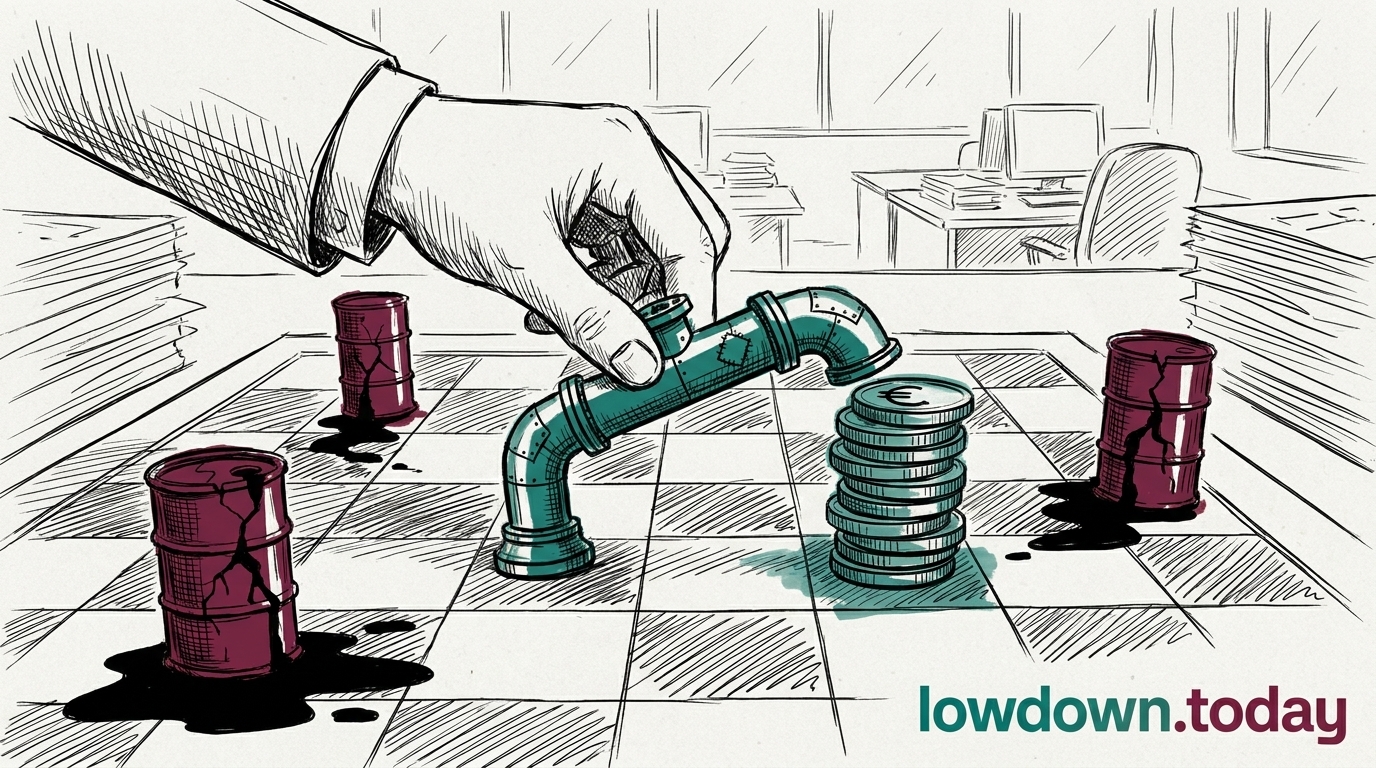
Brent crude settled at $104.21 on Monday, up $2.92 on Trump's verbal alone. Saudi Aramco chief executive Amin Nasser said the market is losing roughly 100 million barrels of supply each week, with prolonged disruption pushing any normalisation into 2027.

ConflictDeveloping
Key takeaway

Brent at $104 prices Trump's words; Aramco's 100 million barrels per week implies a 17.5% unpriced shock.

Brent Crude settled at $104.21 on Monday 11 May, up $2.92 (2.9%) on $101.29 the previous session 1. The move broke the $101 floor that had held through Friday's bulk-carrier strike near Doha, the Mokhber doctrine declaration and the IRGC firing-order threat . Nothing signed underwrote the spike: it came on Donald Trump's Oval Office verbal statement, with no executive order, deployment directive or CENTCOM operational order behind it. Brent traded above $94 on Tuesday morning, holding most of Monday's gain.

Saudi Aramco chief executive Amin Nasser said the same day that the market is losing roughly 100 million barrels of supply each week and that prolonged disruption could push any normalisation into 2027 2. That weekly loss roughly equals Saudi Arabia's full weekly output. Translated into a daily run rate against the notional 80 million barrels per day global crude base, Nasser's number implies a 17.5% supply shock against a curve that has not priced it.

Brent at $104.21 prices the market's probability-weighted average of paper outcomes, not Nasser's physical-market reading; priced literally, Nasser's number justifies materially higher Brent. The ceiling holds while Wall Street still expects a deal; it breaks upward if Trump signs a bombing order on his Friday return, or downward if he signs a written counter-text. For UK consumers the lag template is already running: the $4.54 per US gallon pump benchmark hit on 8 May is the precedent forecourts will follow within a fortnight, putting roughly £1.78 per litre on UK pumps before the Beijing trip closes.

Deep Analysis

In plain English

The price of oil went up sharply on 11 May after Trump's tough statements about Iran. It reached $104.21 per barrel, breaking through a floor of about $101 that had held for several days. The CEO of Saudi Aramco; the world's largest oil company; said the world is losing around 100 million barrels of oil supply every week because of the Hormuz disruption. He warned it could be 2027 before the situation returns to normal. For ordinary people, this means petrol and diesel prices could rise further over the coming weeks if the situation does not improve. Oil prices that stay above $100 for an extended period push up the cost of transport, heating, and most goods that need to be shipped.

Deep Analysis
Root Causes

The Strait of Hormuz carries approximately 21 million barrels of oil per day in normal conditions; roughly a quarter of global seaborne crude. Iran's Persian Gulf Strait Authority has imposed a toll and registration requirement that most Western-flagged carriers have not complied with, effectively reducing transit to a fraction of pre-war volumes.

Saudi Aramco's export routes do not depend on Hormuz for the majority of its exports via the East-West pipeline to Yanbu on the Red Sea, but Aramco ships roughly 7 million barrels per day that do transit the strait; giving Nasser's 'market is losing supply' framing a direct commercial basis, not merely geopolitical observation.

The oil market's difficulty pricing the disruption reflects genuine uncertainty about whether a deal materialises this week or in three months: two scenarios produce $75 and $120 Brent respectively, so the $104 settlement is arithmetically the probability-weighted midpoint.

What could happen next?
  • Consequence

    Sustained Brent above $100 triggers fuel surcharge reviews at major freight carriers. US, UK, and EU logistics cost indices will absorb the move within 30 days.

    Short term · 0.85
  • Risk

    A 2027 normalisation scenario; if Nasser's guidance is treated as credible; would prompt hull and cargo insurers to reprice annual premiums at Q3 2026 renewal cycles, adding $15-25 per barrel in effective delivered cost for Asian buyers.

    Medium term · 0.6
  • Opportunity

    The $101 floor breaking higher gives US negotiators a price signal they can present to Iran: a deal that reopens Hormuz produces immediate Brent compression to $85-90, saving Tehran from the inflationary oil-price feedback on its own import costs.

    Short term · 0.65
First Reported In

Update #95 · OFAC opens the Hong Kong door

CNBC· 12 May 2026
Read original
Different Perspectives
Turkey
Turkey
Turkey, a major buyer of Russian diesel cargoes, loses that access under Moscow's first producer-binding export ban, in force from 8 July to 31 July. Ankara hosted the same week's NATO summit pledging EUR 70bn to Ukraine, sitting on both sides of the fuel-and-alliance ledger.
NATO
NATO
NATO leaders meeting in Ankara on 7 and 8 July pledged EUR 70bn in equipment, assistance and training for Ukraine across 2026, with a 2027 sustainment commitment and a $40bn Drone Edge counter-drone initiative. European allies now fund the vast majority of that package, filling the gap left by Washington's idled crude waiver.
India
India
India's state refiners continued buying discounted Urals crude as June's price fell to $63.18 a barrel, insulating New Delhi from the OFAC waiver gap still constraining Western buyers. Indian refiners could pick up diesel-export share as Russia's producer-binding ban shuts out its former customers.
China
China
China's independent refiners kept importing discounted Urals crude through June as the price fell to $63.18 a barrel, down 26% month-on-month per CREA. Beijing has said nothing on Moscow's new diesel ban, leaving Chinese refiners a likely beneficiary if Turkish and Brazilian buyers seek replacement cargoes.
United States
United States
No successor licence has been issued since General License 134C lapsed on 17 June, leaving a 26-day gap, the longest of the war, in the Russian crude waiver. Washington's silence is tightening the channel without any stated decision, as Treasury weighs whether to let it die.
Ukraine
Ukraine
Ukraine's long-range strike campaign shifted from refineries to seaborne fuel tankers crossing the Sea of Azov, cutting tracked vessel traffic 55% between 30 June and 11 July, per Starboard Maritime Intelligence. The shift targets Russia's export revenue directly rather than just domestic supply, adding pressure alongside the collapsing Urals price.
