Skip to content
Briefings are running a touch slower this week while we rebuild the foundations.See roadmap
Russia-Ukraine War 2026
11APR

Iran War Hands Russia an Unexpected Oil Windfall

2 min read
16:48UTC

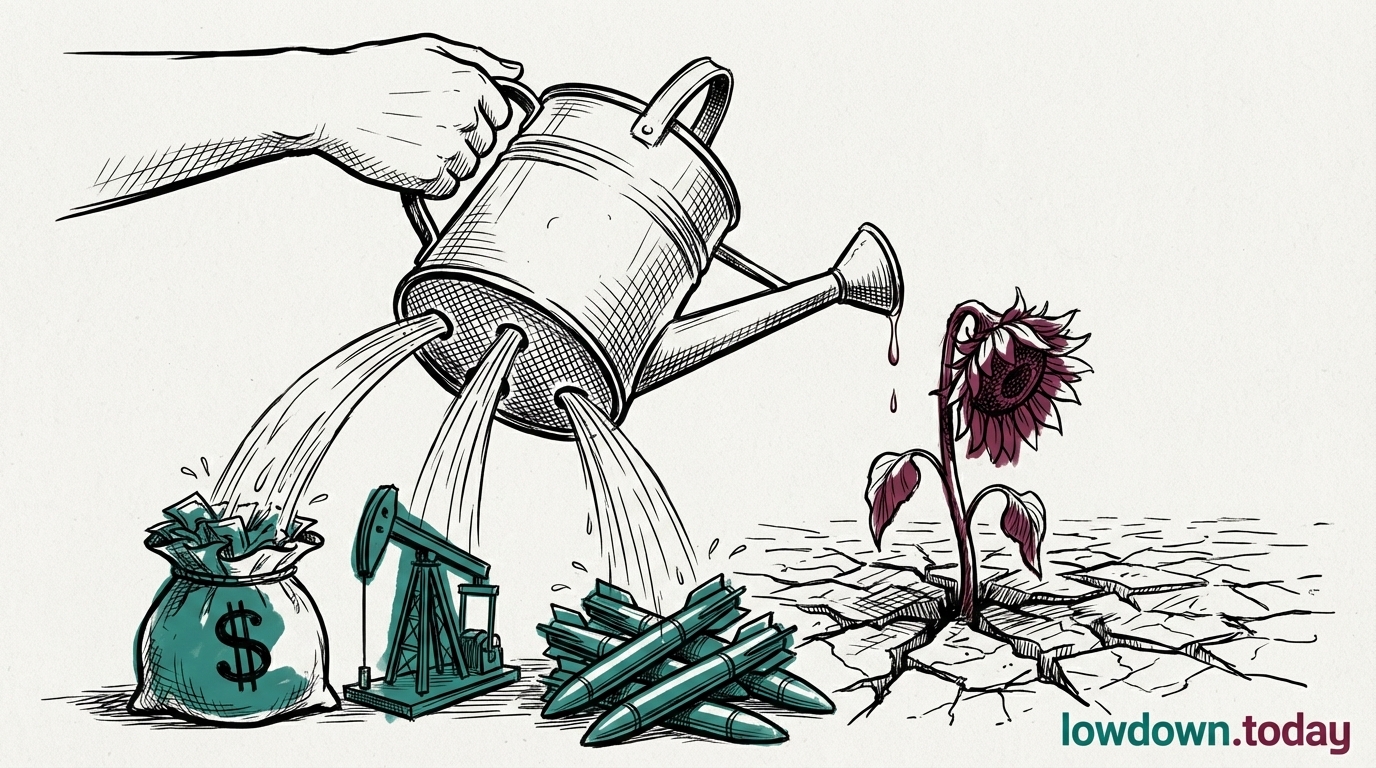
Ukraine's Baltic port strikes cut Russian crude exports by 43%, but the Iran war more than doubled the per-barrel price, projecting a 70% April revenue jump over March.

ConflictDeveloping
Key takeaway

Iran war doubled the per-barrel price, creating a net Russian windfall only sustained Baltic disruption can reverse.

Urals crude reached $123.45 per barrel on 3 April, more than double Russia's $59 budget assumption and nearly triple the January average. The cause is not Russian strength; it is the Iran war, which disrupted Gulf supplies and dragged global benchmarks upward.

Ukraine's Baltic drone campaign inflicted genuine physical damage: 15 tankers did not sail, weekly revenue fell by roughly $1 billion, and Primorsk lost 40% of storage capacity. But the Iran war has separated price from volume in a way the infrastructure campaign cannot control. At $123 per barrel, Russia earns approximately $64 more per barrel than its budget assumed. The G7 price cap of $44.10, enforced through insurance and shipping restrictions, is arithmetically irrelevant. CREA data shows 68% of Russian seaborne crude was already on sanctioned shadow tankers before the surge, meaning the enforcement architecture cannot reach two-thirds of exports even in normal conditions.

The physical threat remains real. Both terminals are offline for petroleum products. Russia's gasoline export ban through July signals domestic storage saturation, not export preference. A refinery specialist told Reuters stockpiles would fill within days, forcing output cuts. Russia's National Wealth Fund had already lost $4.8 billion in two months , but elevated prices now mask the structural erosion.

The decisive variable is strike tempo. Ukraine must sustain Baltic attacks long enough for storage saturation to force output curtailment before Transneft completes Arctic rerouting. That window is measured in weeks, not months.

Deep Analysis

In plain English

Ukraine successfully damaged Russia's ability to ship oil from its Baltic ports, cutting shipments by nearly half. But at the same time, a separate war in the Middle East caused global oil prices to more than double. Russia now earns so much more money per barrel that it is actually making more revenue overall, even though it is selling less oil. The question is whether Ukraine can keep damaging the ports long enough that Russia's storage tanks fill up, forcing it to cut production entirely — which would hurt Russia even at high prices.

Deep Analysis
Root Causes

The Iran war is the primary external cause of the price surge — unrelated to Ukrainian or Russian strategy. Russia's shadow fleet infrastructure (built since 2022) and CREA-documented circumvention of the price cap are the enabling structural conditions allowing Moscow to realise the windfall.

Escalation

The price windfall reduces Russia's incentive to negotiate on energy infrastructure and increases Ukraine's incentive to escalate Baltic strikes. Both sides now have stronger reasons to continue the infrastructure war through April.

What could happen next?
  • Consequence

    Russia's April oil revenues may be the highest since before Western sanctions, directly funding continued war prosecution.

    Immediate · High
  • Risk

    OFAC GL 134A expires 11 April; extension at $121/barrel would hand Moscow far greater revenue per barrel than when issued at $73.

    Immediate · High
  • Consequence

    The G7 price cap enforcement architecture is rendered ineffective while Urals trades at more than double the cap level.

    Short term · High
  • Opportunity

    Forced production cuts from storage saturation would compress Russian revenues even at elevated prices — achievable if Ukraine sustains strike tempo through April.

    Short term · Medium
First Reported In

Update #11 · Russia Sells Less Oil but Earns More

Gulf News / Bloomberg / Business Standard· 5 Apr 2026
Read original
Different Perspectives
Rafael Grossi, IAEA Director General
Grossi's Update 349 of 7 May recorded a drone strike on ZNPP's radiation monitoring laboratory on 3 May. Rosatom's 17 May public attack on the Secretariat's neutrality degrades the diplomatic ground Grossi needs for the sixth repair ceasefire at day 60 on the single backup line.
Indian Government / Embassy Moscow
The Indian Embassy in Moscow confirmed on 18 May that an Indian national was killed and three hospitalised at a refinery construction site in the 17 May barrage. India is among the largest buyers of discounted Russian crude; the fatality forces a diplomatic protest without changing the purchasing posture.
Recep Tayyip Erdogan, Turkish President
Erdogan met Zelenskyy in Ankara for nearly three hours on 15 May before the Istanbul session, recovering Turkey's 2022 mediator role and reducing Trump's leverage by hosting bilateral talks without Washington in the room. Turkey hosts the NATO Ankara summit on 7-8 July; the Istanbul format gives Erdogan standing at both tables simultaneously.
Viktor Orban / Hungarian Government
Budapest's new cabinet, formed 12 May, holds the institutional veto point on the EU tranche disbursement ahead of the first-half June window. Hungary has previously leveraged EU loan tranches to extract bilateral concessions; the combination of a fresh cabinet and a tight disbursement timeline makes Budapest the single highest-leverage actor in the EU track this fortnight.
European Council / Commission
The Commission is preparing a three-document disbursement package for the 9.1-billion euro first tranche of the EU loan to Ukraine, targeting first-half June, but delivery depends on the Magyar cabinet, which formed on 12 May, not blocking the mechanism. The 20th sanctions package remains in force against Russia.
Donald Trump / US Treasury
Treasury issued GL 134C with a 48-hour gap after GL 134B expired, confirming the waiver series functions as permanent monthly management rather than a wind-down instrument. Washington was absent from the Istanbul room; Treasury Secretary Bessent framed the Cuba carve-out as protecting 'most vulnerable nations', maintaining the fiction that the 30-day bridge has a humanitarian rationale.
