Russia National Wealth Fund
Russia's sovereign wealth fund; liquid assets down 60% from pre-invasion as war spending accelerates.
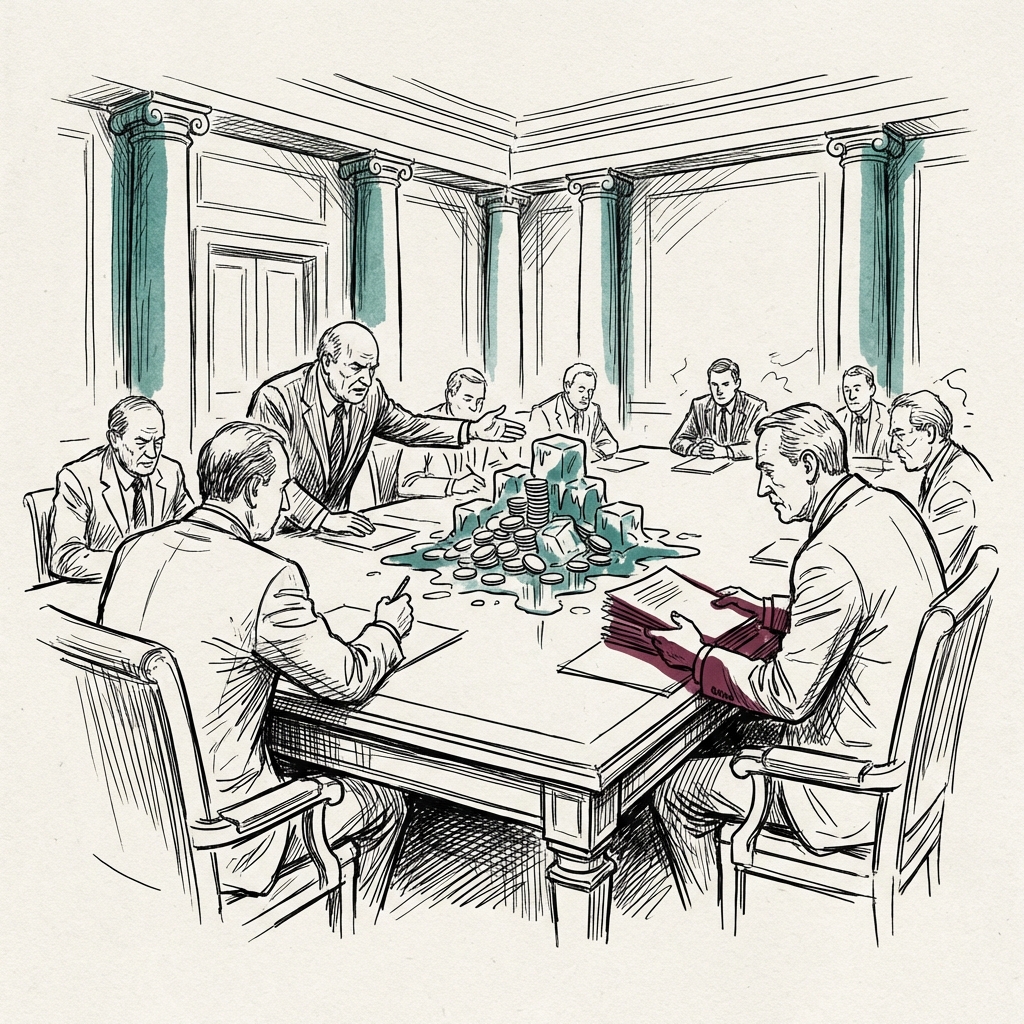
The US licence that let Russian diesel into American markets on 9 October still bars any debit to US-held accounts of the National Wealth Fund, keeping Russia's rainy-day reserve frozen in the United States as its liquid assets run low.
Last refreshed: 12 October 2026 · Appears in 2 active topics
How long can Russia's NWF sustain war spending at current depletion rates?
Timeline for Russia National Wealth Fund
Blocked sovereign account holder
Russia-Ukraine War 2026: Mentioned in: OFAC opens US market to Russian dieselMentioned in: Russia plans record 17.1tn for defence
Russia-Ukraine War 2026Moscow posts surplus as shares sink
Russia-Ukraine War 2026Russia raids reserves to cover deficit
Russia-Ukraine War 2026Mentioned in: OFAC GL 134B expires 16 May, no successor
Russia-Ukraine War 2026Background
The National Wealth Fund is Russia's sovereign wealth fund, set up in 2008 to save surplus oil and gas revenue, steady the federal budget in commodity downturns and back long-term pension obligations. The Finance Ministry manages it. It holds liquid assets, chiefly foreign currency and gold, and illiquid stakes in Russian state companies and projects. Before the 2022 invasion it peaked at about $186bn.
Since the invasion it has become the budget's shock absorber. It shed 400bn roubles, about $4.8bn, in January and February 2026 alone, and by June its liquid assets stood at about 3.6 trillion roubles, roughly 60% below pre-invasion levels. Total assets, including the illiquid stakes, were about 13.1 trillion roubles on 1 July.
Western sanctions shape what it can use. US-held accounts of the fund remain blocked even under the October 2026 licence that opened the US market to Russian diesel. With defence taking 38 to 40% of federal spending in 2026, the pace of the fund's drawdown is the best single indicator of Russia's fiscal staying power.
The fund stays frozen in America
Washington's easing of Russian energy sanctions stopped short of the fund. General License 135, issued on 9 October and running to 7 April 2027, lets US buyers import Russian diesel and pay Russian sellers, but its paragraph (b) bars any debit to US-held accounts of the Bank of Russia, the Finance Ministry and the National Wealth Fund.
That line has held through every waiver change of 2026. The crude-oil licences that came and went in the spring, GL 134A and GL 134B, which expired on 16 May with no successor, covered trade, not the reserve. For the fund, the practical effect is that whatever it holds in US accounts cannot be used to plug Russia's budget gap.
War spending drains the liquid reserve
The fund's liquid assets are the clearest public measure of how long Russia can finance the war from savings. On 17 April Economic Development Minister Maxim Reshetnikov told Meduza the reserves were "largely exhausted", and on 28 April he projected that the liquid share could fall to about $12.5bn by the end of 2026.
The summer brought a pause rather than a recovery. Liquid assets rose by 200bn roubles in June to about $46.4bn on 1 July, as Russia posted its first monthly budget surplus of the year, but the half-year deficit stood at 5.73tn roubles. By 30 September the January to September deficit had reached 5.19tn roubles, with oil and gas revenue forecast 1,335bn roubles short of plan.
The fund stays frozen in America
Why is Russia's oil revenue falling in 2026 despite high spending?
How much money does Russia have left in its National Wealth Fund?
War spending drains the liquid reserve
Why did Russia post a budget surplus in June 2026?
Is Russia's war chest running out of money?
How much did Russia's sovereign wealth fund lose in 2026?
What percentage of Russia's budget goes to defence in 2026?
What is Russia's National Wealth Fund and how large is it?
What happens when Russia's sovereign wealth fund runs out?
Written with AI from Lowdown's published reporting. Not individually reviewed by an editor. Updated 12 October 2026. Editorial standards.