Skip to content
Briefings are running a touch slower this week while we rebuild the foundations.See roadmap
Iran Conflict 2026
16MAY

Kuwait force majeure halts 3.5m bpd

3 min read
12:41UTC

Kuwait became the second OPEC producer in a week to declare force majeure on oil exports — not because its wells are damaged, but because the war has sealed every route to market.

ConflictDeveloping
Key takeaway

Iranian conventional strikes have achieved without destroying wellheads what decades of sanctions failed to do: removing Gulf oil from global markets by severing the export architecture.

Kuwait Petroleum Corporation declared Force majeure on all oil and refined-product exports on Sunday. Production cuts that began Saturday at approximately 100,000 barrels per day were expected to nearly triple by Sunday's end. Kuwait produced approximately 2.6 million barrels per day in January.

Kuwait is the second OPEC producer to invoke Force majeure in a single week. Iraq cut output by approximately 1.5 million barrels per day earlier. Combined, roughly 3.5 million barrels per day of Gulf production capacity is shut in or unable to reach market. The 1990 Iraqi invasion of Kuwait removed approximately 2 million barrels per day from global supply. The current shut-in exceeds that by 75 per cent — and the number is still growing.

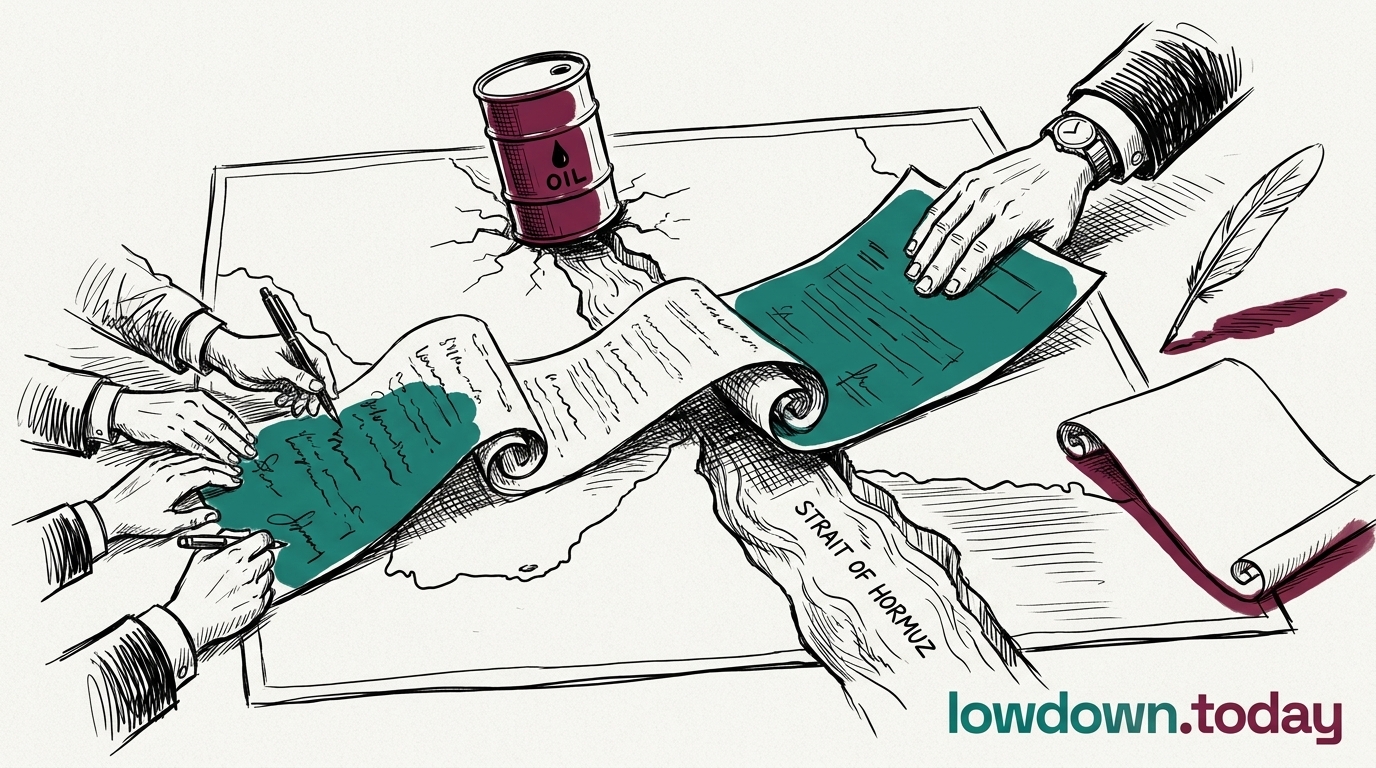
The mechanism is logistics, not destruction. Kuwait's wells are not damaged. Its refineries function. The oil has nowhere to go. Every major P&I club cancelled war risk coverage effective midnight 5 March , and major shipping lines suspended Gulf services. Storage is filling. the strait of Hormuz — through which virtually all Kuwaiti crude exports transit — is commercially sealed. Force majeure signals that KPC does not expect shipping to resume soon.

Brent crude reached $92.69 on Friday . US crude futures posted their largest weekly gain — 35.63% — since the contract began trading in 1983 . Qatar's energy minister warned of $150 per barrel if the Strait remains closed . VLCC freight rates hit an all-time record of $423,736 per day, adding approximately $3–4 per barrel before crude reaches a refinery . The oil shock compounds through two separate timelines: the military campaign, which continues to expand targets across The Gulf, and the insurance collapse, which persists independently of any ceasefire. Even if hostilities ended tomorrow, commercial shipping would not resume until insurers complete reassessments — a process that typically takes weeks. The war's economic damage has already outrun the war itself.

Deep Analysis

In plain English

Kuwait and Iraq normally export roughly 4 million barrels of oil per day. That oil has not stopped being pumped, but there is nowhere to send it — the shipping route through the Strait of Hormuz has collapsed because insurers will not cover ships transiting a war zone, and major shipping lines have stopped going. Kuwait has now formally declared 'force majeure,' a legal term meaning it cannot fulfil its delivery contracts due to circumstances beyond its control. This is the second such declaration in a week. The oil is accumulating in onshore storage with nowhere to go.

Deep Analysis
Synthesis

Two OPEC producers invoking force majeure in one week establishes a precedent that Iranian conventional warfare can achieve structural oil market disruption without damaging wellheads — a strategic capability Iran did not previously demonstrate at scale and one not addressed by traditional counter-proliferation frameworks focused on weapons programmes.

Root Causes

Gulf oil export infrastructure was engineered on the assumption of a stable Hormuz corridor; no alternative deepwater export route exists for landlocked Iraqi crude, and Kuwait's terminals are oriented entirely toward the Gulf. No designed redundancy for a Hormuz closure scenario was ever built into Gulf producer logistics.

Escalation

Force majeure is a legal instrument for sustained, not temporary, disruption — Kuwait's declaration signals its own assessment that the war will not resolve quickly. The trajectory points toward further production curtailment as onshore storage fills, not recovery, unless an alternative export route or escort mechanism is established.

What could happen next?
  • Consequence

    IEA coordinated SPR release becomes probable if disruption persists beyond 72 hours at current scale, but will not address the structural absence of export routes even if released volumes are available.

    Immediate · Assessed
  • Risk

    Onshore storage saturation in Kuwait and southern Iraq could force wellhead shut-ins within days, converting a logistics disruption into a production disruption that takes weeks to reverse even after hostilities end.

    Short term · Assessed
  • Consequence

    Asian refinery operators will conduct emergency procurement of West African, US, and North Sea crudes, driving up alternative benchmark prices and widening the cost disadvantage for refiners outside the IEA framework.

    Short term · Assessed
  • Precedent

    Iran has demonstrated that strikes on logistics and insurance infrastructure — not wellheads — are sufficient to achieve strategic oil market disruption, which will inform future conflict doctrine for state and non-state actors alike.

    Long term · Assessed
First Reported In

Update #29 · New leader kept secret; Bahrain water hit

France 24· 8 Mar 2026
Read original
Causes and effects
This Event
Kuwait force majeure halts 3.5m bpd
The force majeure declaration removes approximately 3.5 million barrels per day of Gulf oil from global markets when combined with Iraq's cuts — a supply disruption exceeding the 1990 Iraqi invasion of Kuwait by 75 per cent, driven entirely by the destruction of export logistics rather than production capacity.
Different Perspectives
India (BRICS meeting host, grey-market beneficiary)
New Delhi hosted the BRICS foreign ministers' meeting on 14 May that Araghchi attended under the Minab168 designation, giving India a front-row seat to Iran's diplomatic positioning. India's state refiners have been absorbing discounted Iranian crude through grey-market routing since April; Brent at $109.30 means every barrel sourced outside the formal market generates a structural saving.
Hengaw / Kurdish human rights monitors
Hengaw's daily reports from Iran's Kurdish provinces remain the sole independent cross-check on Iran's judicial activity during the conflict. Two executions across Qom and Karaj Central prisons on 15 May and five Kurdish detentions on 15-16 May indicate the wartime judicial pipeline is operating independently of military tempo.
Pakistan (mediator and bilateral partner)
Islamabad spent its diplomatic capital as the US-Iran MOU carrier to secure LNG passage for two Qatari vessels through a bilateral Pakistan-Iran agreement, spending its mediation credit for direct economic gain. China's public endorsement of Pakistan's mediatory role on 13 May is the structural reward.
China and BRICS bloc
Beijing endorsed Pakistan's mediatory role on 13 May, one day after the BRICS foreign ministers' meeting in New Delhi. Chinese state banks are processing PGSA yuan toll payments; China has not commented on its vessels' continued Hormuz passage, but benefits structurally from a non-dollar toll system it did not design.
Iraq (bilateral passage partner)
Baghdad negotiated a 2-million-barrel VLCC transit without paying PGSA yuan tolls, offering political alignment in lieu of cash. Iraq's position inside Iran's adjacent bloc makes it the natural first bilateral partner and a template for how Tehran structures passage deals with states that cannot afford Western coalition membership.
Bahrain and Qatar (Gulf signatories)
Both signed the Western coalition paper while hosting US Fifth Fleet and CENTCOM's Al Udeid base, respectively. Qatar occupies the sharpest contradiction: it is on coalition paper while simultaneously receiving LNG passage through the bilateral Iran-Pakistan track, a position Doha has tacitly accepted from both sides.