Skip to content
You can now search across every topic, entity and event.What's new
Iran Conflict 2026
10MAY

Beijing splits MOFCOM defiance from NFRA loan halt

5 min read
14:22UTC

Lin Jian confirmed Beijing's first attack on a Chinese-owned tanker. The same week, Bessent letters to two Chinese banks triggered a quiet NFRA loan halt to refineries MOFCOM had publicly told to defy OFAC.

ConflictDeveloping
Key takeaway

Two Chinese ministries told five refineries opposite things; Bessent's bank letters timed it to the Trump-Xi summit.

Lin Jian, the Chinese Foreign Ministry spokesman, publicly confirmed on 8 May that JV Innovation, a Marshall Islands-flagged, Chinese-owned tanker, was hit on 4 May off the United Arab Emirates' Al Jeer Port 1. The vessel's deck markings read "CHINA OWNER and CREW". Lin said Beijing was "deeply concerned" about attacks on the UAE and "firmly opposes moves that escalate tensions". He did not name Iran. It was the first time China has publicly acknowledged that one of its tankers was struck during the war, and the framing pointedly leaves the attacker unnamed.

The same week, Bloomberg reported that US Treasury Secretary Scott Bessent sent warning letters to two unnamed Chinese banks cautioning against secondary-sanctions exposure for handling Iran-linked transactions 2. Within days, the National Financial Regulatory Administration (NFRA), China's banking supervisor, quietly told domestic lenders to halt new yuan loans to five OFAC-sanctioned refineries, including Hengli Petrochemical . The instruction does not call in existing credit; it freezes the next book.

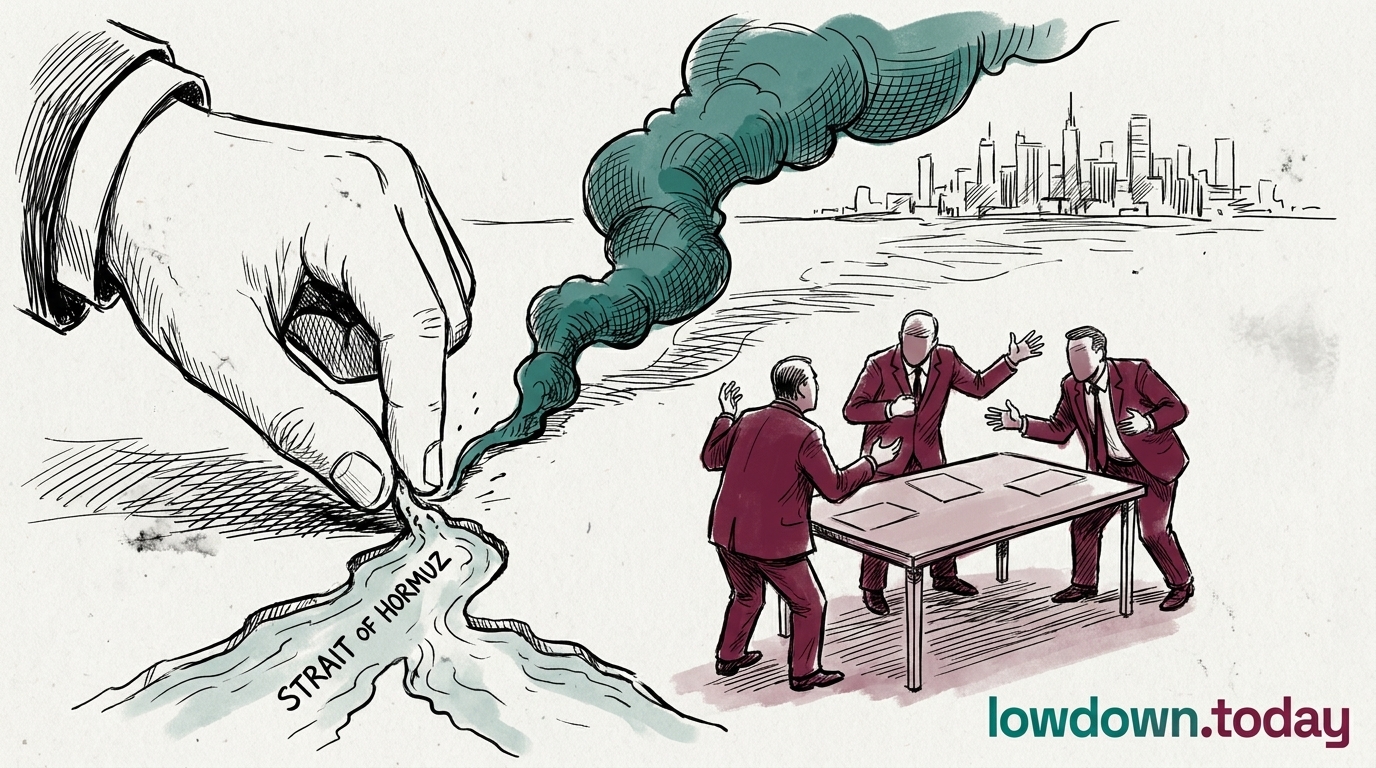
Meanwhile, the Ministry of Commerce (MOFCOM) Announcement No. 21, issued 2 May, ordered those same five refineries publicly to defy the Office of Foreign Assets Control (OFAC) under China's 2021 Blocking Rules and gave them a private right of action in Chinese courts against any Chinese firm that complies . The instructions arrive at the same five refineries from two ministries on the same day, and they say opposite things by design. The closest precedent is the 2017-2019 ZTE compliance episode, where MOFCOM publicly criticised US extraterritoriality while CSRC and PBOC quietly enforced sanctions through the banking system. The novelty in 2026 is the speed: Bessent letter to NFRA action inside a single news cycle.

For Beijing, the split lets the same firms hear different instructions from different ministries on the same day. MOFCOM legal defiance covers the public record; NFRA balance-sheet retreat covers the supervisory channel. Bessent's letters land thirty-six hours before Xi Jinping sits down with Trump with Iran on the table on 14 May. The choreography signals US Treasury views the NFRA mechanism as a concession Beijing was already prepared to make.

Deep Analysis

In plain English

China is Iran's biggest oil customer, buying Iranian crude at a discount while most other countries follow US sanctions. This week, China's government sent two contradictory sets of instructions to the same five oil refineries that process Iranian crude. One Chinese ministry (MOFCOM, which handles trade) ordered those refineries to publicly defy US sanctions: ignore Washington's rules, you are protected under Chinese law. A different Chinese ministry (NFRA, which supervises banks) quietly told the same refineries' lenders to stop making new loans to those companies. This is deliberately contradictory by design. China wants Iran to see the defiance order (keeping Tehran on side) and wants Washington to see the bank lending halt (keeping the US on side before the 14 May summit between Trump and Xi Jinping). The arrangement only works for as long as neither side compares notes too carefully.

Deep Analysis
Root Causes

Two structural conditions make the MOFCOM-NFRA split possible and arguably sustainable.

First, China's **2021 Anti-Foreign Sanctions Law and Blocking Rules** create a domestic legal obligation for MOFCOM to issue defiance orders when US sanctions designate Chinese firms. The Law gives MOFCOM no discretion: Announcement No. 21 is not a political choice but a statutory requirement.

NFRA's credit-risk instructions operate under the **Banking and Insurance Regulatory framework**, a separate statutory pillar. The two ministries can issue contradictory instructions to the same firms without either ministry violating Chinese law.

Second, the **14 May Trump-Xi summit** creates a time-bounded choreographic incentive. Beijing needs to demonstrate to Washington that it is not financing Iran's war economy while simultaneously signalling to Tehran that it is not capitulating to US pressure.

The NFRA-MOFCOM split achieves both goals simultaneously, with the summit as the resolution point where Xi can offer Bessent a verifiable banking-system metric (new yuan loan volume to sanctioned refineries) as a concession, while MOFCOM's defiance order remains on the books for domestic audience management.

What could happen next?
  • Consequence

    If NFRA enforcement holds through June, the five named refineries will need to replace discounted Iranian crude with market-priced alternatives by Q3, potentially reducing China's appetite for a rapid Iran sanctions relief deal.

    Medium term · 0.7
  • Risk

    The MOFCOM defiance order creates a private right of action in Chinese courts against any Chinese firm that complies with OFAC, meaning a Chinese firm that follows US sanctions instructions faces domestic liability even as NFRA tightens credit to the same sanctioned counterparties.

    Immediate · 0.88
  • Opportunity

    Beijing could offer Bessent a verifiable NFRA metric (new yuan loan volume to sanctioned refineries) as a concrete concession at the 14 May summit, establishing a precedent for secondary-sanctions compliance without public capitulation.

    Short term · 0.65
First Reported In

Update #92 · An MOU asking Iran to surrender what nobody can count

CBS News· 9 May 2026
Read original
Different Perspectives
Oil market and P&I insurers
Brent cleared $87 intraday only once CENTCOM's blockade became physical rather than declared, even though P&I Clubs had already excluded Hormuz war risk a week earlier on 7 July: capital hedged ahead of enforcement, but prices moved only after it.
UAE reporting
UAE reporting
UAE reporting placed the Omani tanker deaths at one seafarer against the International Maritime Agency's count of two, the first time in this war that a Gulf state's casualty figures have diverged from an international monitor's.
Jordan
Jordan
Iranian strikes reached Jordan again on 14 July as part of the Gulf-wide retaliation for the Hormuz blockade, extending the conflict's geographic footprint to a state with no direct stake in the strait itself.
Bahrain
Bahrain
Bahrain sounded air-raid sirens on 14 July during Iran's Gulf-wide retaliation, the same day CENTCOM's blockade order and fourth night of strikes pushed the conflict's physical reach into the wider Gulf littoral.
Kuwait
Kuwait
Kuwait intercepted Iranian missiles and drones on 14 July as Tehran's blockade retaliation reached Gulf states beyond Iran's immediate shoreline, confirming Kuwaiti airspace now sits inside Iran's retaliatory envelope.
Oman
Oman
Oman absorbed the war's first tanker casualties in its own waters on 14 July, with two supertankers disabled and seafarers killed, putting the sultanate's shipping lanes directly in the path of the blockade fight for the first time.