Skip to content
Briefings are running a touch slower this week while we rebuild the foundations.See roadmap
Iran Conflict 2026
1MAY

India faces three Iran tracks, speaks on one

3 min read
10:38UTC

India's Ministry of External Affairs engaged Tehran at high level on 23 April after the Epaminondas was seized carrying cargo bound for Mundra port in Gujarat. The MEA has held public silence for eight days on the 15 April OFAC designations naming Indian nationals and India-registered firms in the Shamkhani network.

ConflictDeveloping
Key takeaway

Delhi is handling three Iran tracks but has chosen to speak on only the one with Indian crews at sea.

India's Ministry of External Affairs engaged Tehran at high level on 23 April after the Epaminondas was seized carrying cargo bound for Mundra port in Gujarat 1. The engagement routed through the same ministry that has now held public silence for eight days on the 15 April OFAC designations of the Shamkhani network , which named Chetan Prakash Balhotra, Navi Mumbai-registered Fleet Tanqo Private Limited and other Indian firms .

Foreign Secretary Vikram Misri demarched Iran's ambassador Fathali on 18 April after the IRGC fired on the Indian tankers Sanmar Herald and Jag Arnav . Three Iran tracks now converge on Misri's office inside a week: tanker firings producing a demarche, OFAC sanctions producing silence and the Epaminondas producing quiet diplomacy.

Delhi cannot publicly demand the corps stop firing on Indian-bound vessels while staying silent on Treasury sanctions targeting Indian firms that help Iran evade the same sanctions those vessels operate inside. India is the largest non-Chinese user of Iranian-routed crude, so every week the MEA holds the line leaves Mumbai and Chennai operators unable to price their next cargo. Misri's office has chosen the shipping file over the sanctions file because Indian crews are at sea and Indian firms are on paper.

Deep Analysis

In plain English

India faces three separate problems from the Iran conflict, all landing at once on 23 April. First, an Indian-bound cargo ship was seized by Iran's military in the Strait of Hormuz. Second, the US Treasury named Indian companies and individuals as part of an Iranian oil-smuggling network called the Shamkhani network. Third, the US government's waiver that allowed Indian refineries to legally buy Iranian oil expired with no renewal. India is one of the world's largest oil importers and has historically bought cheap Iranian crude despite US sanctions. It has also been developing a major port at Chabahar in Iran, which India views as its gateway to Central Asia and Afghanistan. New Delhi has been trying to stay on good terms with both the US and Iran, but these three simultaneous developments make that balancing act harder. It is now publicly engaged on the first problem (the ship seizure) while publicly silent on the other two, which carry greater long-term legal and economic risk.

What could happen next?
  • Risk

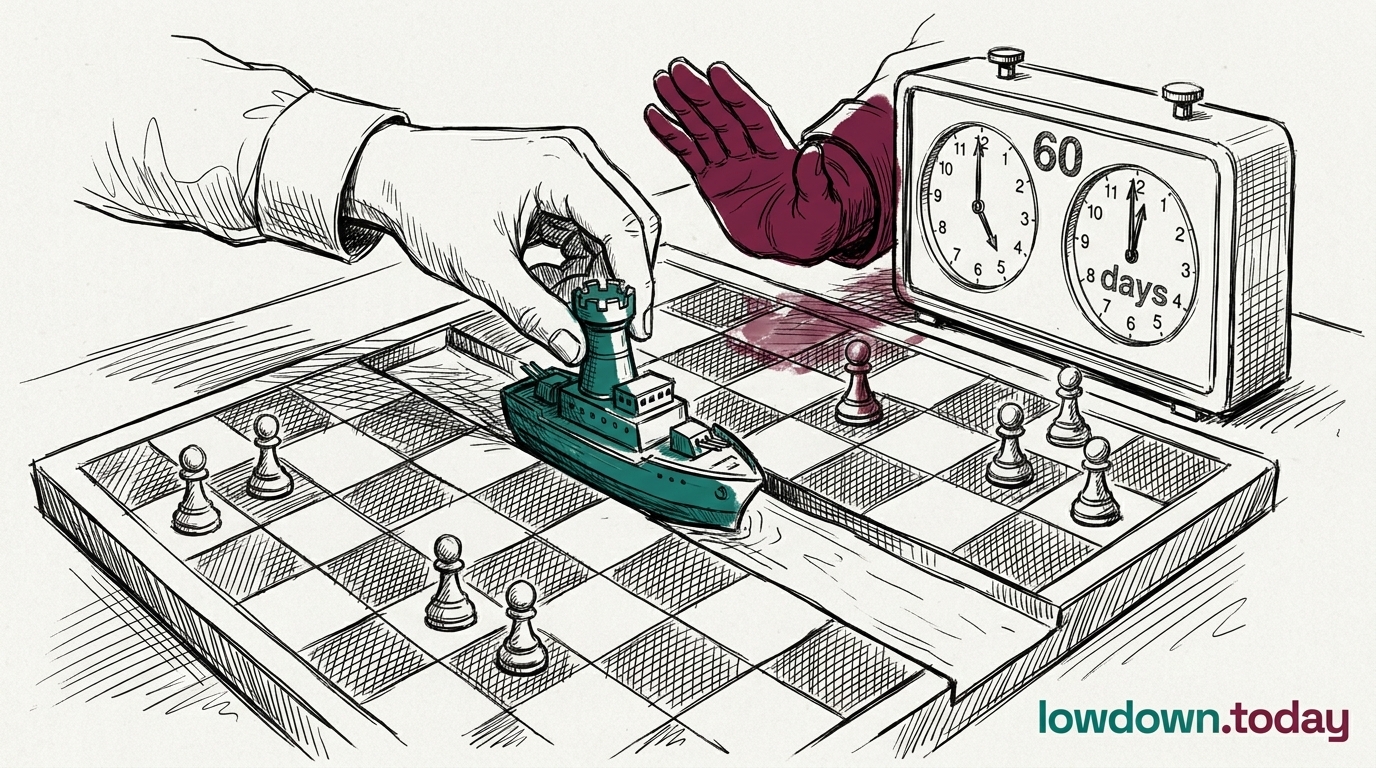
    Indian banks processing transactions for OFAC-designated Indian firms in the Shamkhani network face US correspondent banking sanctions after a 60-day wind-down period, creating systemic risk for India's banking sector connectivity to the dollar system.

First Reported In

Update #77 · Pentagon: six months to clear Hormuz mines

UK Foreign, Commonwealth and Development Office· 23 Apr 2026
Read original
Different Perspectives
Oil markets
Oil markets
Brent fell $1.05 to $106.0 on summit Day 1 but remains $5-7 above the post-ceasefire equilibrium analysts modelled in March; the market is pricing a holding pattern, not a breakthrough. OilPrice.com and Aramco CEO Nasser converge on buffer-exhaustion before Hormuz reopens if the blockade extends past mid-June.
Iranian dissidents and human rights monitors
Hengaw documented a five-prison simultaneous execution cluster on 13 May, with Gorgan appearing for the first time in the wartime register. Espionage charges framed as Israel-linked moharebeh now extend across Mashhad, Karaj, and Gorgan, using the war as judicial cover for protest-era detainees.
BRICS / Global South
Araghchi's Delhi appearance positioned Iran as a victim of US aggression before non-Western foreign ministers, with Deputy FM Bagheri Kani calling on BRICS to act against US aggression. India, as the largest non-Chinese user of Iranian-routed crude, faces pressure to balance bloc solidarity against its own shipping and sanctions exposure.
China
China
Beijing accepted the Nvidia chip clearance on summit Day 1 and gave Rubio verbal acknowledgement of Iran as an Asian stability concern, having already put Pakistan on paper as the mediatory channel on 13 May (ID:3253), deflecting the US ask for direct Chinese action without refusing it.
Iran (government and civilian diplomatic track)
Araghchi denied any Hormuz obstruction at BRICS Delhi on 14 May while Iran's SNSC had finalised a Hormuz security plan the day before. Israel Hayom's single-sourced 15-year freeze offer gives Tehran a deployable figure in non-Western forums regardless of corroboration; the state attributed 3,468 wartime deaths with no independent verification.
United States (Trump administration and Senate moderates)
Trump signed a chip clearance for 10 Chinese firms on summit Day 1 and zero Iran instruments across 76 days; Rubio and Vance made verbal Iran asks without paper. Murkowski voted yes on the 49-50 war-powers resolution after Hegseth told the Senate that Article 2 makes an AUMF unnecessary.