Skip to content
Briefings are running a touch slower this week while we rebuild the foundations.See roadmap
Iran Conflict 2026
21APR

Paris coalition is 51 nations, not 40

3 min read
10:51UTC

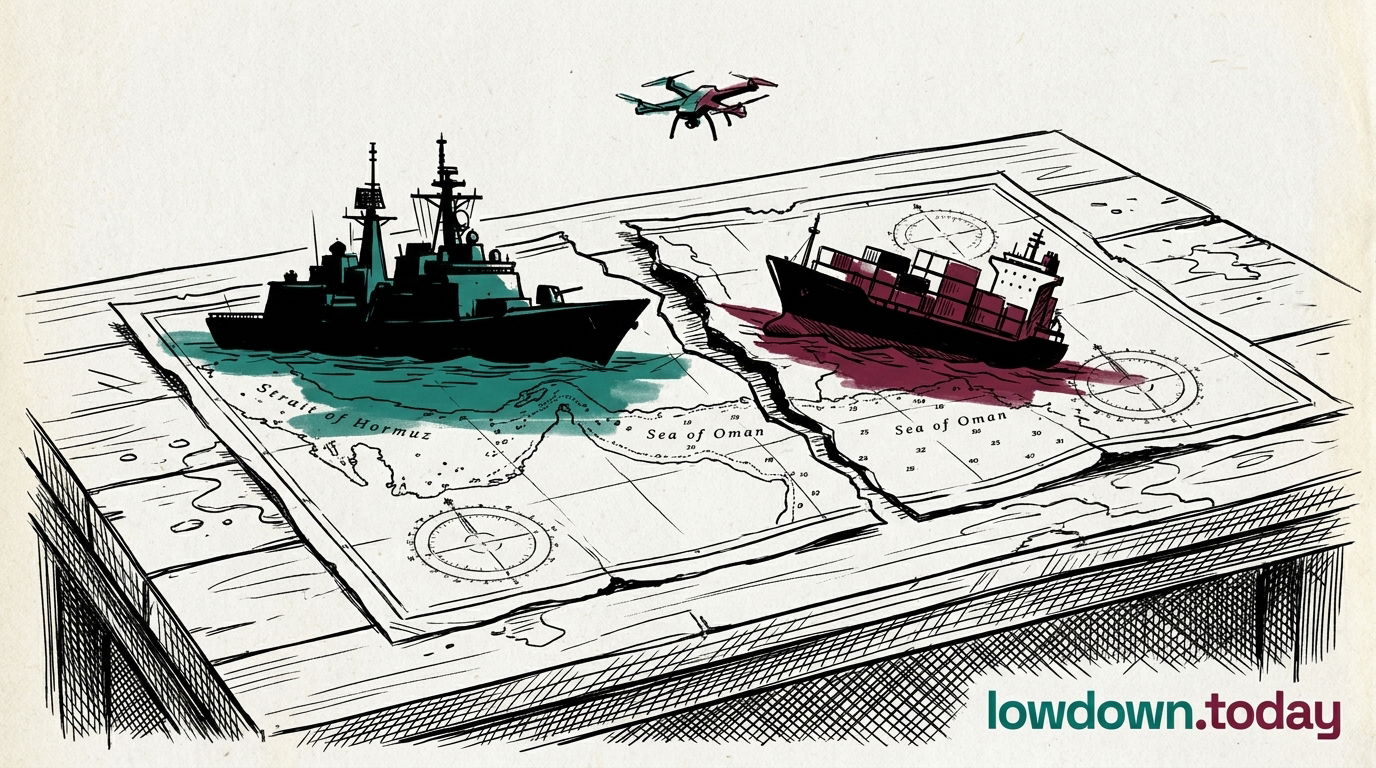
A Macron-Starmer joint statement published on GOV.UK on 17 April put the Hormuz coalition at 51 nations. Most coverage is still running the 40-nation figure.

ConflictDeveloping
Key takeaway

Britain and France will draft the post-war Hormuz rulebook next week; Washington will be briefed after.

The Macron-Starmer joint statement published on GOV.UK on 17 April gave the Hormuz coalition at 51 nations, not the 40 reported in the first wave of coverage 1. The 27% upward correction is a primary-source fact from the UK government's own publication platform that has not yet displaced the 40-nation figure in most wire copy. The statement characterises the mission as "strictly defensive" and makes deployment contingent on "a sustainable ceasefire agreement".

Italy, France, the UK and Germany were named; the Gulf Cooperation Council (GCC) and Saudi Arabia were not. The United States was not in the room and will be "briefed on the outcome". Military chiefs from the 51-nation coalition will meet at Northwood, the UK Permanent Joint Headquarters in north-west London, in the week of 20 April to draft rules of engagement . Over a dozen countries have offered assets, logistics or finance.

The deployment trigger binds the mission to whichever architecture emerges from the 22 April ceasefire expiry question, which is the same ceasefire Tehran is currently running a 24-hour open-and-close cycle on. Rules of engagement written at Northwood by UK and French officers will reflect European legal preferences drawn from UNCLOS transit-passage doctrine, the same legal spine the European Union used when it rejected Trump's Hormuz toll joint venture earlier in the war. In international maritime law, the first credible multilateral text usually holds; any later US arrangement will either reach into this framework or argue round it.

Deep Analysis

In plain English

More countries than first reported (51 rather than 40) have joined a coalition to protect ships at the Strait of Hormuz once the war ends. Britain and France are leading it; the United States is not part of it. British and French military officers will meet next week at Northwood, a UK military headquarters north of London, to write the rules for how the coalition will actually operate.

Deep Analysis
Root Causes

The 27% discrepancy between initial reporting (40 nations) and the verified figure (51) reflects how the coalition was assembled: the Macron-Starmer summit on 17 April was a video conference of leaders who were asked to signal political support rather than commit assets.

Many of the additional 11 nations are likely small-navy or land-locked states that pledged finance or logistics rather than hulls. The GOV.UK primary source lists only Italy, France, UK and Germany as named naval contributors; the remaining 47 commitments are not individually enumerated.

GCC and Saudi absence is structurally determined: Riyadh and the Gulf states face a dilemma where joining the coalition aligns them with an Israeli-adjacent US military operation at a moment when they are managing their own relations with Tehran. Saudi Arabia's closest strategic interest is a swift end to the conflict that restores Hormuz throughput for its own oil exports; a long-running Western naval mission at the strait does not serve that interest.

What could happen next?
  • Meaning

    Northwood ROE drafting without US participation means the post-war Hormuz navigation framework will be built on European legal preferences, potentially conflicting with any future US bilateral arrangement Iran negotiates separately.

    Short term · Assessed
  • Meaning

    The GCC and Saudi absence creates a political asymmetry: the states most economically dependent on Hormuz throughput are not co-authors of the rules governing it.

    Short term · Assessed
  • Meaning

    A 51-nation coalition contingent on a 'sustainable ceasefire' is parked until after the 22 April deadline resolves, meaning its operational value in the current standoff is zero.

    Short term · Assessed
  • Meaning

    If the coalition secures Gulf basing before the ROE are finalised, the precedent set is a European-led permanent naval presence in the Gulf, the first since Britain withdrew east of Suez in 1971.

    Short term · Assessed
First Reported In

Update #72 · Hormuz opens and closes in 24 hours

GOV.UK· 18 Apr 2026
Read original
Different Perspectives
Israel
Israel
IDF Chief Eyal Zamir declared on 3 June there was no ceasefire for his forces, and strikes killed at least 10 civilians and one Israeli soldier on 4 June. The IDF killed Hezbollah's chief engineer and warned three south Lebanon villages to evacuate on 5 June, advancing into ground the unsigned Washington framework has not caught.
Hezbollah / Lebanon
Hezbollah / Lebanon
Naim Qassem rejected the Washington Lebanon framework on 4 June as "absurd, humiliating and insulting", blocking a ceasefire instrument that required Hezbollah to withdraw north of the Litani before any Israeli withdrawal. Over one million Lebanese remain displaced; the framework's collapse prolongs that toll.
Iran
Iran
Foreign Minister Araghchi publicly coupled the Lebanon ceasefire to the Iran-US nuclear track on 4 June, carrying IRGC authority rather than his own civilian mandate. The IRGC delegation has sent no HEU counter-proposal since Araghchi confirmed no progress that same day; Mojtaba Khamenei's 21 May order to keep the 440.9 kg stockpile inside Iran remains operative.
United States
United States
Rubio placed the Iran-US deal at 95 per cent complete on 4 June while the administration signed no Iran instrument and OFAC designated only Cuban targets. Trump separately disclosed and rejected an airlift plan to collect Iran's HEU stockpile, claiming the material is "entombed", a claim the IAEA cannot verify.
China
China
Beijing's MOFCOM Blocking Rules constrain OFAC enforcement on the mainland; China has not corroborated Trump's verbal account of any bilateral summit, and the rial's failure to hold its Rubio bounce, combined with the IRGC's stablecoin rail closure, increases Chinese yuan-denominated oil-payment exposure through Hormuz.
Bahrain
Bahrain
The IRGC struck Bahrain on 3 June as its sirens sounded and its PAC-3 magazine neared exhaustion; excluded from Rubio's 2 May emergency resupply, Bahrain received a 50-round Federal Register notice on 1 June on an 18-month delivery timeline, meaning it is defending the US Fifth Fleet headquarters on the last rounds it has.