Skip to content
Briefings are running a touch slower this week while we rebuild the foundations.See roadmap
STARs
ConceptUS

STARs

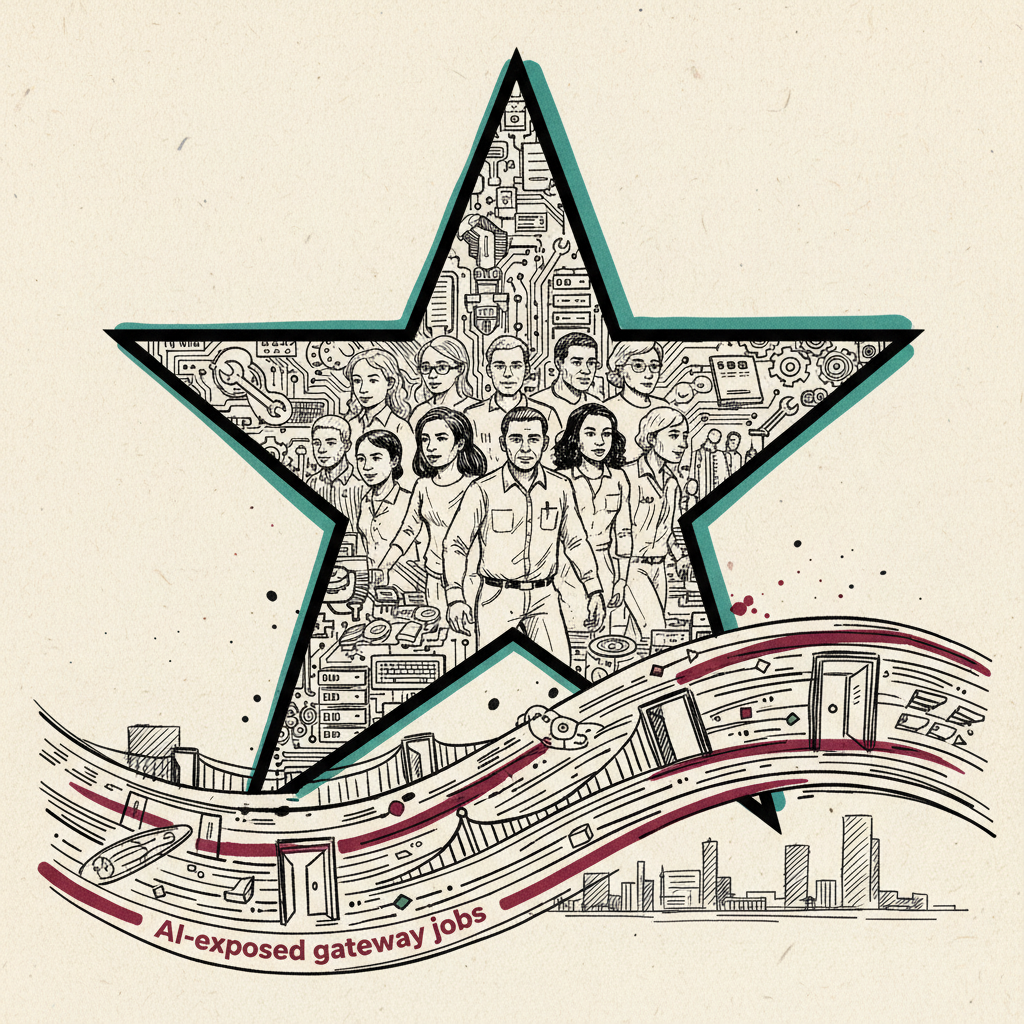
Workers skilled through alternative routes rather than four-year degrees; 11 million in AI-exposed gateway jobs.

Last refreshed: 22 May 2026 · Appears in 1 active topic

Key Question

Do 11 million workers without degrees face AI displacement with nowhere to go?

Timeline for STARs

View full timeline →
Common Questions
What are STARs and why are their jobs at risk from AI?
STARs (Skilled Through Alternative Routes) are roughly 70 million US workers without four-year degrees. Research found 11 million of them work in gateway jobs in the highest AI-exposure occupational categories, making them especially vulnerable to displacement.Source: background
How many US workers don't have college degrees and could be replaced by AI?
Opportunity@Work estimates roughly two thirds of the US workforce (about 70 million people) are STARs who gained skills without four-year degrees. Of those, 11 million work in the most AI-exposed gateway occupations.Source: background
Can workers without degrees retrain for new AI jobs?
Opportunity@Work argues that degree requirements on new AI-era roles create a structural barrier: STARs displaced from gateway jobs often cannot access the adjacent knowledge-work positions because of credential screens, even if they have the underlying skills.Source: background
Are women more exposed to AI job losses than men?
Yes. An ILO and World Bank study of 135 countries found women face nearly double the AI job risk of men globally, and in high-income countries the gap is nearly three to one. Female-dominated clerical roles overlap heavily with the STARs gateway-job categories.Source: background
What are STARs workers and why do they matter for the AI jobs debate?
STARs (Skilled Through Alternative Routes) are the roughly 70 million US workers who built skills outside a four-year degree. They matter because 11 million hold gateway jobs most exposed to AI substitution, making them the group most at risk of displacement without a retraining PATH.Source: Opportunity@Work
How many US jobs held by non-degree workers are at high AI risk?
Opportunity@Work research with Brookings and the Hamilton Project identified 11 million gateway jobs in the highest AI-exposure occupational categories held predominantly by STARs workers.Source: Opportunity@Work / Brookings
Why are STARs workers more vulnerable to AI job losses than degree holders?
STARs hold the gateway jobs most exposed to AI substitution, but the adjacent knowledge-work roles they might move into require degrees they do not have. AI is removing the entry rung while degree requirements block the next one.
Which companies have dropped degree requirements in response to STARs research?
Apple, IBM, and Accenture are among major firms that have dropped four-year degree requirements for some roles, partly in response to skills-based hiring advocacy using the STARs framework.

Background

STARs (Skilled Through Alternative Routes) is a term coined by Opportunity@Work to describe an estimated 70 million US workers who developed their skills through military service, community college, trade apprenticeships, or sustained on-the-job training rather than completing a four-year university degree. The concept challenges the assumption that a bachelor's degree is a reliable proxy for workplace competency, arguing that degree-based hiring screens exclude a large share of the capable workforce and concentrate economic mobility among the credentialled.

The AI displacement debate gave the STARs framework new urgency. Research published by Opportunity@Work with Brookings and the Hamilton Project found 11 million gateway jobs in the highest AI-exposure occupational categories are held predominantly by STARs. These roles, which previously offered non-degree workers a route into the middle class, are now simultaneously threatened by AI substitution and shielded from displaced workers by the degree requirements of adjacent knowledge-work roles. The finding positions STARs as the group most likely to face displacement without a retraining ladder.

STARs represent a structural feature of the US labour market: Opportunity@Work estimates that two thirds of the US workforce qualifies, disproportionately Black, Latino, and rural. The ILO and World Bank's 2026 joint study on AI exposure found women globally face nearly double the AI job risk of men, a finding that intersects with the STARs distribution; female-dominated clerical and administrative roles are both high-exposure and often held by workers without degrees.

Source Material