Skip to content
Briefings are running a touch slower this week while we rebuild the foundations.See roadmap
Iran Conflict 2026
14APR

Northwood plan leaves allied ships exposed

2 min read
09:22UTC

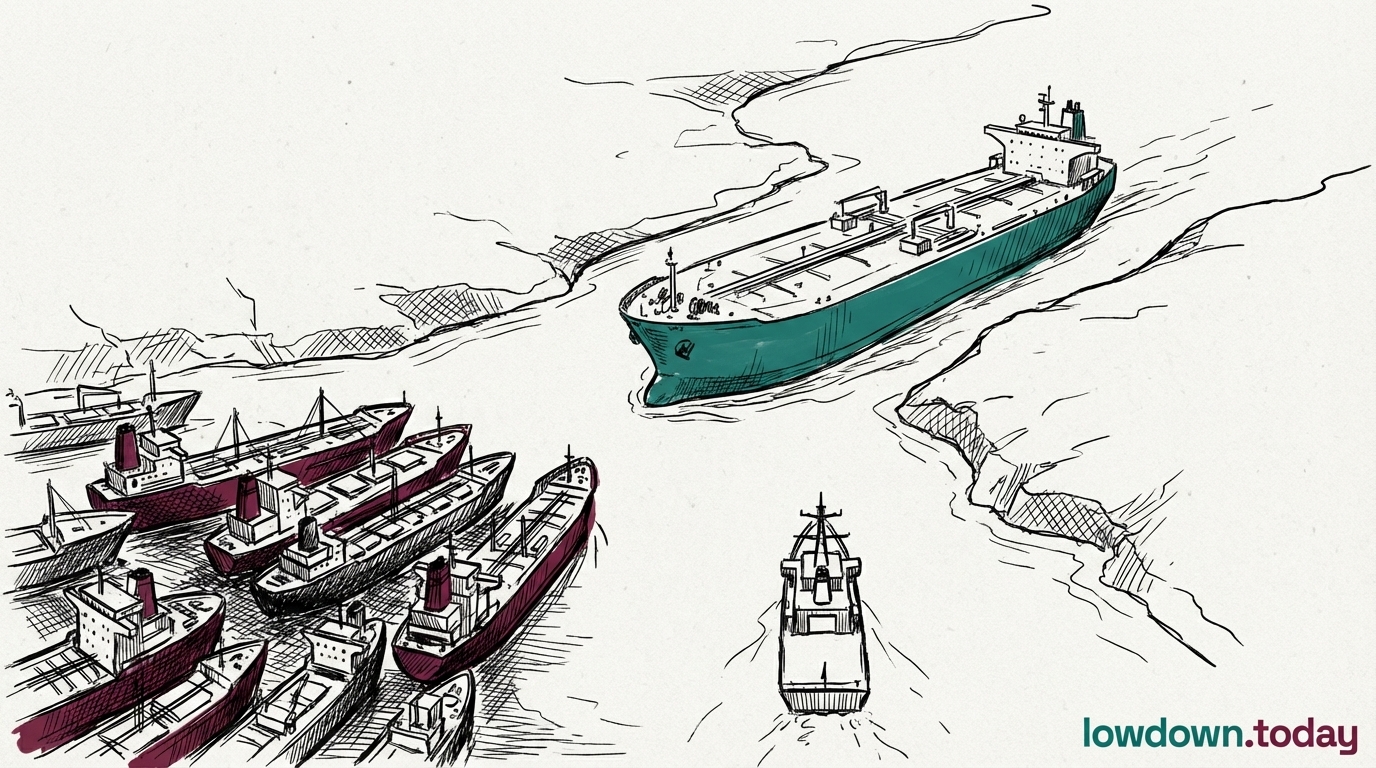
Thirty nations produced an operational Hormuz plan at UK Permanent Joint Headquarters Northwood on 22-23 April. The White House's two-tier ceasefire leaves European, Asian and Gulf-flagged shipping outside the cover.

ConflictDeveloping
Key takeaway

Coalition plan is ready; ceasefire cover is not, and Europe's flagged hulls carry the exposure.

Thirty nations sent military planners to the UK Permanent Joint Headquarters at Northwood on 22-23 April 2026 to translate the 51-nation Paris posture into an operational Strait of Hormuz plan covering warships, armed convoy escorts, mine-hunting drones, radar coverage and intelligence-sharing 1. The Northwood summit itself opened on 22 April . No participating nation published rules of engagement, and the deployment trigger remains "as soon as conditions permit, following a sustainable ceasefire."

The White House confirmed a two-tier ceasefire ruling that explicitly excludes European, Asian and Gulf-flagged shipping from ceasefire cover regardless of escort architecture. Saudi Arabia and the Gulf Cooperation Council (GCC) still sit off the Coalition paper despite Riyadh's welcome of the 21 April ceasefire extension. Every European, Asian or Gulf-flagged vessel in the strait operates without the umbrella the paper would otherwise extend, even when sailing inside a Coalition convoy.

Allied exclusion makes the Northwood architecture coercive of allies as much as of Iran. The Hormuz plan exists on paper at Northwood; the ceasefire that would activate it does not. France, the United Kingdom and the other 28 participants have committed hulls and radar to a framework the United States controls the trigger on, and US reading of ceasefire cover decides which of their hulls are covered when a mine-layer breaks for open water.

The Pentagon email leaked on 24 April closes the loop. European capitals that declined the Iran-campaign ABO request are the same capitals that now watch their flagged shipping sit outside the ceasefire bubble. Article 42.7 of the EU treaty, the mutual-defence clause raised at the Cyprus summit, is the institutional counterweight, but it reaches the flag rather than the cargo, and the cargoes are already at sea.

Deep Analysis

In plain English

Thirty countries sent military planners to Northwood, the UK's military command headquarters outside London, to turn the paper promise from the 51-nation Paris conference into an actual military plan: which warships, which drone mine-hunters, which radar systems, and who shares intelligence with whom. Activation requires a 'sustainable ceasefire': no government or coalition has published a definition of that term, and the US attended neither the Paris conference nor the Northwood summit. Thirty countries have agreed on paper how to police Hormuz after the war, but the deployment clock cannot start until someone else writes the ceasefire text that triggers it, using a legal framework Washington did not help draft.

What could happen next?
  • Precedent

    Rules of engagement drafted at Northwood by UK and French officers under UNCLOS transit-passage doctrine will form the legal baseline for Hormuz management post-war, creating a multilateral framework any subsequent US arrangement must negotiate against rather than replace unilaterally.

First Reported In

Update #78 · Allies flagged, adversaries listed, nothing signed

GOV.UK· 24 Apr 2026
Read original
Different Perspectives
Qatar
Qatar
Qatar holds approximately $12 billion in frozen Iranian assets that Tehran named as the precondition for any Hormuz reopening sequence; with Oman sidelined and no agreed HEU custodian, the asset-routing architecture that any deal requires has no operational channel and no neutral financial intermediary to run it through.
Hengaw and Iranian civilian population
Iranians face an internet capped at 40 per cent by hardware their president cannot dismantle, field killings that leave no court record, and judicial executions running in parallel; Hengaw, based in Norway, is the primary remaining monitor of a repression system the IRGC is deliberately moving beyond auditable records. The real toll is higher than any single monitor's count.
China
China
China supplied deep-packet-inspection hardware that caps Iran's internet at 40 per cent and enables an instant on-demand blackout, and was barred by Trump as a potential HEU custodian on 27 May. Beijing gains from Iran's continued non-alignment with the West while the DPI sale extends Chinese surveillance-technology exports as a geopolitical instrument.
Pakistan
Pakistan
Foreign Minister Ishaq Dar met Rubio in Washington on 29 May, formally inheriting the role of sole active mediator after Oman's forced withdrawal. Pakistan lacks Oman's banking infrastructure for frozen-asset routing and carries its own regional stakes, making it a less structurally neutral broker for the Qatar-held $12 billion sequencing.
Kuwait
Kuwait
Kuwait invoked Article 51 of the UN Charter after absorbing an Iranian ballistic-missile strike on Ali Al Salem Air Base on 28 May, becoming the first Gulf state to make a formal individual self-defence claim in the war. The invocation creates a legal record enabling a future bilateral defence-pact activation without yet triggering it.
Oman
Oman
Oman denied any Hormuz toll plan within hours of Bessent's 28 May threat, absorbing a sanctions warning from the country it has brokered for since 1981. The rapid capitulation preserved the channel formally, but Tehran now knows Washington will threaten its own mediator, which changes Muscat's calculus on how far it can lean into any joint-management architecture.