
Skip to content
Briefings are running a touch slower this week while we rebuild the foundations.See roadmap
Iran Conflict 2026
26MAR

Day 27: Iran rejects ceasefire; Kharg fortified

3 min read
09:36UTC

Iran dismissed Washington's first formal ceasefire framework as 'maximalist and unreasonable' and countered with five conditions including Hormuz sovereignty recognition and war reparations. US intelligence shows Tehran laying mines and MANPADs on Kharg Island beaches ahead of a potential Marine amphibious assault, while Brent crude fell to $97 on confused talk signals and the Philippines became the first country to declare a national energy emergency.

Key takeaway

Both sides are preparing for diplomacy to fail. Their first formal peace terms are structurally incompatible, Kharg Island fortification and 82nd Airborne deployment are converging toward a ground confrontation, and the economic shockwave has already forced a US treaty ally into a national energy emergency.

This briefing mapped
Loading map…
Diplomatic
Military
Economic
Domestic
Humanitarian

Tehran's five conditions amount to a demand for unconditional victory; the gap with Washington's 15-point plan is structural, not tactical.

Sources profile:This story draws on centre-left-leaning sources from United Kingdom and United States
United KingdomUnited States

Iran’s Foreign Minister Abbas Araghchi rejected the US 15-point ceasefire plan as “extremely maximalist” on Tuesday. Tehran published 5 counter-conditions: a halt to attacks, war reparations, Hormuz sovereignty recognition, protection of Hezbollah and allied militias, and fulfilment of pre-war Geneva demands.

US terms ask Iran to surrender its nuclear programme and disband regional proxies; Iran’s terms ask Washington to cede authority over the waterway carrying one-fifth of the world’s oil. Not 1 item overlaps. 

Briefing analysis

In 1951, Iranian Prime Minister Mohammad Mossadegh nationalised the Anglo-Iranian Oil Company, asserting sovereignty over Iran's petroleum resources. Britain organised an international embargo that cut Iranian production to near zero for two years. Mossadegh held firm, believing Western dependence on Iranian oil would force concessions. The embargo held; Iran's economy collapsed; a CIA-MI6 coup (Operation Ajax) in 1953 restored the Shah.

Today's standoff inverts the Abadan structure. Then, the West controlled the chokepoint (embargo). Now, Iran controls it (Hormuz). Tehran's demand for sovereignty over the strait echoes Mossadegh's demand for sovereignty over Abadan. The lesson from 1953: the side controlling the infrastructure need not prevail; the side willing to endure the longest deprivation often does. Washington's bet is that Iran's tolerance for economic pain has limits. Tehran's bet is that American tolerance for $100+ oil and allied energy emergencies has limits too.

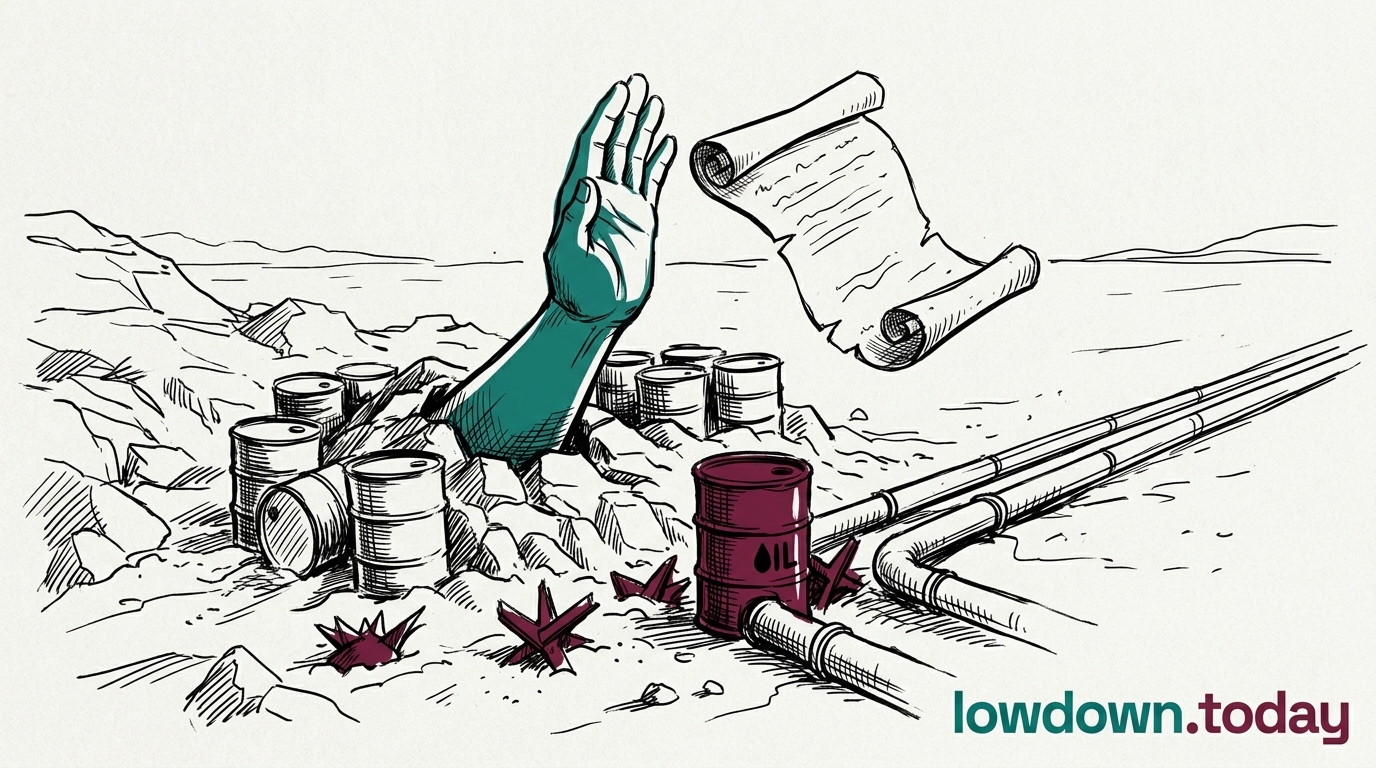
Tehran is laying anti-personnel traps and positioning anti-aircraft missiles on the island that handles 90% of Iran's oil exports.

Sources profile:This story draws on mixed-leaning sources from United States and United Kingdom
United StatesUnited Kingdom
LeftRight

US intelligence reports show Iran laying anti-personnel mines, anti-armour mines, and MANPADs on Kharg Island beaches ahead of a potential US Marine amphibious assault.

The fortification transforms a planned US leverage operation into a potential high-casualty assault against prepared defences on sovereign Iranian territory. 

Sources:CNN·The Week
1 CNN2 The Week

Brent crude dropped to $97 on Trump's negotiation claims, despite Iran's categorical rejection.

Sources profile:This story draws on mixed-leaning sources from United States
United States
LeftRight

Brent crude fell to $96.68 per barrel, down from $104, on confused signals about US-Iran peace talks.

Markets are pricing rhetoric over reality; when Iran's rejection registers, a rapid correction could strain derivatives markets at record backwardation. 

Sources:CNBC·Fortune

Manila has 45 days of fuel left and may buy sanctioned Iranian or Venezuelan oil to survive.

Sources profile:This story draws on centre-left-leaning sources from Philippines and United States
PhilippinesUnited States

President Ferdinand Marcos Jr. declared a national energy emergency on Tuesday, the first country to invoke emergency powers over the Iran war. With 90% of its oil from the Middle East, the Philippines has 45 days of reserves.

Manila is considering buying Iranian or Venezuelan crude, both under US sanctions, to survive a disruption caused by a US war. Sri Lanka ordered 25% energy cuts; Slovenia introduced rationing, the first EU state to do so. 

Sources:Rappler·ABC News
1 Rappler2 ABC News

Pew finds 59% opposition, 29% Republican dissent, and a public expecting the war to last at least six months.

Sources profile:This story draws on neutral-leaning sources

A Pew Research Centre survey of 3,524 American adults taken 16-22 March found 59% called striking Iran the wrong decision and 61% disapprove of Trump’s handling. The partisan split: 88% of Democrats oppose, but 29% of Republicans also disagree with their own president.

Fifty-four percent expect the war to last at least 6 more months. Only 8% think it ends within a month. Trump says it is nearly over; most Americans do not believe him. 

Non-belligerent Gulf states absorb daily attacks; Kuwait's airport hit for the fourth time in 26 days.

Sources profile:This story draws on mixed-leaning sources from Qatar and United Arab Emirates
QatarUnited Arab Emirates

Iranian drones struck Kuwait International Airport for the 4th time in 26 days, while Saudi Arabia intercepted 32 drones and a ballistic missile over the Eastern Province in 11 hours. A Moroccan civilian working with UAE forces was killed in Bahrain.

None of these countries is a formal belligerent, but all host US military forces. The Islamic Revolutionary Guard Corps (IRGC) treats US basing as sufficient grounds to hit host-nation infrastructure regardless of formal status. 

Ships running out of water and food; seven killed; no evacuation framework despite IMO appeals.

Sources profile:This story draws on centre-left-leaning sources from United States
United States

Approximately 2,000 vessels and 20,000 seafarers remain stranded west of the strait of Hormuz, according to the International Maritime Organisation (IMO). Seven seafarers have died and more than 20 vessels have been attacked since 1 March; ships are running out of food and drinking water.

The crews come from the Philippines, India, Bangladesh, and Myanmar. The IMO asked Gulf Cooperation Council states to establish a safe-passage evacuation framework. None had responded as of Tuesday. 

Sources:ABC News
1 ABC News

Three monitoring bodies report tolls varying fourfold, reflecting the information blackout inside Iran.

Sources profile:This story draws on neutral-leaning sources from Iran
Iran

Hengaw documented 6,530 killed in Iran in 25 days, with 5,890 military or government personnel across 186 cities. HRANA counted 3,291. Iran’s Health Ministry reported 1,750. The 3 estimates span a factor of nearly 4.

The gap reflects genuine uncertainty: communications infrastructure has been degraded by strikes, hospitals are overwhelmed, and military reporting chains may be disrupted. The true figure will not be established until the war ends. 

Four IDF divisions occupy a 30km strip while Hezbollah sustains 3,500 strikes; the toll passes 1,000.

Sources profile:This story draws on mixed-leaning sources from Qatar and United Kingdom
QatarUnited Kingdom
LeftRight

Israel’s 30-kilometre security zone south of the Litani River became operational, with evacuation orders issued to 50 villages across southern Lebanon and Beirut’s southern suburbs. The Lebanese death toll reached 1,072 killed and 2,966 wounded since 2 March.

Hezbollah has fired 3,500 missiles and drones, roughly 145 per day. 4 IDF divisions inside Lebanon have not suppressed that rate. Northern Command officers told reservists to prepare for operations lasting until at least May. 

Pentagon's rapid-deployment paratroopers head to the Gulf while the president says the war is nearly over.

Sources profile:This story draws on mixed-leaning sources from United States
United States
LeftRight

The 82nd Airborne Division’s headquarters, roughly 1,000 paratroopers under Maj. Gen. Brandon Tegtmeier, received orders to deploy to the Middle East. Combined with 8,000 Marines aboard USS Boxer, over 50,000 US personnel are now committed to the theatre.

Trump said the same day the US had “won the war.” Paratroopers are not sent to wind down conflicts. The combination of Iranian beach mining on Kharg and the 82nd’s deployment points toward ground-operation planning. 

Closing comments

Escalating toward ground confrontation. Kharg fortification and 82nd deployment create convergence.

Different Perspectives
Trump administration
Claims war won and talks productive while deploying 82nd Airborne and preparing ground options.
Israeli government
Israeli government
Self-excluded from US-Iran talks. Accelerating strikes anticipating a ceasefire before objectives met.
Philippines government
First non-belligerent energy emergency. Considering sanctions-violating purchases to survive.
Pakistan government
Pakistan government
Mediator leveraging ties with both sides but unable to bridge the substantive gap.
Iranian government
Iranian government
Rejects negotiations while publishing counter-conditions. Demands Hormuz sovereignty, reparations, and militia protection.
Stranded seafarers
Stranded seafarers
20,000 civilians trapped in a war zone with no escape route and no country claiming responsibility.