Skip to content
You can now search across every topic, entity and event.What's new
Iran Conflict 2026
23JUL

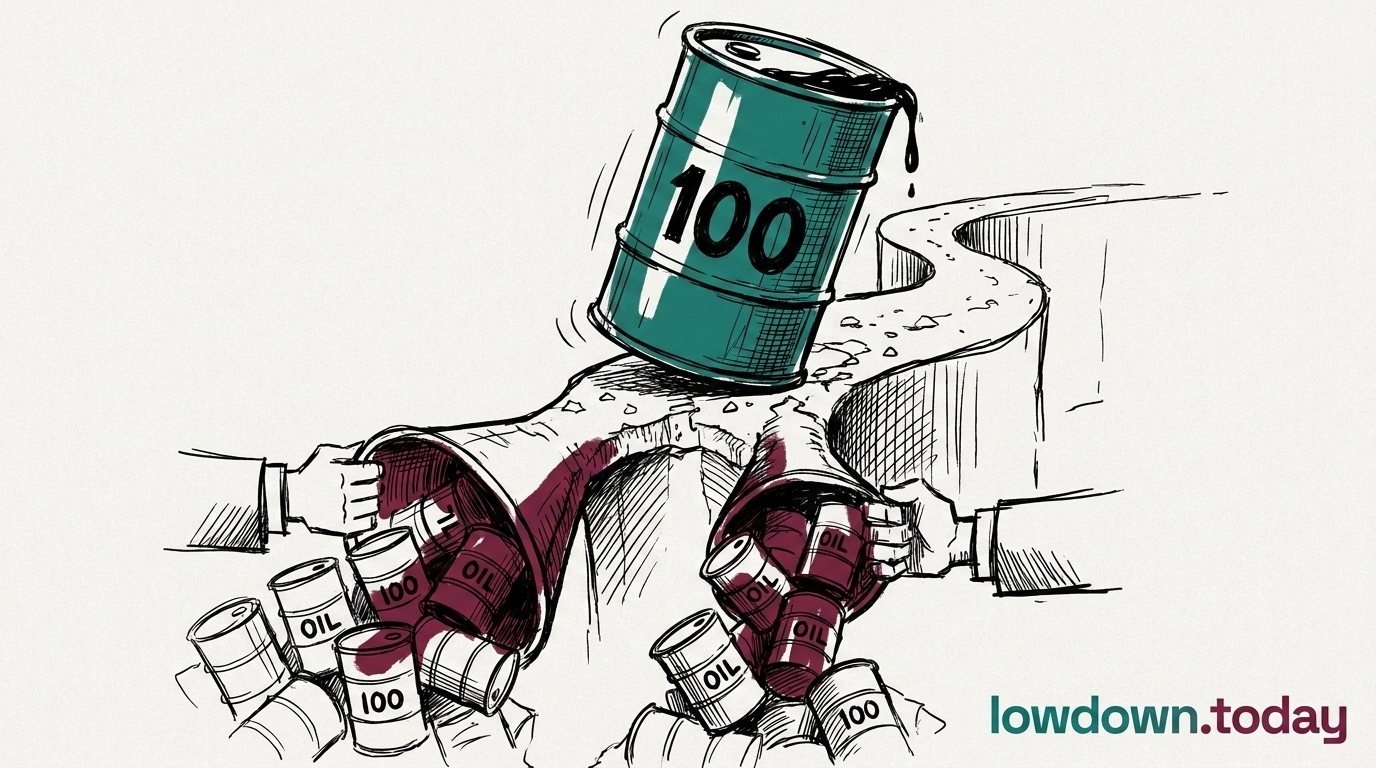
Brent round-trips 9% down and 7% up in a weekend

3 min read
19:27UTC

Oil fell nine per cent on Friday after Araghchi's corridor announcement, then rebounded seven per cent on Monday once the IRGC seizures proved the corridor was void.

ConflictDeveloping
Key takeaway

Brent's weekend round-trip priced the distance between an Iranian foreign-ministry clearance and an IRGC clearance.

Brent Crude closed up roughly 7% to $96.88 on Monday 20 April after a 9% drop on Friday 18 April, the sharpest single-day round-trip of the war, per Euronews trading data. Between Friday close and Monday open the underlying supply picture had not changed; the market's read on whose paper bound the strait had.

The Friday drop followed Foreign Minister Abbas Araghchi's civilian corridor announcement and a brief window of reopening optimism. The Monday rebound followed two weekend developments that voided that corridor: the IRGC tanker strikes and the subsequent US seizure of the Iranian-flagged Touska. Traders had priced Friday on an Iranian clearance system they could take at face value; by Monday morning Guard Corps enforcement had falsified that assumption and Brent marked down the recovery as void.

For European drivers that round-trip translates to roughly 4 to 5 pence per litre of flex at the pump on a lag of two to three weeks, once wholesale contracts reprice and retail margin adjusts. For Protection and Indemnity (P&I) insurance clubs, the Friday-to-Monday whipsaw adds war-risk premium on every hull that has transited or will transit Hormuz while the divergence holds, because the clubs price on the most recent kinetic data point, not the most recent diplomatic announcement. A counter-view from energy strategists at Goldman Sachs is that the supply floor under Brent remains the physical volume still moving despite the blockade; that reading is compatible with this round-trip, because the volatility is on the clearance system rather than on confirmed outages.

Deep Analysis

In plain English

Oil prices fell sharply on Friday after Iran's foreign minister announced the Strait of Hormuz was open for shipping. Then they rose almost as sharply on Monday after Iran's Revolutionary Guard fired on Indian ships that had been told they could cross, proving that the foreign minister's announcement did not actually open the strait. In two days, the price of a barrel of oil went down 9% and then back up 7%. That swing had nothing to do with how much oil was actually in the ground or flowing through pipes. Both moves were driven entirely by uncertainty about which Iranian official controls the strait. On Friday the answer appeared to be the diplomat; by Monday it was clear the answer is the general.

Deep Analysis
Root Causes

The 16-percentage-point round-trip traces to a single structural vulnerability in how oil markets process split-authority enforcement: futures markets can only price one authoritative voice per trading session.

Araghchi's Friday corridor announcement cleared as the authoritative signal because it came from the named foreign minister of a sovereign state. The IRGC Navy's Tabnak order, published in Farsi two days earlier, had not been processed as load-bearing by non-Farsi-reading algorithmic trading systems.

By Monday, IRGC enforcement of the Sanmar Herald firing and the Touska seizure made the Tabnak order legible to English-language market infrastructure. Friday's price reflected the civilian signal; Monday's price reflected the Guard Corps enforcement reality. The same physical strait, two trading sessions, two incompatible prices.

What could happen next?
  • Consequence

    Oil markets will reprice every future Iranian civilian announcement against the probability that IRGC enforcement overrides it, adding a permanent institutional-split premium to Hormuz-origin crude.

First Reported In

Update #74 · Two unsigned rulebooks collide at Hormuz

Euronews· 20 Apr 2026
Read original
Causes and effects
This Event
Brent round-trips 9% down and 7% up in a weekend
The market mispriced Iranian authority across the weekend and corrected inside one session. For European consumers that volatility flows through to the pump on a two-to-three week lag, and for P&I clubs it resets the war-risk premium on every Hormuz hull.
Different Perspectives
India
India
India buys more Saudi crude than any other country and has 2.5 million nationals working in the kingdom, so a $100 Brent and a live strike on Saudi tankers reach New Delhi through both fuel bills and remittance risk. Neither channel has an alternative route the way Saudi Arabia's own pipeline does.
Qatar
Qatar
Qatar co-authored the four-mediator ten-day ceasefire proposal alongside Egypt, Pakistan and Oman, centred on resuming Hormuz navigation, while separately pursuing its dated compensation claim against Iran at the UN Security Council filed on 21 July. Doha is mediating and litigating in the same week.
Israel
Israel
Israeli intelligence, reported by the Wall Street Journal, assesses Iran moved thousands of centrifuges and part of its roughly 440kg enriched-uranium stock into Pickaxe Mountain after the June 2025 strikes on its three main nuclear sites. Some of the US refuelling aircraft now deploying to the region are bound for Israeli bases and Ramon Airport.
Houthis
Houthis
Yahya Saree announced the missile and drone strikes on the Encelia and Layla on 22 July as enforcement of the embargo his forces had declared by radio warning alone two days earlier. Six vessels already turned back on the broadcast; the strike shows Houthi forces will use weapons once warnings stop working.
Saudi Arabia
Saudi Arabia
Saudi Arabia's state news agency confirmed only a fire on the Encelia's bow, with the crew safe; the Layla strike remains unconfirmed by Riyadh. The kingdom built its Petroline pipeline specifically to bypass Hormuz through the Red Sea, so the tanker fire lands on the route Riyadh had already spent billions escaping.
United States
United States
Washington is weighing both ten-day proposals but wants a longer truce than either offers, and moved F-16 and F-35 jets plus refuelling aircraft into the region while it decides. That deployment, not Trump's Pickaxe Mountain remarks, is the measurable US action, buying options for the day talks fail rather than betting on them.