Skip to content
You can now search across every topic, entity and event.What's new
Iran Conflict 2026
30JUN

US and Iran halt fire, sign nothing

3 min read
15:13UTC

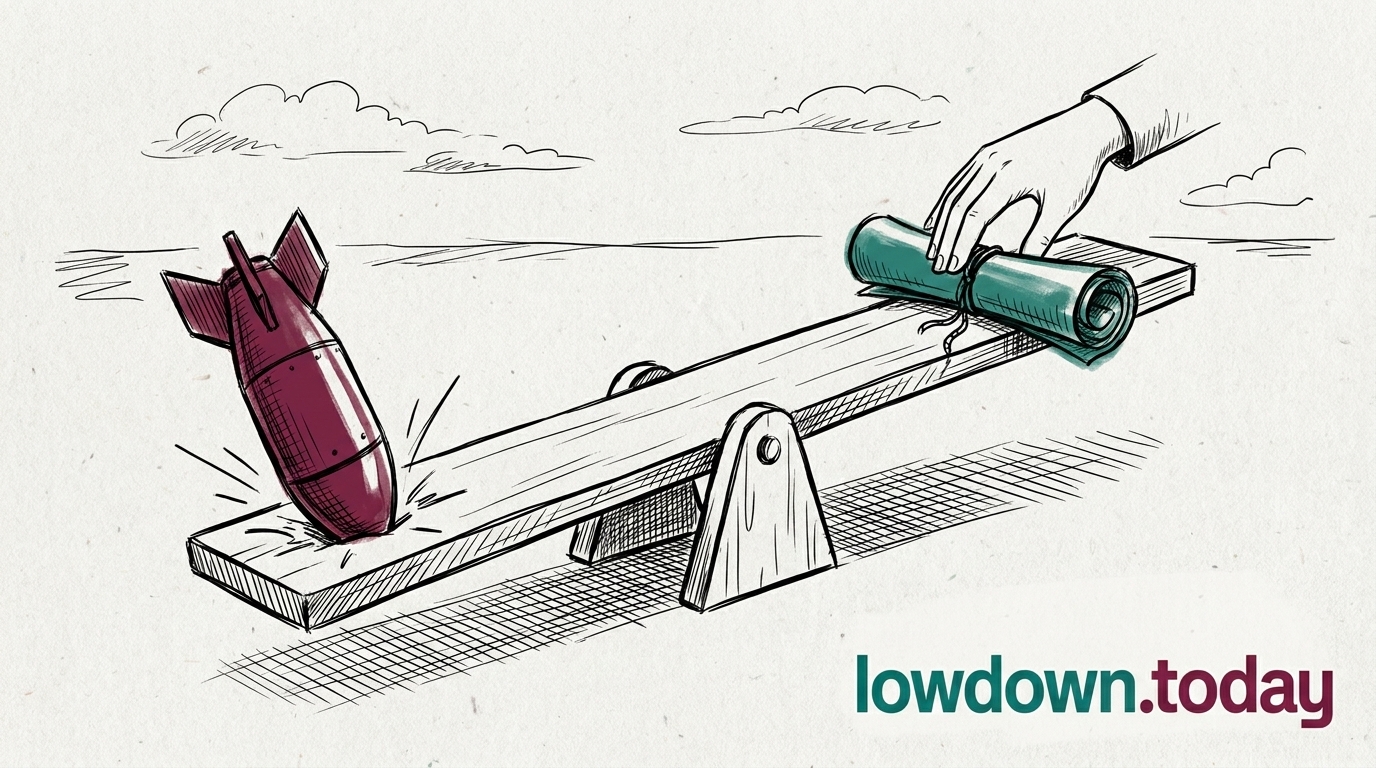
Washington and Tehran verbally agreed to halt operations on 29 June, then sent Steve Witkoff and Jared Kushner to Doha, with no signed text and no direct meeting.

ConflictDeveloping
Key takeaway

Washington halted operations by word, signed no new instrument, and sent envoys to Doha for indirect talks.

Washington and Tehran agreed to halt offensive operations on Monday 29 June, a verbal understanding rather than a signed text 1. The US announced that commercial vessels could "move freely" through the Strait of Hormuz, yet Brent Crude barely moved on the news 2.

A day later, on Tuesday 30 June, Steve Witkoff and Jared Kushner landed in Doha for talks on implementing the MOU (Memorandum of Understanding) signed on 16 June 3. Qatar's foreign ministry confirmed there was no direct US-Iran meeting: both delegations sat separately with Qatari and Pakistani mediators, the same shuttle format that produced the earlier Switzerland round 4. Kushner's prior Gulf work was the 2020 Abraham Accords, the normalisation deals between Israel and four Arab states, not the Iran war; sending a family envoy raised the round's political weight without putting an American across the table from an Iranian.

Across the whole window, no new Iran executive order, sanction or military authorisation was signed 5. The one standing instrument, General License X (GL X), which authorises Iranian oil sales through 21 August, predates this week . Trump had promised on 21 June to hit Iran "very hard again, only harder" ; his government degraded ten targets, then stood down and sent mediators. Set against that, the two strikes read as calibration rather than passivity, and the stand-down lets Trump claim a win without signing anything that would bind him.


Deep Analysis

In plain English

On 29 June 2026, the United States and Iran agreed verbally to stop military operations against each other. Neither Trump's government nor Iran's foreign ministry signed any document. The US announced that civilian ships could once again pass through the Strait of Hormuz, the narrow shipping lane between Iran and the Arabian Peninsula through which around a fifth of the world's oil flows each day. The following day, two senior US envoys flew to Doha, the capital of Qatar. One was Steve Witkoff, a New York businessman and personal friend of President Trump who had previously helped broker a ceasefire in Gaza. The other was Jared Kushner, Trump's son-in-law, who had arranged the 2020 Abraham Accords, a set of agreements normalising relations between Israel and several Arab countries. Neither man met directly with Iranian officials. Both sat in a separate room while Qatari and Pakistani diplomats passed messages back and forth between the two sides. The fact that nothing was written down matters: either side can resume operations without technically breaking a signed agreement.

Deep Analysis
Root Causes

The stand-down's verbal-only nature reflects a structural impasse neither government can resolve without domestic political cost. A signed agreement would require Washington to acknowledge Iran as a treaty partner in a way that triggers the Congressional War Powers Act debate; for Tehran, signing directly with a Trump representative requires the Supreme Leader's explicit endorsement of terms Iran has publicly contested for months, particularly on Hormuz routing.

Kushner's addition to the Doha track replicates the Abraham Accords personal-envoy model, in which Gulf leaders negotiated directly with Trump's family network rather than through State Department channels.

That model's speed advantage, bypassing bureaucratic process, is offset by its fragility: agreements built on personal relationships do not survive personnel changes and produce no institutional memory. The absence of any new signed Iran executive order or sanction across the entire 28-30 June window confirms the White House is treating this as a personal-track negotiation rather than a treaty process.

What could happen next?
  • Risk

    A verbal-only stand-down with no monitoring mechanism can collapse the moment either side frames a local incident as a ceasefire breach, returning the situation to full military exchange without the friction of a treaty violation process.

    Immediate · Reported
  • Consequence

    Kushner's entry to the Iran track signals Trump is treating this as a personal-network deal rather than a State Department-led process, which speeds decision-making but reduces institutional durability if personnel change.

    Medium term · Assessed
  • Opportunity

    The shuttle format that produced the January 2025 Gaza ceasefire framework is now operational in Doha for Iran, offering a template that has worked before for Witkoff under comparable indirect-contact conditions.

    Short term · Assessed
First Reported In

Update #141 · Iran hits two US bases; Trump pulls back

GlobalSecurity.org· 30 Jun 2026
Read original
Different Perspectives
India
India
New Delhi has a national unaccounted for among GFS Galaxy's eleven-strong Indian crew, turning a standoff over transit rights into a consular emergency for a state with no seat at either table.
Oman
Oman
Muscat's 9 July arrangement to jointly manage Hormuz traffic with Iran, outside the frozen US channel, is overridden within days by Tehran's own unilateral closure and strike on GFS Galaxy.
Qatar
Qatar
Doha keeps mediating from an exposed position: Al Udeid hosts the CENTCOM strikes it is trying to broker a stand-down around, a week after a Qatari carrier was itself hit in the strait.
United States / CENTCOM
CENTCOM flew a third strike wave in a week, roughly 140 targets, killed Lieutenant Dehghani at Jask, and insists the strait remains open. It signed no instrument making that claim enforceable against Iran's closure.
Iran / IRGC
Iran / IRGC
Tehran struck GFS Galaxy and declared Hormuz closed, reasserting IRGC toll authority after its Oman-brokered management track failed to bind Washington to anything. The strike restores unilateral control after days of a negotiated alternative gaining ground.
Russia
Russia
Grossi's non-confirmation came from Kaliningrad, hours after Rosatom, the state agency that built and fuels Bushehr, hosted his talks. A refusal delivered from inside Russia's own nuclear orbit carries weight a Western capital could not manufacture, though Moscow itself made no statement on Iran's strike claim.



