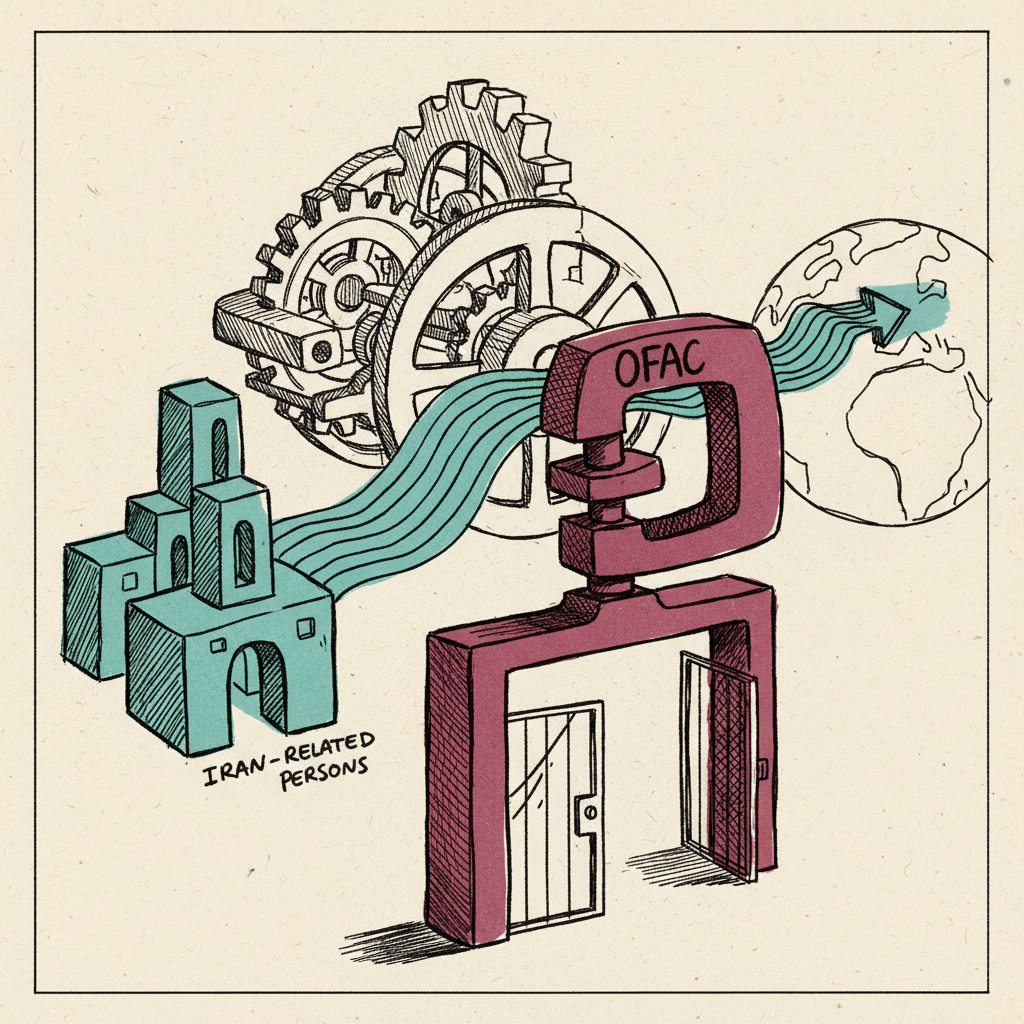
What does General Licence W's wind-down window reveal about OFAC's next enforcement target?
Timeline for General License W
Mentioned in: OFAC cuts the Iranian-oil waiver short
European Oil MarketsMentioned in: US and Iran halt fire, sign nothing
Iran Conflict 2026Mentioned in: Bessent locks Iran's funds in Qatar
Iran Conflict 2026Iran's oil outpaces the frozen deal
Iran Conflict 2026Extended the Sakhalin-2 energy services authorisation for Japan as a standalone Russia-programme licence
European Oil Markets: OFAC rolls the gas, not the crudeBackground
A general licence (GL) is a standing OFAC authorisation that permits categories of transactions otherwise prohibited under a sanctions programme, without requiring a specific case-by-case licence. Wind-down general licences are the standard tool for managing the transition when new entities are added to the Specially Designated Nationals (SDN) list: they give counterparties a time-limited window to unwind contracts, close positions, and exit relationships without violating sanctions. General licences are issued under the authority of underlying executive orders; they create no new policy and can be revoked at any time.
General Licence W was issued by OFAC on 1 May 2026 as part of the sixth Iran-related enforcement package of the 2026 war, pursuant to Executive Order 13902 (Iran additional sectors, January 2020) and Executive Order 13224 (counterterrorism, September 2001). The same package designated three Iranian foreign exchange houses and the Panama-flagged tanker NEW FUSION to the SDN list, and published a sanctions alert naming the Iranian Red Crescent Society, Bonyad Mostazafan, and Iranian embassy accounts as prohibited Hormuz toll payment channels.
GL-W sits within OFAC's Iran-crude waiver architecture as a wind-down instrument in a lengthening succession. GL-U, which authorised Iranian crude in transit, was issued on 20 March 2026 and subsequently lapsed. GL-V was then published on 10 June 2026 as GL-U's successor, extending the waiver architecture to cover the next tranche of blocked persons and transactions. GL-W itself addresses the 1 May additions specifically. Running alongside the Iran track is the parallel Russia waiver architecture: GL 134C governs the Russia in-transit cover strand, operating under separate authority but within the same OFAC enforcement framework that shapes compliant-tanker availability for both Iran-linked and Russia-linked cargoes. Treasury Secretary Scott Bessent framed the package as part of a campaign to "relentlessly target the regime's ability to generate, move, and repatriate funds". Compliance officers at correspondent banks treat each new GL as both an authorisation and a signal of what OFAC considers the next enforcement frontier.