Skip to content
You can now search across every topic, entity and event.What's new
Iran Conflict 2026
17JUN

Trump declares Iran deal, signs nothing

4 min read
09:37UTC

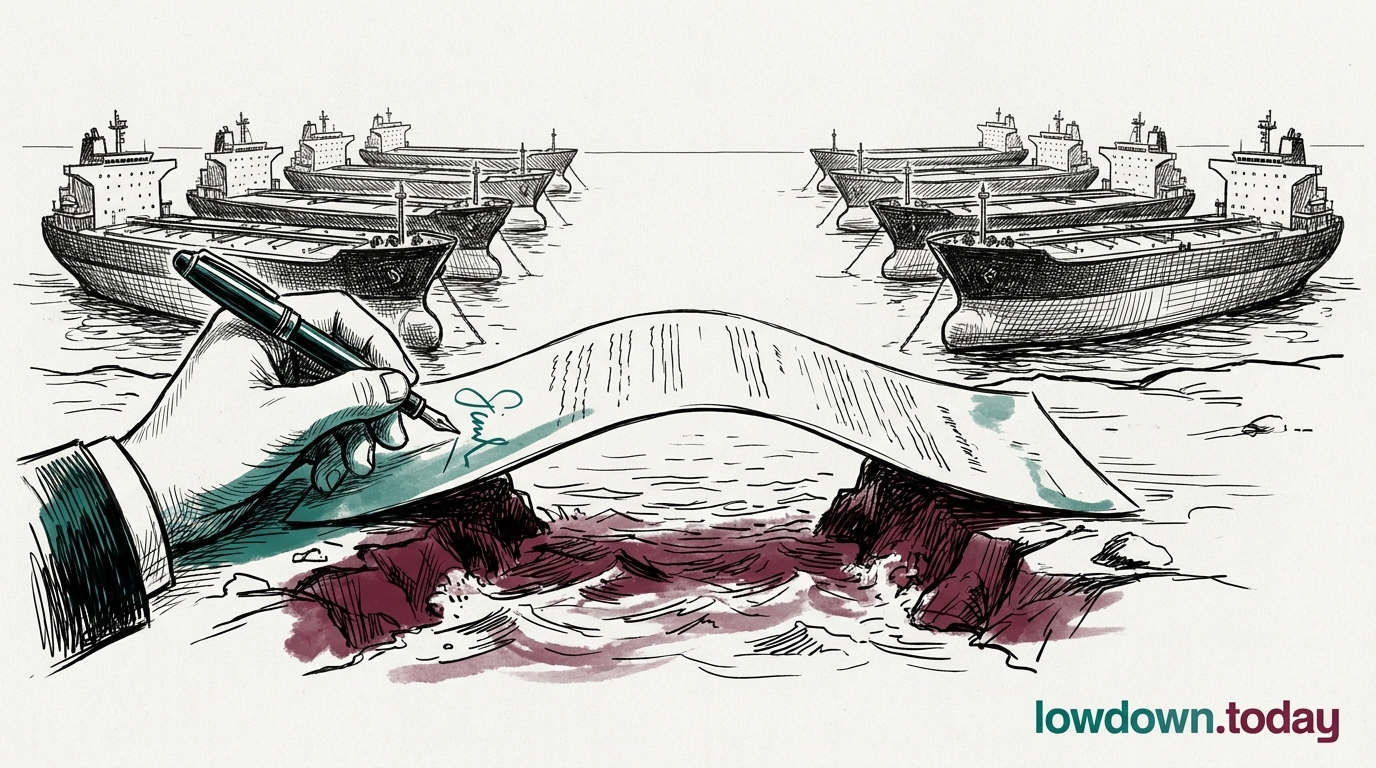
Trump posted on Saturday 23 May that the Iran war deal was 'largely negotiated' and Hormuz 'will be opened'; the only paper the White House signed all weekend was a Memorial Day proclamation.

ConflictDeveloping
Key takeaway

Trump declared the war nearly settled, yet signed no Iran instrument and published no text.

Donald Trump posted on Truth Social on Saturday 23 May that a deal to end the Iran war had been "largely negotiated" between the United States, the Islamic Republic of Iran and other listed countries, adding that the strait of Hormuz "will be opened" 1. the strait is the 33-kilometre chokepoint between Iran and Oman through which roughly a fifth of the world's seaborne oil passes; Iran's blockade of it has driven this war since late February. It is the most consequential thing Trump has said about Iran in 86 days of fighting. He signed nothing.

The only presidential instrument The White House published across the 22 to 24 May window was a Memorial Day proclamation 2. No Iran order, no sanctions action, no Hormuz text. The verbal track that has carried this war since 28 February reached its loudest moment on a weekend that produced zero signed Iran paper , extending the streak that ran unbroken through the prior week's two non-Iran financial orders .

On Sunday 24 May, Axios reported the shape of what had been agreed 3. It is a 60-day Memorandum of Understanding (MoU), extendable by consent, not a treaty. During those 60 days Hormuz reopens toll-free, Iran clears its mines, the US lifts the naval blockade and issues waivers letting Tehran sell oil, while US forces stay in the region and withdraw only if a final deal follows. The draft rests on Iran's 14-point document and was approved on the Iranian side by Speaker Mohammad Bagher Ghalibaf, and on the US side by JD Vance, Steve Witkoff and Jared Kushner 4. Marco Rubio, speaking in New Delhi, repeated the American conditions: no weapon, Hormuz open without tolls, uranium handed over 5.

the MOU text has not been published. The sequence front-loads the reversible concessions, blockade lift and oil waivers, and defers the one irreversible commitment, the uranium, to a later negotiation. That ordering lets Tehran collect sanctions and shipping relief across the 60 days while never binding itself to surrender the stockpile.


Deep Analysis

In plain English

On Saturday 23 May, US President Donald Trump posted on his social media platform Truth Social saying a deal to end the Iran war had been 'largely negotiated'. The next day, the news outlet Axios reported the shape of that deal: a 60-day temporary agreement (called a memorandum of understanding, or MOU) under which Iran would reopen the Strait of Hormuz (the critical sea passage through which about 20% of the world's oil flows), clear its naval mines from the waterway, and negotiate a pause on its nuclear programme. In exchange, the US would lift its naval blockade and issue waivers on some oil sanctions. The agreement would be approved on Iran's side by the Speaker of Iran's parliament, and on the US side by Vice President JD Vance and two presidential advisers. The catch: none of this has been formally signed. Trump made similar verbal deal announcements at least four times before this one, and Iran denied or contradicted each of them within hours. The MOU text was not published as of Sunday 24 May, leaving it as a reported verbal agreement rather than a binding document.

Deep Analysis
Root Causes

Trump's preference for verbal deal-making over signed instruments is a structural feature of his administration, not a tactical choice. The White House presidential-actions index recorded zero signed Iran instruments across 80 days of war before this declaration.

Truth Social posts function as policy statements in this administration because the executive can claim they represent presidential intent without triggering congressional notification requirements that a formal executive order or treaty would impose.

The Iranian side's use of Ghalibaf rather than Pezeshkian or Araghchi reflects a parallel constraint: the Majlis and IRGC institutional bloc must be included in any deal architecture, or hardliners can torpedo implementation. Ghalibaf bridges that bloc. But his approval is not the same as Khamenei's, and the Supreme Leader's uranium-stay directive three days earlier sits in direct tension with the MOU's enrichment-suspension commitment.

Escalation

Marginally de-escalatory on the military track but no change on the nuclear track. The MOU framework, if it holds, pauses kinetic activity and begins a Hormuz reopening. But Khamenei's uranium directive three days earlier means the nuclear gap has widened since the deal's reported terms were agreed. The deal declaration itself creates a new risk: if negotiations fail publicly, the reversion to conflict may be sharper than if no deal had been announced.

What could happen next?
  • Risk

    A failed public deal announcement carries greater escalation risk than no announcement, because domestic audiences on both sides will have raised expectations to manage.

    Short term · Assessed
  • Opportunity

    If the 60-day MOU holds through formal signing, it creates the first institutional anchor for a permanent settlement and removes the immediate military pressure on Hormuz.

    Medium term · Suggested
  • Precedent

    Ghalibaf's parliamentary approval of an MOU, if accepted by all parties, establishes that Iran's Majlis can bind the executive on foreign policy — a constitutional precedent with long-term implications for Iranian governance.

    Long term · Suggested
First Reported In

Update #106 · Trump says deal; OFAC says nothing

NBC News· 24 May 2026
Read original
Causes and effects
This Event
Trump declares Iran deal, signs nothing
The loudest verbal move of an 86-day war landed on a weekend that produced no signed Iran instrument of any kind.
Different Perspectives
Lloyd's Market Association
War-risk underwriters price the Houthis' Red Sea attacks because the group announces its targets in advance, but the unclaimed Damietta drone gives insurers a hit with no author to price against. An attack nobody claims costs shipping more than one that is claimed, since premiums are set against a known pattern, not raw damage.
US Central Command
US Central Command
CENTCOM has announced no strike on Iran since resuming bombing on 30 July within hours of an IRGC salvo on Jordan, and centcom.mil did not respond to requests to confirm any pause. The command has gone quiet before while a larger operation was being weighed, so silence alone proves nothing about what it has or has not done.
Hengaw
Hengaw
Hengaw recorded at least 67 executions in Iran during July, of which the state acknowledged only eight, and reported the 1 August execution of protest detainee Arvin Kheirkhahan at Shahrud with no advance notice to his family. A family's first notice of a death sentence is now usually the instruction to collect a body.
Egypt
Egypt
Egypt's government asked media on 2 August to report the Damietta attack accurately, named no author, and said no findings will be published before its own investigation concludes. Cairo holds the debris and jurisdiction over an attack on its own soil, and naming a culprit now would pull it into a dispute it has avoided for five months.
Iran's Foreign Ministry
Araghchi called the Hormuz talks with Oman final-stage on 2 August, four days after his own deputy rejected Oman's lane proposal, and denied the Damietta drone strike as an Israeli false flag while two Iranian officials privately claimed it for Tehran. Iran's public position now contradicts itself on both files at once.
Bahrain and Kuwait
Bahrain and Kuwait
Bahraini and Kuwaiti aircraft flew their own strikes on Iranian depots in July with Emirati air cover behind them, and Ynetnews reports some Gulf capitals wanted the 2 August strike to proceed rather than stop. States that have already taken fire see a closing window on Iranian weakness, not a reason to pause.



