Skip to content
You can now search across every topic, entity and event.What's new
Iran Conflict 2026
13JUN

Trump touts a deal he cannot sign

3 min read
10:52UTC

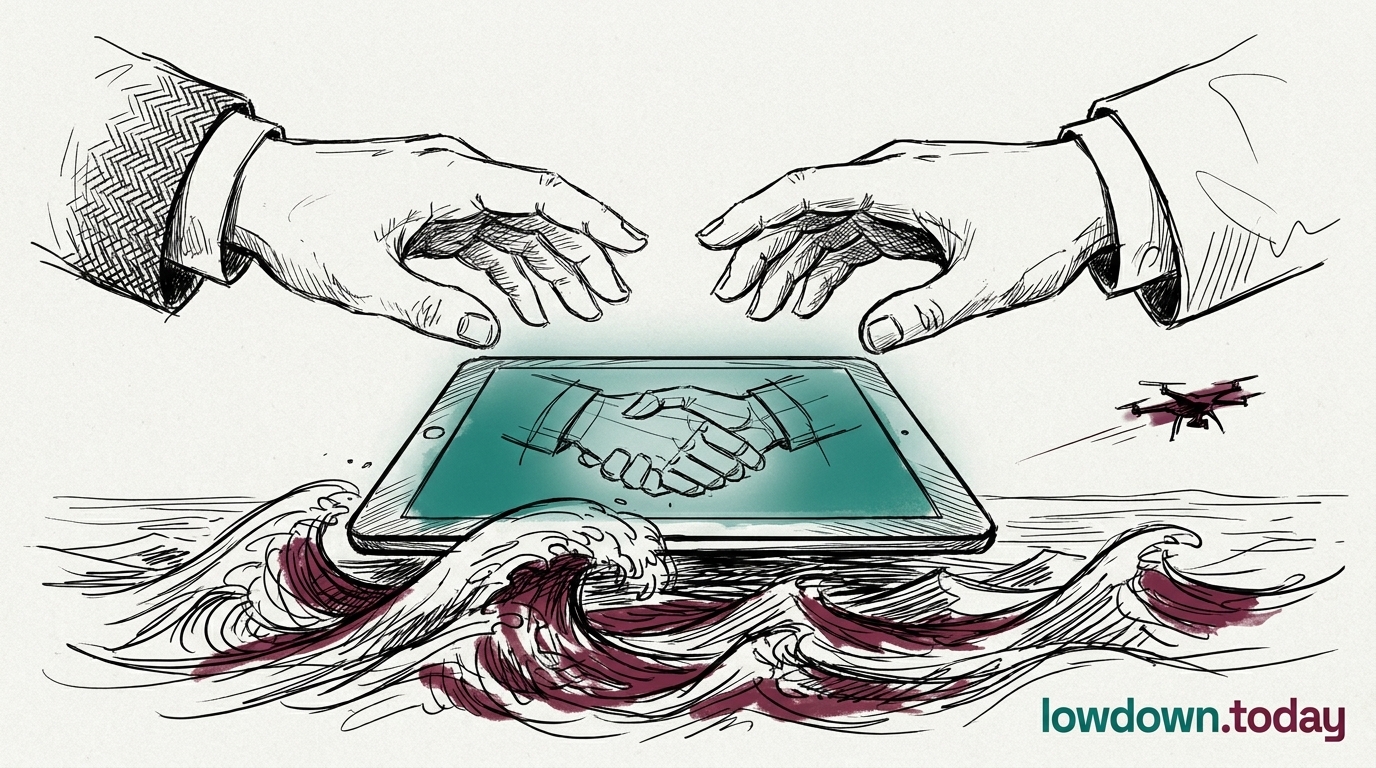
Donald Trump said on 9 June that an Iran deal was in 'the final throes' and could be signed 'in two or three days', and credited the US naval blockade as 'much stronger than bombing'. Neither claim rests on a signed instrument.

ConflictDeveloping
Key takeaway

Trump promised a deal in days and praised an unsigned blockade, neither backed by a signature.

Donald Trump said on Tuesday 9 June that an Iran deal was in "the final throes", that the Strait of Hormuz would reopen "immediately upon signing, which could be in two or three days", and that the US naval blockade had "turned out to be much stronger than bombing" 1. the strait of Hormuz is the Persian Gulf chokepoint through which roughly a fifth of the world's seaborne oil passes.

The line about the blockade matters more than the timeline. CENTCOM (US Central Command, the Pentagon's Middle East command) runs that blockade on a written military order, not a presidential instrument, and it has redirected 127 vessels and disabled six without an executive signature behind it . On Tuesday Trump elevated that unsigned mechanism above kinetic force in public for the first time, even as the one ally executing kinetic force ignored him.

Trump has floated near-term deals before, telling reporters on 4 June a deal could close "this weekend" before his own Secretary of State, Marco Rubio, said on 7-8 June that enrichment matters could take months . For 102 days his words pointed at Tehran. This week the harder words pointed at Israel instead, while the deal stayed a promise rather than a document.

Tehran negotiates through written positions and general-officer shuttles, channels that respond to signed paper, not to interview cadence. A blockade Trump now calls war-winning and a deal he says is days away both rest on the same absence: no signature that would force the War Powers clock or bind either side to terms.

Deep Analysis

In plain English

Since late February, the US Navy has been blocking the Strait of Hormuz, the 33-kilometre chokepoint through which most Gulf oil exports pass. Trump is now publicly saying this blockade has worked better than the earlier bombing campaign, and that an agreement with Iran could be signed within days. The problem is that Iran's government communicates with Washington only through written messages that take three to five days to travel through middlemen. So when Trump says a deal is nearly done, he may be talking about a conversation where the last message from the other side arrived days ago. Financial markets have already priced in 'nearly done' twice this year and reversed both times when nothing was signed.

Deep Analysis
Root Causes

Trump's 'final throes' claim reflects a structural asymmetry in the negotiation: Iran communicates only in writing through intermediaries with a 3-to-5-day courier lag (confirmed by Rubio on 2 June), meaning Trump receives no real-time feedback on whether Tehran accepts the terms he publicly endorses. In that information vacuum, his public statements function as aspirational pressure rather than confirmed progress.

The blockade's effectiveness claim is grounded in real data , CENTCOM reached 127 redirected vessels with six disabled by 2 June , but Trump's framing elides the fact that the blockade operates without a signed presidential instrument, which means it exists in a legal grey zone that any future administration could end by executive order. Crediting it as the decisive weapon before a deal is signed risks creating a removal cost that constrains whatever agreement follows.

What could happen next?
  • Risk

    A third 'deal within days' claim that produces no signature will accelerate market scepticism of any future announcement, potentially delaying the economic relief a genuine deal would provide.

  • Consequence

    Iran's negotiators will read Trump's public credit to the blockade as confirmation that Washington values it as an end-state rather than a transition instrument , which hardens Tehran's demand for full sanctions relief before any reopening.

First Reported In

Update #122 · Trump warns Bibi as Israel strikes anyway

Al Jazeera· 9 Jun 2026
Read original
Causes and effects
This Event
Trump touts a deal he cannot sign
Trump elevated an unsigned military blockade above kinetic force in public for the first time, even as the deal he promised carried no presidential signature.
Different Perspectives
Iran's Supreme Leader's office and Iranian households
A letter published through state media named Lebanon's territorial integrity and an end to Israeli operations there as the war's ending condition; the same week, spokesperson Mohajerani cut the subsidised petrol ration from 70 to 50 litres a month. Iranian agencies still disagree on who inside the office signed the letter.
Oman
Oman
Muscat proposed a voluntary-funded coalition to police Hormuz, the corridor its own coastline gives it standing to manage, while Iran wants control and toll rights over shipping and Washington insists on free navigation. Oman's remit stops at the strait; it has no comparable claim over Iraq, the Caspian, or Lebanon.
Kyiv
Kyiv
President Volodymyr Zelenskyy confirmed the Caspian strike on an Iranian vessel carrying military cargo from Russia's Astrakhan region, opening a front that ties Iran's war to its supply relationship with Moscow rather than to anything the Gulf mediators are discussing.
Riyadh
Riyadh
Maj Gen Turki Al Malki named Iraq as the launch point for drones intercepted over the Eastern Province and Riyadh, the first time this war has reached Saudi Arabia from that direction rather than from Yemen. Nothing landed, but a second launch geography aimed at Saudi oil now exists alongside the Houthi front.
Baghdad
Baghdad
Iraq's Foreign Ministry summoned its own ambassador in Riyadh after Saudi Arabia's Defence Ministry said the drones came from Iraqi territory, while the same day drones struck Iranian-Kurdish opposition camps inside Iraq. Baghdad is disowning attacks it did not launch from territory it does not fully control.
The Pentagon and Congress
Acting press secretary Joel Valdez attributed the toll's reversal to site anomalies, the same explanation the department gave for the opposite cut on 24 July; Representative Thomas Massie called the category change an absurd ruse designed to reset the war's legal clock. Neither side agrees on which explanation, or which war, is real.