Skip to content
Foundations rebuilt, and the first new thing is here: search across every topic, entity, and event.Try search
Iran Conflict 2026
11JUN

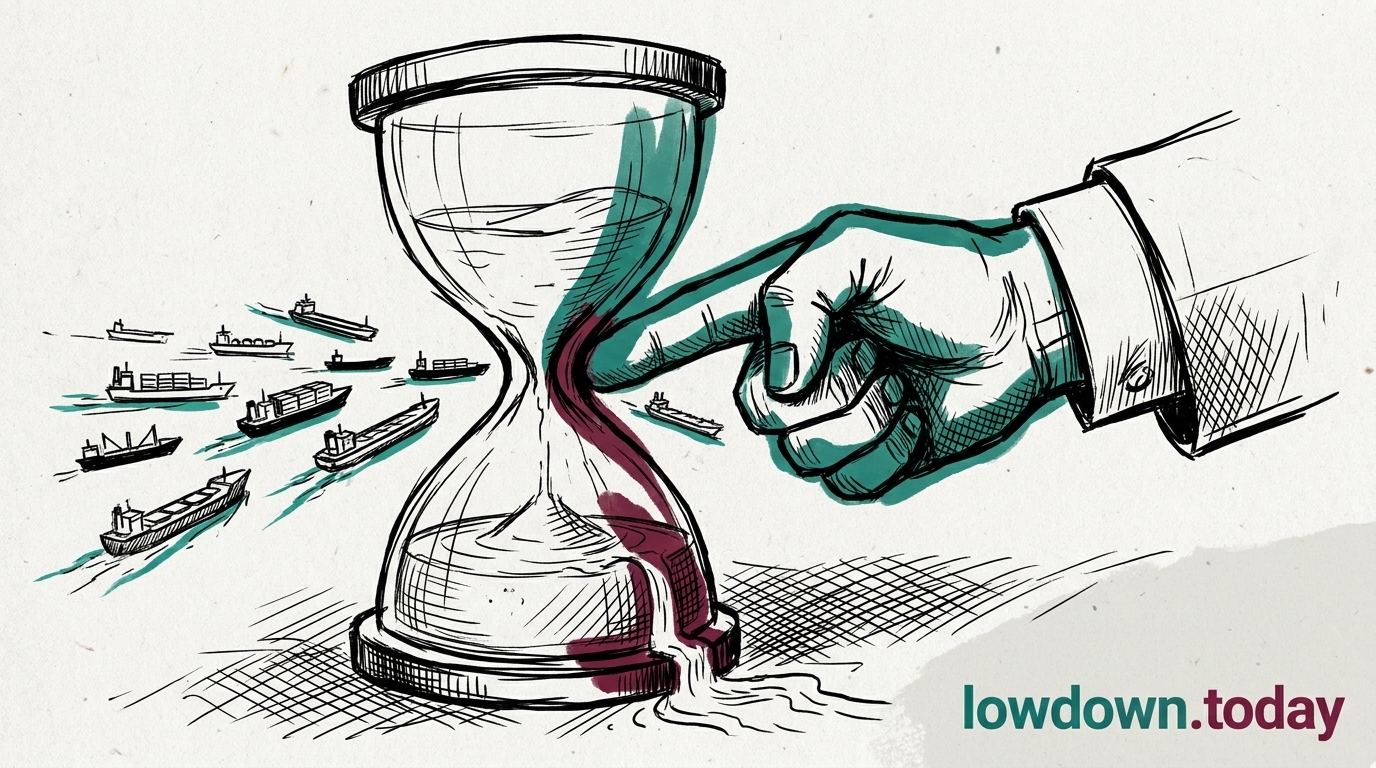
Three days to the Hengli cliff

4 min read
09:17UTC

OFAC General Licence V on Hengli expires end of Sunday 24 May; from Monday, any dollar payment to China's second-largest independent refinery costs the clearing bank its US access.

ConflictDeveloping
Key takeaway

Sunday 24 May is the first hard-dated OFAC-MOFCOM enforcement moment of the Iran war.

OFAC (the Office of Foreign Assets Control, the US Treasury bureau that administers sanctions) issued General Licence V on 24 April 2026 alongside the SDN designation of Hengli Petrochemical (Dalian) Refinery Co., Ltd., authorising a 30-day wind-down of US-person and US-dollar transactions with the refinery. That clock runs out at the end of Sunday 24 May. From Monday, any non-US bank that processes a single Hengli dollar payment becomes exposed to secondary sanctions and loses its US correspondent access.

Hengli is China's second-largest independent refinery and the first mainland Chinese refinery OFAC has designated; earlier rounds carefully avoided mainland targets and routed designations through Hong Kong, UAE and Marshall Islands shells . MOFCOM (China's Ministry of Commerce) closed the legal gap on 2 May with Announcement No. 21, directing Hengli and four sister refineries (Luqing, Jincheng, Xinhai, Shengxing) to disregard the US sanctions under China's 2021 Blocking Rules. MOFCOM and OFAC now collide on the same dollar wire from Monday morning.

Hengli Petroleum, the refinery's Singapore trading arm, has begun laying off staff in anticipation of the shutdown, Manifold Times reported 1. The corporate-level retreat sits oddly against Beijing's posture: Iran's appointment of a new ambassador to Beijing on 18 May was briefed as 'unprecedented' commitment to the China relationship , and MOFCOM's blocking statute is engineered for exactly this enforcement moment. Hengli Petroleum Singapore began layoffs at the trading desk on 20 May regardless.

The nearest precedent is OFAC's April 2018 designation of Rusal, Russia's largest aluminium producer. Aluminium prices spiked roughly 35 per cent in three weeks; Glencore and other counterparties unwound positions within days; the sanctions forced the removal of Oleg Deripaska's controlling stake before the wind-down expired. The transmission mechanism was dollar clearing, not trade flows, which is why the Singapore layoffs are the operational tell. General Licence V is the only Iran-touching US instrument with a working clock; every other lever, from the unfiled Murkowski AUMF to the oral Pentagon order, runs on Trump's verbal track . OFAC's wind-down clock cannot be postponed by a Truth Social post.

Deep Analysis

In plain English

When the US government punishes a foreign company for buying Iranian oil, it issues a 'designation' banning American banks from handling any money going to that company. Normally there is a 30-day grace period to wind down existing deals. That grace period for Hengli, a giant Chinese oil refinery in Dalian, runs out on Sunday 24 May. After Sunday, any bank that processes a dollar payment connected to Hengli can be cut off from the US financial system. That matters because most international payments, even between non-American companies, still travel through US-linked banks. China's government told Hengli to ignore the US order. The difficulty is that Hengli's trading office in Singapore handles international payments in a jurisdiction that cannot use China's legal shield against US enforcement.

Deep Analysis
Root Causes

OFAC's path to Hengli runs through a structural gap in the MOFCOM blocking order: Announcement No. 21 directs Chinese entities not to comply, but it cannot immunise the dollar-clearing layer. Hengli's Singapore trading arm operates in a jurisdiction that does not recognise China's blocking statute as a defence against US regulatory action.

China's de-dollarisation project remains incomplete at the clearing-bank layer. Beijing has built yuan-denominated crude pricing at the Shanghai International Energy Exchange since 2018, but 80% of global oil trade still prices and clears in dollars. Hengli's exposure exists precisely because China's oil-import infrastructure has not yet migrated to yuan settlement at the clearing-bank layer. MOFCOM's order arrived before the infrastructure it needs to function.

What could happen next?
  • Risk

    Chinese banks with US correspondent relationships face a binary after 24 May: refuse Hengli dollar settlement and breach MOFCOM's blocking order, or process it and trigger OFAC secondary sanctions. Either path creates legal exposure in at least one jurisdiction.

    Immediate · Assessed
  • Precedent

    Hengli is the first mainland Chinese refinery to face a hard OFAC deadline. If enforcement holds without a negotiated carve-out, it establishes that the secondary-sanctions mechanism can target MOFCOM-shielded entities, changing the risk calculus for all five refineries named in Announcement No. 21.

    Short term · Reported
  • Consequence

    Hengli's removal from the Iranian crude-buyer pool tightens an already-constrained sanctioned-oil market, compounding the IEA's 246-million-barrel inventory draw recorded across March and April 2026.

    Short term · Reported
  • Risk

    Beijing may escalate retaliatory trade measures against US firms in China if OFAC enforcement is seen to override MOFCOM's sovereign blocking order without diplomatic resolution.

    Medium term · Suggested
First Reported In

Update #104 · Three days to Hengli

Manifold Times· 21 May 2026
Read original
Different Perspectives
Oil markets / Lloyd's underwriters
Futures markets priced CENTCOM's strikes-complete statement as a de-escalation signal and pushed Brent down 1.7 per cent to $94.71, even as the IRGC declared Hormuz closed. Lloyd's war-risk premiums held elevated because institutional de-listing requires a UN Security Council resolution that Russia and China have just shown they will block.
Pakistan (mediator)
Pakistan (mediator)
Interior minister Mohsin Naqvi carried dual civilian and military letters to Mojtaba Khamenei in Tehran on 6-7 June with no public response. The IRGC's Hormuz closure on 11 June shows the corps is acting independently of the channel Pakistan is using, making the mediation structurally unable to produce a binding commitment without direct IRGC access.
Russia and China
Russia and China
Russia and China voted against GOV/2026/40 at the IAEA Board, following through on the blocking position coordinated with Grossi in Geneva on 5 June; both states continue to oppose Western institutional pressure on Iran at every multilateral venue.
E3 and IAEA (UK, France, Germany)
The E3 co-sponsored IAEA resolution GOV/2026/40, adopted 21-3-10 on 10 June, demanding Iran disclose 440.9 kg of unaccounted HEU and admit inspectors to four denied facilities. The 10 abstentions and Russia-China noes leave any Security Council referral without a viable enforcement path.
IRGC / Iran military command
The corps declared Hormuz closed to all traffic on 11 June and claimed two vessels struck, overriding the MoU its own civilian negotiators were pursuing through Pakistan. The closure order used the Persian Gulf Strait Authority apparatus to convert a toll mechanism into a military prohibition.
Trump administration / CENTCOM
CENTCOM completed a second day of strikes on Tehran, Sirik and Minab, rejected the IRGC Hormuz closure as inconsistent with observed transit, and said strikes were complete. Hegseth framed the bombing explicitly as the negotiation: the method is coercive deal-making with no stated pause threshold.