Skip to content
Briefings are running a touch slower this week while we rebuild the foundations.See roadmap
Iran Conflict 2026
1JUN

Five April Deadlines Box In the White House

3 min read
08:32UTC

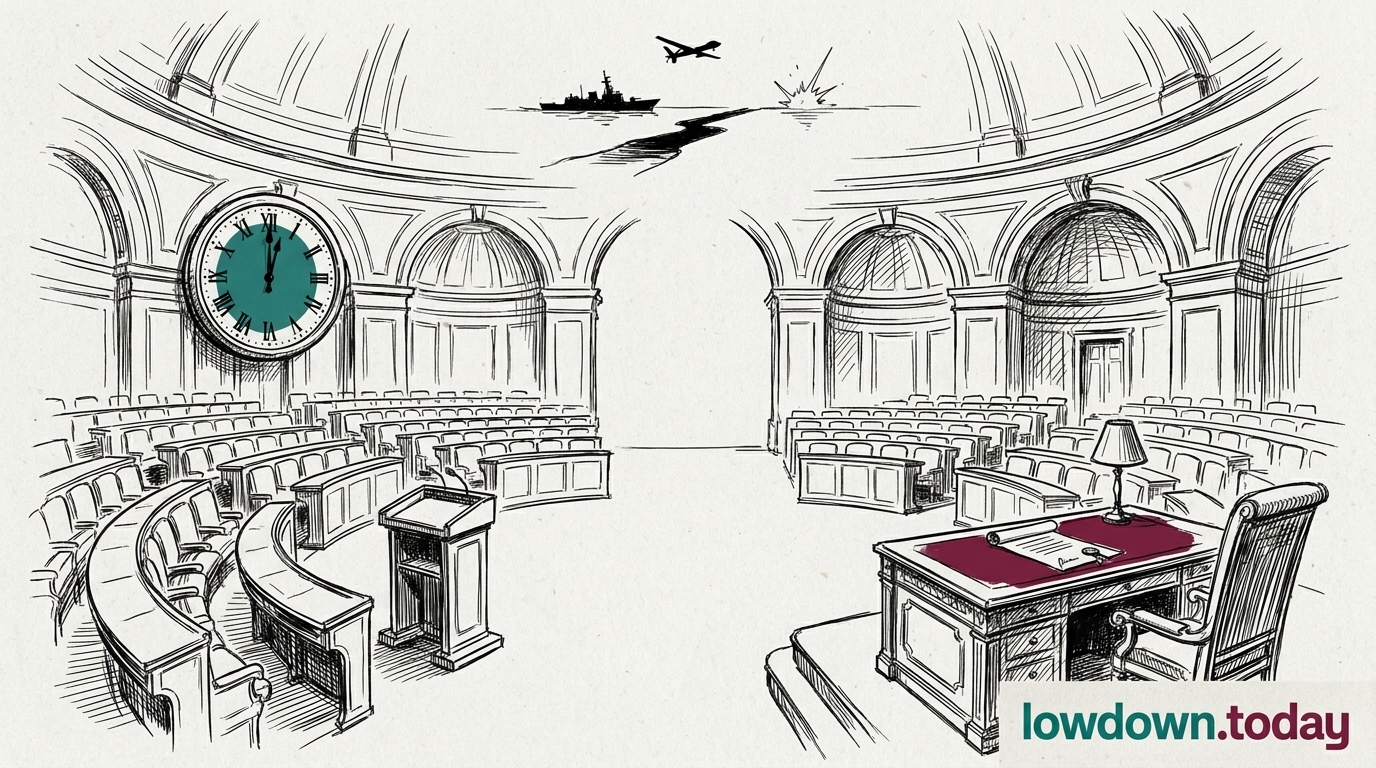
Five legal and political deadlines converge within a 10-day April window: General License U expires 19 April, Congress returns mid-month, the War Powers Resolution clock nears its threshold on 29 April, and the 6 April power grid deadline expires with no extension announced. Brent crude rose 6.6 per cent to $107.80.

ConflictAssessed
Key takeaway

Five April deadlines compound into a 10-day legislative and legal corridor no party has mapped as a connected sequence.

Brent Crude rose 6.6 per cent to $107.80 on 3 April, according to Reuters and Bloomberg. March's gain of roughly 55 per cent is the largest monthly increase since Brent's inception in 1988. Iraqi oil exports via the Ceyhan pipeline dropped 43 per cent from 236,000 to 135,000 barrels per day, an independent supply shock unrelated to Hormuz. QatarEnergy halted downstream urea production; urea now trades at roughly $700 per metric tonne, up from $400-490 before the war .

The economic pressure is inseparable from the legal corridor now narrowing. General License U (GL-U), issued by US Treasury , expires 19 April, removing the legal basis for 128 million barrels of Iranian crude currently in transit. Congress returns from recess mid-April. The War Powers Resolution 60-day clock, which started around 28 February, reaches its threshold near 29 April. The 6 April power grid deadline is expiring with no extension yet announced.

Prior extensions came 2-3 days in advance. Trump declared the nuclear goal attained on 1 April . Iran's same-day IAEA suspension vote, and three previous deadline extensions, show neither side has the domestic political room to accept the other's framing. The 6 April expiry could be extended a fourth time, enforced with power grid strikes, or allowed to lapse without comment. Allowing it to lapse would erode the deadline mechanism entirely.

Pezeshkian published an open letter to the American public on 1 April asking whose interests are served by continued war. Axios reported US-Iran indirect talks continue through Pakistan after the Kharazi strike , citing three US officials. The diplomatic and legal tracks are running in parallel with an escalating military one. April's convergence is when those tracks intersect in ways that constrain all parties simultaneously.


Deep Analysis

In plain English

Five different legal and political deadlines all hit within ten days in April. One involves a special licence that lets ships legally carry Iranian oil; if that licence expires, $13.8 billion worth of oil at sea suddenly has no legal buyer. Another involves a law that gives Congress the power to tell the president to stop a war after 60 days. None of these individually would stop the conflict, but together they box in the administration's freedom to act.

Deep Analysis
Root Causes

The convergence of five deadlines in ten days is structurally novel even if each individual mechanism is precedented. GL-U is the most significant: it is a Treasury instrument, not a congressional one, which means its lapse is automatic unless OFAC acts. Congress cannot force the administration to renew GL-U, but it can create significant market disruption if GL-U lapses while Congress is debating WPR and the 6 April deadline has just expired.

The 128 million barrels in transit covered by GL-U represent roughly $13.8 billion in oil at current prices. A sudden legal vacuum around those barrels creates a financial system disruption that has no precedent in wartime sanctions management.

Escalation

Escalatory risk is concentrated in the 13-19 April window (GL-U), with a secondary peak around 29 April (WPR). The administration has more freedom of action on WPR (veto) than on GL-U (automatic lapse). If GL-U lapses without a replacement instrument, it will trigger the most significant financial disruption of the conflict to date and may force a rapid de-escalation regardless of battlefield conditions.

What could happen next?
2 risk1 consequence1 meaning1 opportunity
  • Risk

    GL-U lapse on 19 April without replacement creates a $13.8 billion legal vacuum in transit oil with no precedent in wartime sanctions management; financial system disruption is immediate.

    Short term · High
  • Consequence

    Urea at $700/mt will translate into higher wheat and corn production costs within one growing season, affecting grocery prices in Europe and the developing world by Q3 2026.

    Medium term · High
  • Meaning

    The five converging deadlines create a legislative and financial corridor that constrains the administration in ways the battlefield does not; no single actor in Washington has mapped them as a connected sequence.

    Immediate · High
  • Risk

    The WPR 60-day threshold near 29 April gives a bipartisan minority the legal basis to force a floor vote; whether the votes exist to pass it depends on the battlefield picture in the intervening three weeks.

    Short term · Medium
  • Opportunity

    The GL-U mechanism creates negotiating leverage the administration can deploy: extending GL-U for 30 days as a signal of willingness to de-escalate, without formal ceasefire commitment.

    Short term · Medium
First Reported In

Update #57 · Bridge strike kills eight; Army chief fired

Reuters / Bloomberg· 3 Apr 2026
Read original
Different Perspectives
Human rights monitors (Hengaw, Amnesty International, Iran HRM)
Monitors documented a second death sentence for Zahra Tabari, 68, reported cemetery record deletions at Behesht-e Zahra, and a poll showing 81.5% of medical residents want to emigrate, against a background of 200+ confirmed executions since February. Iran's security courts operate at uninterrupted wartime tempo regardless of the diplomatic track.
Pakistan (mediator)
Pakistan (mediator)
Islamabad carried Trump's revised MOU demanding HEU destruction to Iranian negotiators, formally inheriting the role of sole active mediator after Oman's forced withdrawal. Pakistan lacks Oman's banking infrastructure for frozen-asset routing and carries its own regional stakes, making it a less structurally neutral broker.
Kuwait
Kuwait
Kuwait intercepted Iranian missiles and drones for a second time in days on 1 June, with air-raid sirens sounding nationwide, after invoking Article 51 self-defence on 28 May following the Ali Al Salem ballistic-missile strike. The repeated interceptions test whether Kuwait's domestic politics can sustain hosting US forces as a de facto co-belligerent.
China (PRC)
China (PRC)
Beijing sent scholars to Shangri-La rather than its defence minister and addressed Taiwan without mentioning Iran, maintaining bilateral energy corridor protection with Tehran while refusing diplomatic exposure at multilateral forums. Trump barred China as an HEU custodian on 27 May, removing Beijing from the deal architecture while China continues supplying DPI hardware that caps Iran's internet.
Lloyd's of London / war-risk underwriters
Lloyd's held its Hormuz war-risk designation at $10-14 million per voyage while Brent recovered to $93.91, maintaining the structural divergence from futures pricing that has persisted since late May. Underwriters require a UN Security Council resolution or government certification letter, not diplomatic optimism.
Gulf Cooperation Council states (Saudi Arabia, UAE, Bahrain, Qatar)
Five Gulf states wrote to the IMO on 21 May rejecting Iran's PGSA transit authority over international waters; Saudi Arabia and the UAE have not confirmed participation in the European Hormuz mission. The GCC is navigating between US security guarantees and exposure to Iranian fire, with no Gulf state formally co-belligerent except Kuwait.



