Skip to content
You can now search across every topic, entity and event.What's new
Iran Conflict 2026
2APR

Strike on Kharazi Kills the Back-Channel

2 min read
08:35UTC

The one man coordinating Iran's only functioning diplomatic channel to Washington was critically wounded at his Tehran home. His wife was killed.

ConflictDeveloping
Key takeaway

The war's last diplomatic exit closed on the evening its architect declared victory.

Kamal Kharazi, head of Iran's Strategic Council on Foreign Relations and former foreign minister (1997-2005), was struck at his Tehran home on 1 April. His wife was killed. Two unnamed Iranian officials told the New York Times that Kharazi was personally overseeing engagement with Pakistan for a possible meeting between Iranian officials and US Vice President JD Vance 1.

The strike landed the same evening Trump delivered an Oval Office address declaring the war's core strategic objectives nearing completion . In practice, the speech provided the backdrop to the destruction of the mechanism Trump's own administration needed. The Pakistan channel had been the sole pathway with any prospect of progress. Iran rejected the US 15-point plan as 'maximalist' weeks ago. Its five counter-conditions share nothing with Washington's terms. Araghchi declared six months of war readiness on 1 April .

With Kharazi incapacitated, the Pakistani intermediary role is intact but its Iranian counterpart is gone. Kharazi was uniquely positioned: a former FM with institutional credibility in Tehran, personal relationships with Pakistani officials from the JCPOA era, and willingness to engage publicly in English. Replacing that combination of access, trust, and linguistic reach during wartime is not a personnel problem. It is a structural impossibility on any timeline relevant to the 6 April deadline.

Iran's drones struck Kuwait International Airport fuel tanks and a QatarEnergy tanker in Qatari waters while Trump spoke. The war did not pause for the speech.

Deep Analysis

In plain English

Kamal Kharazi was Iran's back-channel diplomat. While Iran's Foreign Ministry was publicly saying there were no talks, Kharazi was quietly working through Pakistan to arrange a meeting between Iranian officials and US Vice President Vance. He has now been critically wounded in an airstrike and his wife killed. There is nobody left who was doing that job. Finding a replacement during an active war, with a deadline four days away, is not a realistic prospect.

Deep Analysis
Root Causes

The strike reflects a broader Israeli targeting doctrine that prioritises disrupting any diplomatic pathway that might produce a ceasefire before Iran's nuclear programme is permanently dismantled. Israel has struck Iranian diplomatic infrastructure repeatedly: Ali Larijani, SNSC secretary and chief nuclear negotiator, was killed in March. Kharazi's role was similar in function: he represented the back-channel that would allow Iran to exit the war without a formal nuclear concession.

The structural cause is the divergence between US and Israeli war objectives. The US wants Hormuz reopened; Israel wants Iran's nuclear capability permanently eliminated. A Pakistani-mediated deal that produces Hormuz reopening without nuclear resolution satisfies the US and defeats the Israeli objective. Removing the diplomat who could close that deal serves one party's interest at the other's expense.

Escalation

Removing the diplomatic interlocutor while the military option faces a minesweeping gap leaves only two paths: escalation or indefinite stalemate. The 6 April deadline arrives with no mechanism for compliance. A fourth extension without a functioning channel is formally meaningless; Iran has no counterparty to notify.

What could happen next?
  • Consequence

    The 6 April power grid deadline produces either strikes or a fourth extension, with no diplomatic cover for either choice.

    Immediate · 0.82
  • Risk

    Iran's hardliner faction uses the Kharazi strike as evidence that engagement leads to assassination, foreclosing future back-channels for years.

    Medium term · 0.71
  • Precedent

    Striking an active diplomatic intermediary during ceasefire negotiations violates customary protections for diplomatic personnel under VCDR Article 22 analogues.

    Long term · 0.65
First Reported In

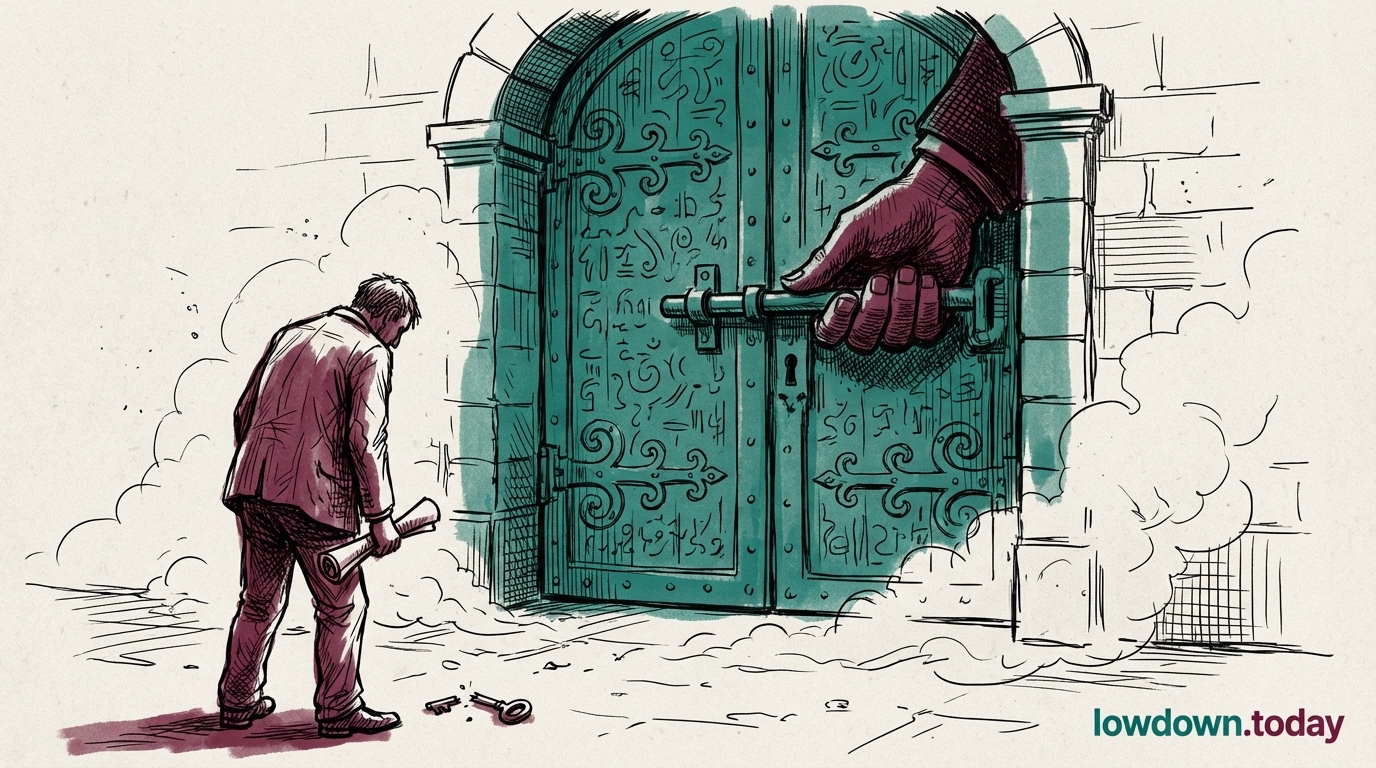
Update #55 · The Last Door Closes

Al-Arabiya (AFP wire)· 2 Apr 2026
Read original
Different Perspectives
India
India
New Delhi has a national unaccounted for among GFS Galaxy's eleven-strong Indian crew, turning a standoff over transit rights into a consular emergency for a state with no seat at either table.
Oman
Oman
Muscat's 9 July arrangement to jointly manage Hormuz traffic with Iran, outside the frozen US channel, is overridden within days by Tehran's own unilateral closure and strike on GFS Galaxy.
Qatar
Qatar
Doha keeps mediating from an exposed position: Al Udeid hosts the CENTCOM strikes it is trying to broker a stand-down around, a week after a Qatari carrier was itself hit in the strait.
United States / CENTCOM
CENTCOM flew a third strike wave in a week, roughly 140 targets, killed Lieutenant Dehghani at Jask, and insists the strait remains open. It signed no instrument making that claim enforceable against Iran's closure.
Iran / IRGC
Iran / IRGC
Tehran struck GFS Galaxy and declared Hormuz closed, reasserting IRGC toll authority after its Oman-brokered management track failed to bind Washington to anything. The strike restores unilateral control after days of a negotiated alternative gaining ground.
Russia
Russia
Grossi's non-confirmation came from Kaliningrad, hours after Rosatom, the state agency that built and fuels Bushehr, hosted his talks. A refusal delivered from inside Russia's own nuclear orbit carries weight a Western capital could not manufacture, though Moscow itself made no statement on Iran's strike claim.