Skip to content
Briefings are running a touch slower this week while we rebuild the foundations.See roadmap
Iran Conflict 2026
26MAY

Rial bill, yuan portal, two ships

4 min read
08:44UTC

Iran's Majlis passed an 11-article Hormuz bill mandating rial-only fees; Brent fell 5.16% to $105.54 the same day Windward logged only two commercial transits through the strait.

ConflictDeveloping
Key takeaway

Brent priced a diplomatic probability the strait did not honour.

Iran's Majlis National Security Committee passed an 11-article Strategic Action Plan for Hormuz and Persian Gulf Security, Mehr News Agency reported in Farsi on 20 May 1. The bill mandates that all passage fees be collected exclusively in Iranian rial, bans vessels from nations 'that participated in the imposed war', requires war-damage reparations before such vessels may transit, and enforces compliance through seizure and 20 per cent cargo confiscation. The committee passed it; the Majlis has not scheduled a floor vote.

The rial-only clause cannot coexist with the operational reality. The PGSA (the IRGC-backed Persian Gulf Shipping Authority that administers Hormuz tolls) launched its vessel-submission portal on 18 May accepting yuan wire transfers up to $2 million per vessel and Bitcoin payments ; the formal fee schedule promised that day remains unpublished. If the bill is signed in its current form, Iran's legislature will have made its own enforcement mechanism unlawful in its own currency rules. Beijing has been paying through the yuan channel the legislature now wants to ban.

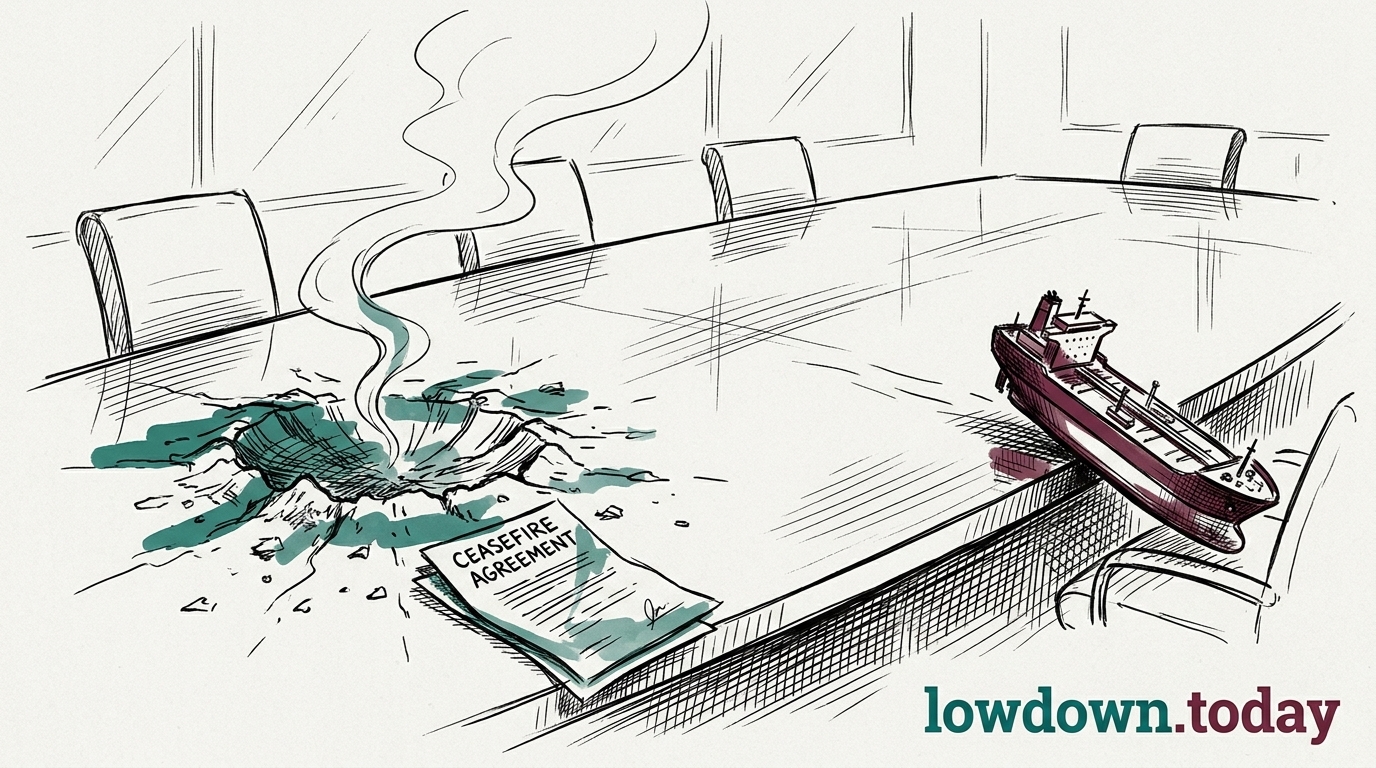
Brent Crude settled at $105.54 on Wednesday 20 May, down 5.16 per cent from the $111.22 close on Tuesday 19 May. The $5-per-barrel spread between Brent and the IEA's May projection of $106, which Goldman Sachs and Morgan Stanley had identified as a structural insurance premium, compressed to near-parity in a single trading session . The market priced diplomatic optimism the waterway did not honour: Windward's maritime tracker logged only 2 commercial transits through the strait on 20 May, down from 7 on 19 May and against a pre-crisis baseline of roughly 95 per day 2. Roughly 18 million barrels of crude per day that normally moves through Hormuz sat in anchorage or was diverted onto slower routes.

Lloyd's of London's Joint War Committee still conditions the reopening of Hormuz war-risk cover on written rules of engagement from either the 26-nation coalition or PGSA ; hull rates priced at 110-125 per cent of vessel value on the secondary market. The Majlis rial bill adds a second governance incompatibility on top of the missing tariff: a coalition ROE cannot mention rial without conceding Iranian sovereignty over the strait, and a PGSA ROE that names rial blocks the yuan channel Chinese buyers depend on. The benchmark fell 5.16 per cent in screen terms while the physical waterway carried two vessels. One kinetic event or a defeated Senate floor vote and the structural premium re-emerges by Saturday.

Deep Analysis

In plain English

The Strait of Hormuz is a narrow waterway between Iran and Oman through which roughly 20% of the world's oil normally flows. Since the conflict began, Iran has been charging ships to transit, but doing so informally using Chinese yuan or Bitcoin. On 20 May, Iran's parliament took a step toward making these charges formal law, specifying that all fees must be paid in Iranian rials. The problem is that the Iranian rial is cut off from most international banking because of sanctions. You cannot easily pay in rials using a normal bank account if you are a shipping company in Japan or Singapore. So the law as written would effectively ban most commercial shipping from the strait unless Iran sets up a separate workaround. The same day, the price of Brent crude oil fell 5% because traders were betting that ongoing diplomatic talks meant the strait might reopen soon. But in practice, only 2 ships crossed the strait that whole day 97% below normal showing the market was pricing hope, not reality.

Deep Analysis
Root Causes

The rial-only bill emerges from a structural tension inside Iran's wartime governance: the IRGC-backed PGSA needs hard-currency inflows to sustain its operations, while the Majlis needs to demonstrate to the domestic audience that the war is extracting economic tribute from adversaries. These two requirements are operationally incompatible.

Iran's blocked access to SWIFT and US correspondent banking means the rial cannot function as an international settlement currency. The rial cannot be the settlement currency for international transactions because no international bank will hold rial receivables under current sanctions.

The bill's rial-only clause is therefore not an operational payment mechanism; it is a sovereignty signal a legislative assertion that Iran has the right to denominate trade in its own currency, regardless of whether the mechanism exists to implement it.

What could happen next?
  • Consequence

    The rial-only clause directly invalidates the PGSA's yuan and Bitcoin payment channels that launched on 18 May (ID:3477), creating a governance split between Iran's legislative and operational arms that prevents any commercial shipper from achieving compliant transit.

    Immediate · Assessed
  • Risk

    Lloyd's Joint War Committee requires written rules of engagement before reopening Hormuz war-risk cover (ID:3481). The rial bill adds a second incompatibility: even if the coalition publishes rules, no insurer can underwrite under a regime requiring rial settlement that no counterparty can legally execute.

    Short term · Assessed
  • Risk

    China and India, which have bilateral passage arrangements using yuan and direct clearing, face a potential future demand to convert those arrangements into rial-denominated terms, which would be operationally impossible under current sanctions.

    Medium term · Suggested
  • Meaning

    The Brent-physical divergence on 20 May market down 5.16% while only 2 vessels transited shows the oil price is pricing a diplomatic probability, not operational reality. When the diplomatic track stalls again, the structural insurance premium identified by Goldman Sachs and Morgan Stanley will reassert sharply.

    Immediate · Assessed
First Reported In

Update #104 · Three days to Hengli

Mehr News Agency· 21 May 2026
Read original
Different Perspectives
Global shipping and insurance markets
Lloyd's Joint Hull Committee held Hormuz war-risk at $10-14 million per voyage on 26 May, requiring a signed government instrument or UNSC resolution before acting. Futures traders repriced Brent 1.63% on the Bandar Abbas strike; insurers did not move because no qualifying document has been produced in 87 days.
Pakistan
Pakistan
Pakistan's army-chief channel relayed the draft MOU to Tehran and backs Iran's framing that the ball is in Washington's court. Islamabad's general-officer corps now holds structural authority over the deal's critical text, having extracted the only substantive nuclear-monitoring concession of the war; legitimising this channel is itself a strategic choice Washington has not publicly affirmed.
China
China
Chinese DPI hardware arrived in Iran for a tiered censorship system, while China's NFRA ordered state banks to halt new lending to five sanctioned refiners after GL V expired. Beijing is simultaneously exporting surveillance infrastructure to Tehran and adjusting sanctions exposure to US pressure.
Saudi Arabia
Saudi Arabia
Riyadh signed the IMO letter rejecting Iran's Hormuz toll system and requested Trump stand down the 19 May strike alongside the Qatari Emir and UAE President. Saudi Aramco has already warned that Hormuz normalcy is delayed to 2027; at $87 per barrel as Riyadh's budget breakeven, every month of war-risk insurance premium erodes the fiscal cushion the crown prince requires.
Qatar
Qatar
Doha hosted Iranian negotiators, holds $12 billion in frozen Iranian assets Tehran has named as a Hormuz precondition, and signed the five-Gulf-state IMO letter rejecting Iran's PGSA transit route on the same week. Qatar cannot release the assets without a Washington order and cannot credibly claim neutrality after the IMO signature; it is covering both outcomes rather than bridging them.
Israel
Israel
Prime Minister Netanyahu called Trump on 24 May to object that the Lebanon war-end clause inside the draft MOU would force Israel to wind down its campaign against Hezbollah. His objection gives Jerusalem an effective veto over text Washington and Tehran had otherwise largely settled, without Israel being a party to the deal.