Skip to content
Briefings are running a touch slower this week while we rebuild the foundations.See roadmap
European Tech Sovereignty
27MAY

Beijing flips its blocking statute live

4 min read
15:19UTC

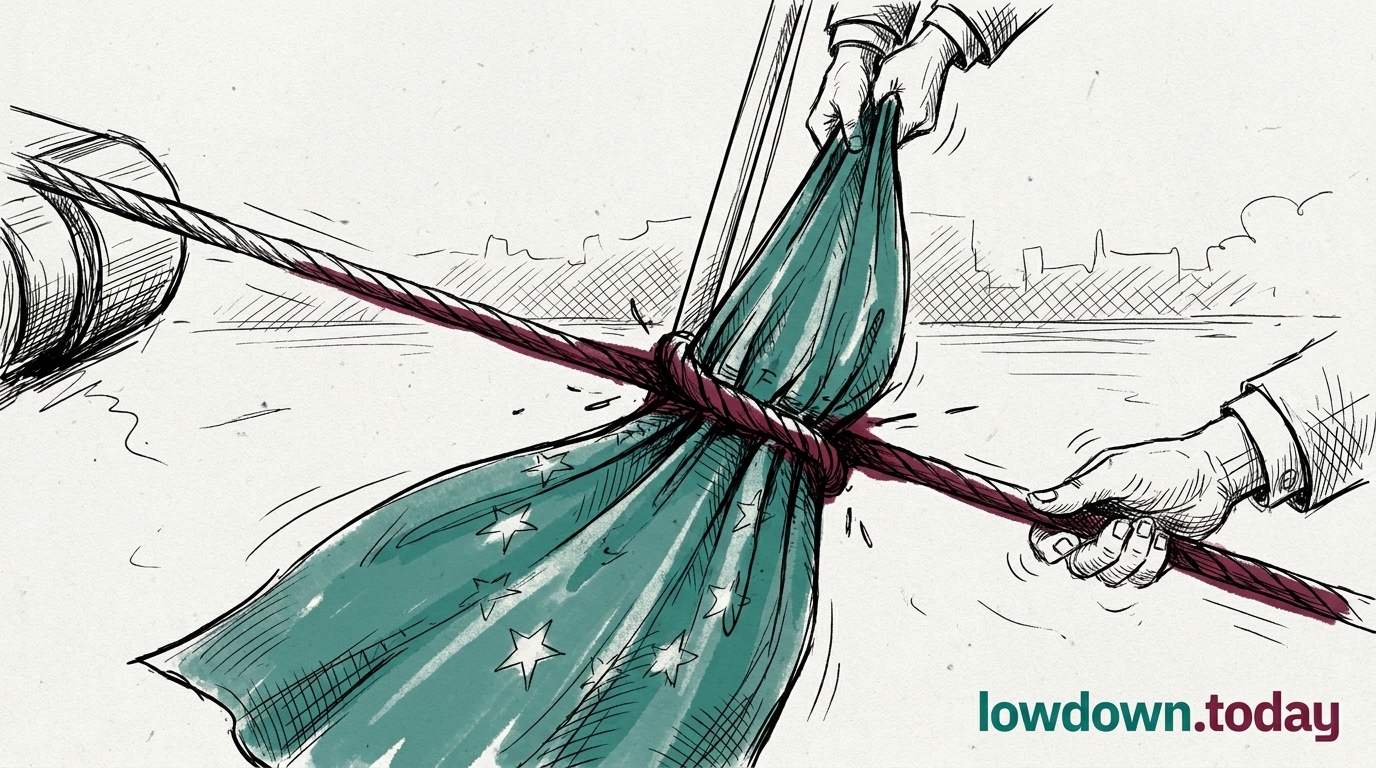
China's Ministry of Commerce issued Announcement No. 21 on 2 May, directing Chinese citizens, companies and organisations not to comply with the two US executive orders that authorise OFAC's Iran sanctions programme.

TechnologyDeveloping
Key takeaway

Beijing rewrote the legal floor before Trump lands, turning every Western OFAC compliance officer into a litigation target inside China.

China's Ministry of Commerce (MOFCOM) issued Announcement No. 21 on Saturday 2 May 2026, directing Chinese citizens, companies and organisations not to recognise, enforce or comply with two US instruments: Executive Order 13902, the January 2020 order authorising secondary sanctions on Iran's metals sector, and Executive Order 13846, the August 2018 order restoring secondary sanctions on Iran's energy and financial sectors 1. The announcement activates the dormant 2021 Blocking Rules for the first time in five years , and Beijing's accompanying list named the five Chinese refiners now protected from US enforcement , including Hengli Petrochemical (Dalian) under OFAC General Licence V.

A Chinese refiner penalised by a Western counterparty for buying Iranian crude can now sue that counterparty in a Shanghai or Beijing court under the announcement's private right of action. Every Western bank, insurer and shipper running an OFAC compliance programme becomes a litigation target inside the People's Republic, with damages enforceable against Chinese-domiciled assets. The operational consequence is twin liability: enforce, and face Chinese-court litigation; do not enforce, and face US regulatory sanction.

The doctrinal lineage matters for reading Beijing's signal. The 2021 Rules on Counteracting Unjustified Extra-Territorial Application of Foreign Legislation were modelled on the EU Blocking Statute that has applied to US Cuba and Iran sanctions since 1996. The European version has been activated formally only twice in thirty years. China invoking its version inside five years of promulgation, eight days before a Trump arrival, signals that Beijing's read of the bilateral position has crystallised. The political calendar is doing the work the legal text could not on its own.

The compatibility between MOFCOM No. 21 and the MOU now in Iranian hands is what makes the timing tactical rather than confrontational. The MOU's blockade-lifting clause and Hengli's OFAC General Licence V wind-down expiry on 24 May converge on the same fortnight. A US-China sanctions de-escalation deal that pauses enforcement against the five named refiners can be papered without rewriting either instrument, provided the 14-15 May Beijing summit produces a written track. Xi Jinping has named no public agenda item for the summit, leaving Beijing's legal infrastructure as the pre-positioned answer to a question Washington has not yet asked in writing.

Deep Analysis

In plain English

The United States has long used financial sanctions to pressure other countries, including rules that say foreign companies can be punished if they do business with Iran. China's government responded on 2 May by activating a law it had written five years ago but never used. This law tells Chinese companies they do not have to follow US rules about Iran, and it goes further: it lets Chinese firms sue Western banks or companies in Chinese courts if those Western firms cut ties with them because of US sanctions. In practical terms, this means a Western bank that refuses to handle payments for a Chinese oil refinery buying Iranian crude could potentially be taken to court in China and asked to pay compensation. The law was activated one week before the scheduled meeting between US President Trump and China's Xi Jinping in Beijing, which most observers read as Beijing placing a legal card on the table before the summit began.

Deep Analysis
Root Causes

The 2021 Rules on Counteracting Unjustified Extra-Territorial Application of Foreign Legislation were promulgated in January 2021, days after the Biden administration took office, in anticipation of continued US sanctions pressure.

OFAC's April 24 designation of Hengli Petrochemical (Dalian) under EO 13902 was the specific trigger that moved the instrument from dormant to active: Hengli is a state-adjacent company whose $30 billion Dalian refinery processes approximately 10% of China's domestic refining capacity, making the designation an attack on infrastructure Beijing treats as strategically sovereign.

MOFCOM published the announcement eight days before Trump arrives in Beijing for the 14-15 May summit, giving China a concrete legal deliverable to offer or withdraw at the summit table. Beijing needed a pre-positioned instrument before Trump arrived as the party seeking a deal on Iran.

The announcement's activation converts the summit into a meeting where both sides hold legal instruments that affect the other's corporate interests: OFAC's GL-V Hengli deadline on 24 May on the US side, and the MOFCOM private right of action on China's side.

What could happen next?
  • Precedent

    China's first use of the 2021 blocking rules establishes that non-Western states will deploy counter-sanction legal architecture within the conflict window, not after, compressing the timeline for US sanctions designers who previously relied on the absence of credible countermeasures.

    Medium term · 0.8
  • Risk

    The 24 May GL-V Hengli expiry creates a hard deadline that either produces a sanctions accommodation at the Trump-Xi summit or triggers the first Chinese-court enforcement action under MOFCOM No. 21.

    Short term · 0.85
  • Consequence

    Western banks with China onshore operations must now assess dual OFAC and MOFCOM compliance exposure on every Iran-linked transaction involving Chinese counterparties, a compliance structure that did not exist before 2 May.

    Immediate · 0.9
First Reported In

Update #90 · Pakistan carries paper; Brent below $100

Fortune· 7 May 2026
Read original
Causes and effects
This Event
Beijing flips its blocking statute live
Beijing's first invocation of its 2021 Blocking Rules creates a private right of action in Chinese courts against Western firms that enforce US Iran sanctions, eight days before the Trump-Xi summit.
Led to
Beijing splits MOFCOM defiance from NFRA loan halt
MOFCOM Announcement No. 21, already in DB as 3091, is the Chinese legal instrument simultaneously ordering OFAC defiance that contradicts the NFRA loan halt in this event.
Occurred 8 May 2026
Read story →
OFAC sanctions China's biggest SAR satellite firm
MOFCOM's Blocking Rules and the OFAC CGSTL/CITC designations are two contradictory instruments now applying simultaneously to Chinese firms in Iran's supply chain
Occurred 8 May 2026
Read story →
China backs Pakistan as US-Iran channel
MOFCOM's 2 May Blocking Rules remain live alongside Beijing's Pakistan-channel endorsement, showing China preserving both legal and diplomatic counter-architecture simultaneously
Occurred 13 May 2026
Read story →
Economic Fury hits four Hong Kong shells
MOFCOM Announcement No. 21 protected five mainland refineries, creating the legal gap OFAC exploited by targeting Hong Kong-registered entities instead
Occurred 11 May 2026
Read story →
Iran runs Hormuz as a favours system
The PGSA formal toll system established on 5 May was supplemented by the bilateral state-to-state passage deals Iran operated with Iraq and Pakistan in mid-May under Araghchi's codified doctrine.
Occurred 15 May 2026
Read story →
Azizi names Hormuz toll regime on X
Azizi's X post formalised politically the PGSA yuan-toll architecture that had been collecting fees since early May (ID:3091)
Occurred 16 May 2026
Read story →
Drone hits perimeter of Barakah nuclear plant
The Ghasha field fire established the UAE drone-strike arc that Barakah's perimeter hit now extends to a nuclear target.
Occurred 17 May 2026
Read story →
Brent breaks $110, ADNOC bypasses Hormuz
PGSA yuan-toll revenue from Hormuz transits since March is what ADNOC's Fujairah bypass route will structurally erode.
Occurred 18 May 2026
Read story →
Different Perspectives
ASML / European tech industry
ASML's Q2 2026 guidance came in €300m below consensus as China DUV revenue collapsed 17 percentage points; the company's CEO wrote US export-control outcomes directly into 2026 guidance. European tech firms named on the USTR retaliation list alongside SAP, Siemens and Spotify face the same calculus: US trade exposure constrains what Brussels can legislate on their behalf.
France / Anne Le Henanff
Le Henanff chaired the G7 Digital Ministerial at Bercy on 29 May with CAIDA off the agenda, pivoting France's presidency to AI safety principles it had not designed the week around. France backs CAIDA but cannot override Berlin's tariff calculus, so the ministerial produced no new French-led commitment.
Germany / Federal government
Berlin's automotive sector faces up to $200bn in threatened US tariffs, a commercial exposure that dwarfs any benefit CAIDA's public-sector cloud rules would deliver to German digital firms. Federal silence inside the College of Commissioners functions as a block under consensus adoption rules without requiring a formal veto.
USTR / Ambassador Andrew Puzder
Puzder's public warning on 25 May that CAIDA is inconsistent with the EU-US trade framework was the first time Washington made its bilateral pressure visible before a Commission adoption vote rather than after. The USTR Section 301 determination on 24 July provides the enforcement backstop.
European Commission / Henna Virkkunen
Virkkunen framed the third slip as a procedural delay in finalising a 400-page text without addressing Puzder's trade-framework red line publicly. The Commission enforces existing law against Google while losing the legislative timeline on CAIDA, exposing an asymmetric position: enforcement holds; new sovereignty legislation does not.
OpenForum Europe / open-source community
The EUR 350m Sovereign Tech Fund has no Commission host, no budget line, and no commissioner's name attached six weeks after the April conference, while Germany is already paying maintainers to staff international standards bodies. The CRA open-source guidance resolves contributor liability but leaves the financial-donations grey area open with the 11 September reporting clock running.
