Skip to content
Briefings are running a touch slower this week while we rebuild the foundations.See roadmap
European Tech Sovereignty
27MAY

Brussels slips sovereignty law a third time

2 min read
15:19UTC

The Tech Sovereignty Package did not adopt on 27 May as promised; it slipped a third time to a tentative 3 June after the US ambassador called it a red line. France now chairs the G7 in two days with nothing to table. Mistral buys into industrial AI while wearing a USTR target, and the digital euro becomes the one instrument still on schedule.

Key takeaway

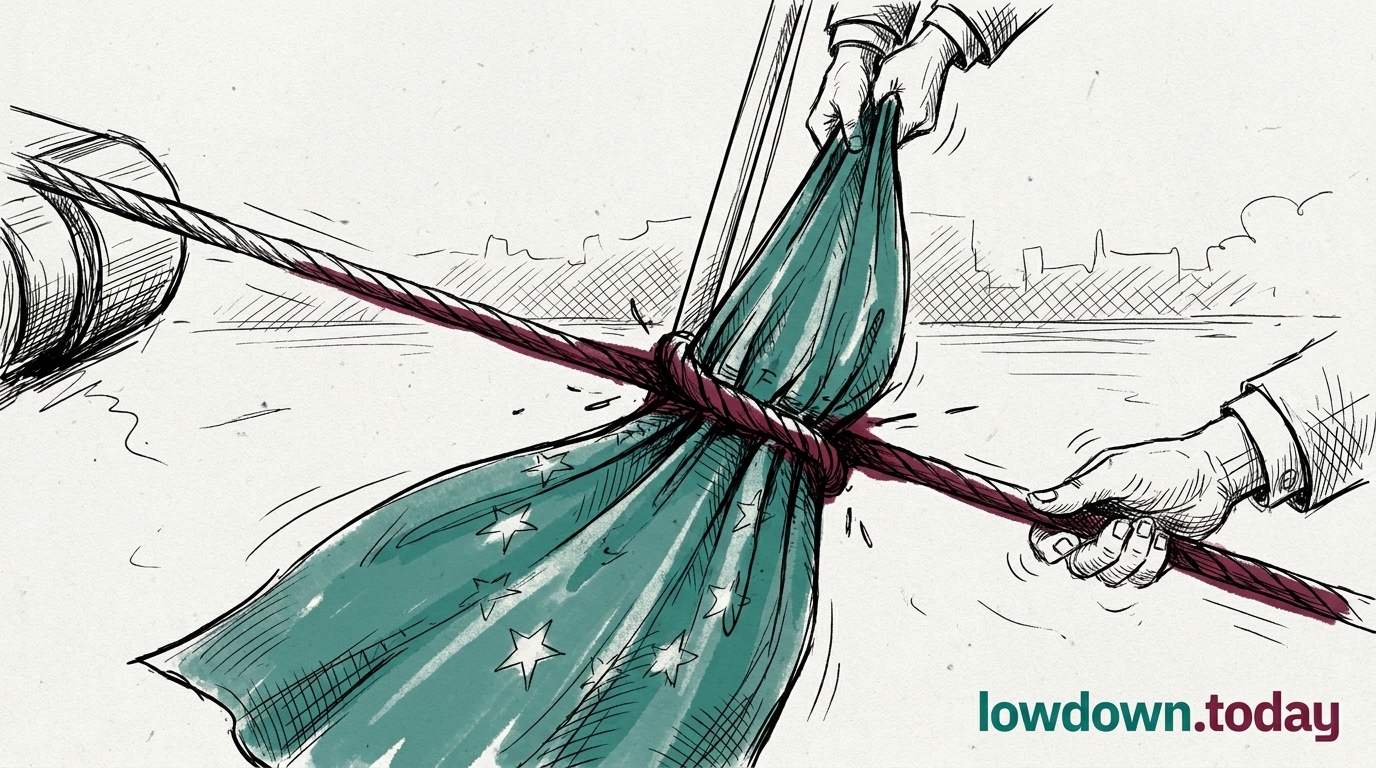
Europe's sovereignty instruments advance when they avoid US trade exposure and stall when they do not.

This briefing mapped
Loading map…
Regulatory
Diplomatic
Competitive
Economic
Infrastructure

The Cloud and AI Development Act did not reach the College of Commissioners on Wednesday 27 May, the date Brussels itself had locked, and the US ambassador supplied the reason: a trade-framework red line.

Sources profile:This story draws on neutral-leaning sources

The EU's Cloud and AI Development Act (CAIDA) missed its third adoption deadline on 27 May 2026. The package, bundling Chips Act II, slipped to 3 June after US Ambassador Andrew Puzder publicly called CAIDA a breach of the EU-US trade framework.

Berlin faces up to $200bn in threatened US tariffs on cars and treats digital procurement rules as a secondary concern against that exposure. Germany's resistance inside the College of Commissioners produced the third successive delay. 

France chairs the G7 Digital Ministerial at Bercy on Friday 29 May, two days after the sovereignty package it had planned to showcase failed to adopt. The agenda omits cloud sovereignty entirely.

Sources profile:This story draws on neutral-leaning sources

France chaired the G7 Digital Ministerial at Bercy on 29 May 2026. The EU's cloud sovereignty law, CAIDA (Cloud and AI Development Act), missed adoption two days before, so France had no package to present to G7 partners.

The agenda covered AI safety, small-business AI adoption, environmental sustainability, and child protection. France had planned Bercy as CAIDA's international launch; without it, ministers endorsed existing AI positions rather than a new French-led commitment. 

Mistral acquired Vienna physics-simulation startup Emmi AI on 19 May and opened a Linz office, pivoting from Europe's answer to ChatGPT toward the software that designs planes, cars and chips.

Sources profile:This story draws on neutral-leaning sources

Mistral AI, France's sovereign AI company, bought Emmi AI, a Vienna physics-simulation startup, on 19 May 2026. More than 30 engineers joined Mistral, and Linz became a new Mistral office.

Emmi builds AI that models physical processes for aerospace, cars, and semiconductors. Those markets are dominated by US firms Ansys and Siemens Digital. Mistral's second acquisition signals a deliberate move away from competing with OpenAI toward industrial engineering AI, where domain data matters more than computing scale. 

Sources:Tech.eu

Commission sources say Brussels is preparing its first major self-preferencing fine against Google, a high triple-digit million euro penalty held back for months on geopolitical grounds.

Sources profile:This story draws on mixed-leaning sources from United States
United States

Brussels confirmed on 25 May 2026 it is preparing a fine against Google in the hundreds of millions of euros under the Digital Markets Act (DMA). It covers Google promoting its own services and Gemini AI above rivals in Search.

Google faces three enforcement instruments in six weeks from late July 2026: this fine, a DMA search-data ruling, and EU AI Act enforcement. Competition chief Teresa Ribera called US pressure on the process blackmail. 

Sources:CNBC·ppc.land

The ECB signed standards agreements on 24 April and confirmed pilot provider selection for June, making the digital euro the one European sovereignty instrument still moving on time.

Sources profile:This story draws on mixed-leaning sources from France
France
LeftRight

On 24 April 2026 the European Central Bank (ECB) signed standards agreements with three payment bodies, keeping the digital euro on schedule. Banks to distribute it will be chosen in June 2026.

Unlike the delayed Cloud and AI Development Act, the digital euro attracts no US trade pressure because it restricts no American firm. Two disputes remain: how much digital euro any person may hold, and how banks get compensated for carrying a product that competes with their own. 

DigiTimes reported ESMC Dresden has pulled its initial-production target forward to 2027 from 2029, a claim covering first risk wafers rather than full volume and unconfirmed by the company.

Sources profile:This story draws on neutral-leaning sources
Sources:DigiTimes
Closing comments

Direction: sideways into deepening structural trap. The mechanism that would tip it upward is a Commission legal opinion, published before the 24 July Section 301 determination, establishing that CAIDA falls outside WTO goods and services disciplines and beyond the trade framework's scope. Without that opinion, Germany's automotive calculus does not change: the €84bn export exposure is the anchor, and no CAIDA drafting concession resolves a tariff threat that is legally orthogonal to the digital law. A fourth CAIDA slip, past the June European Council, would push the package into the autumn trilogue window and make October 2026 the earliest plausible adoption, extending US hyperscaler public-sector contract eligibility by two quarters from the Commission's own locked timeline.

Different Perspectives
European Commission / Henna Virkkunen
Virkkunen framed the third slip as a procedural delay in finalising a 400-page text without addressing Puzder's trade-framework red line publicly. The Commission enforces existing law against Google while losing the legislative timeline on CAIDA, exposing an asymmetric position: enforcement holds; new sovereignty legislation does not.
USTR / Ambassador Andrew Puzder
Puzder's public warning on 25 May that CAIDA is inconsistent with the EU-US trade framework was the first time Washington made its bilateral pressure visible before a Commission adoption vote rather than after. The USTR Section 301 determination on 24 July provides the enforcement backstop.
Germany / Federal government
Berlin's automotive sector faces up to $200bn in threatened US tariffs, a commercial exposure that dwarfs any benefit CAIDA's public-sector cloud rules would deliver to German digital firms. Federal silence inside the College of Commissioners functions as a block under consensus adoption rules without requiring a formal veto.
France / Anne Le Henanff
Le Henanff chaired the G7 Digital Ministerial at Bercy on 29 May with CAIDA off the agenda, pivoting France's presidency to AI safety principles it had not designed the week around. France backs CAIDA but cannot override Berlin's tariff calculus, so the ministerial produced no new French-led commitment.
ASML / European tech industry
ASML's Q2 2026 guidance came in €300m below consensus as China DUV revenue collapsed 17 percentage points; the company's CEO wrote US export-control outcomes directly into 2026 guidance. European tech firms named on the USTR retaliation list alongside SAP, Siemens and Spotify face the same calculus: US trade exposure constrains what Brussels can legislate on their behalf.
