Skip to content
Welcome, thoughtbot's Giant Robots listeners!Start here
European Oil Markets
31JUL

GFS Pride sinks in the Strait of Hormuz

3 min read
09:33UTC

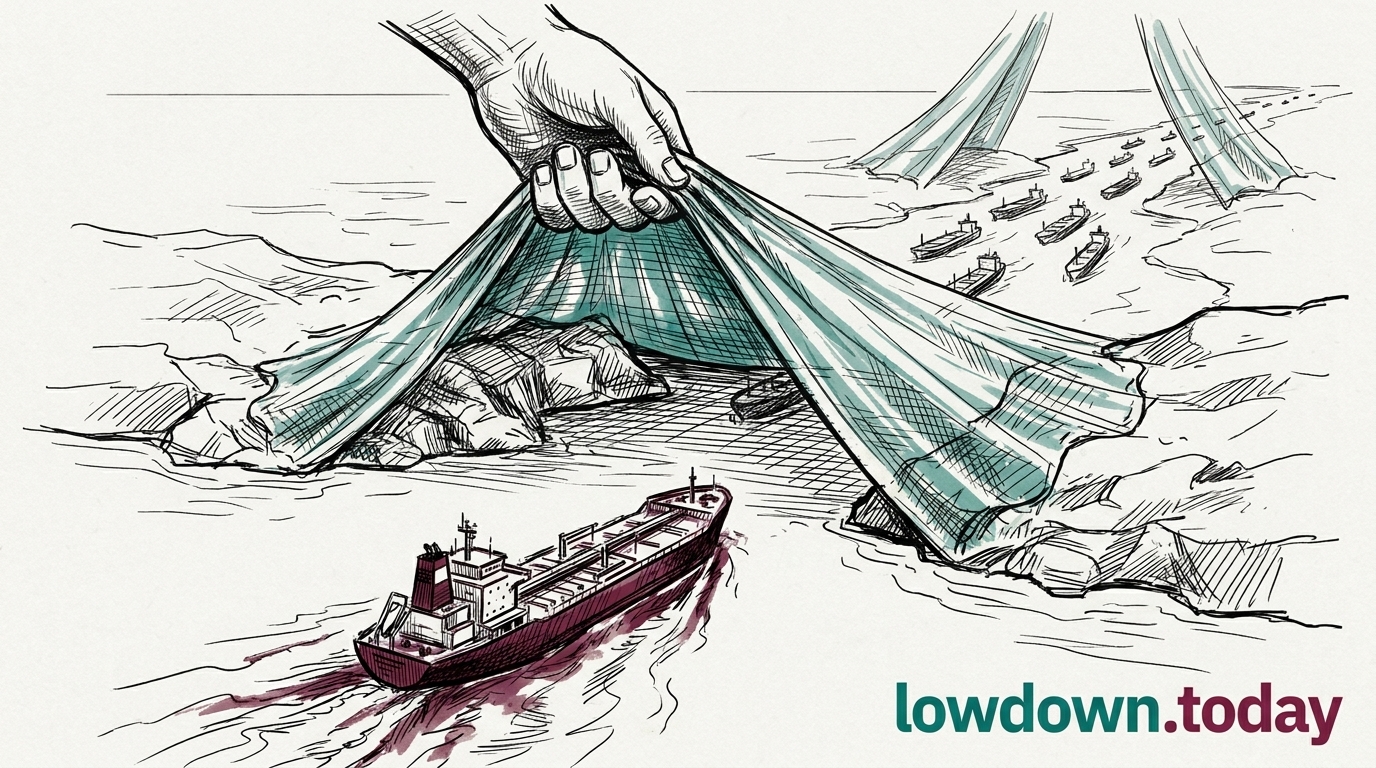
A projectile hit the container ship GFS Pride inside Hormuz on 13 October and it went down the next day, the third merchant ship lost in the war.

EconomicDeveloping
Key takeaway

A third merchant ship has sunk in Hormuz as attacks on shipping ran at about a dozen a week.

An unidentified projectile hit the Singapore-flagged container ship GFS Pride inside the Strait of Hormuz on 13 October. It sank the next day, and all 21 crew got off, CNBC reported⁠1. The International Maritime Organization (IMO), the UN shipping agency, counts it as the third merchant ship sunk in the war.

The Islamic Revolutionary Guard Corps (IRGC) said a mine sank it. A maritime security firm told CNBC there was no independent evidence of that⁠2. Tehran called the tanker El Gaia a mine casualty last month while CENTCOM (US Central Command) said a missile hit it.

The sinking capped two weeks of attacks. IMO data showed 11 tankers attacked in the week to 4 October⁠3. UKMTO (UK Maritime Trade Operations, the Royal Navy's merchant-shipping desk) then warned of 12 attacks on ships from 5 to 11 October, Iran International counted⁠4. Half a dozen ships were reported hit on 11 October alone. The four tankers struck in late September now look like the start of a run.

On 11 October a drone struck the Nicaragua-flagged tanker Petro Dolphin, carrying 11 Indian seafarers, at Sohar anchorage in Oman; the Valthera was hit the same day. India's Ministry of External Affairs says National Security Adviser Ajit Doval raised seafarer safety with Mohsen Rezaei, secretary of Iran's Supreme National Security Council, on 12 October⁠5. An Indian crewman died aboard the bulk carrier Cape Dao in September.

On 17 October the IRGC Navy, the Guards' own fleet, said two "law-breaking" supertankers had hit mines, state-affiliated Mehr News Agency reported⁠6. One was carrying over 2 million barrels. It named neither ship, and nothing independent confirms the claim. Mines, if they exist, threaten every hull in the strait, including ships Tehran would call lawful.


Deep Analysis

In plain English

the strait of Hormuz is the narrow sea lane between Iran and Oman. In normal times about a fifth of the world's oil passes through it. Since the war began, ships in and near the strait have been hit by missiles, drones and, Iran says, sea mines. GFS Pride was a container ship, carrying goods in metal boxes, not oil. The IRGC (Islamic Revolutionary Guard Corps) is Iran's elite military force and runs its naval operations in the strait.

Deep Analysis
Root Causes

The blockade has split the Gulf into two shipping systems. Iran loaded no crude in the Gulf in September, while its neighbours rebuilt exports through bypasses, ship-to-ship transfers and escorted transits. Every non-Iranian barrel that gets out weakens Tehran's hand, which gives it a motive to make transit costly.

Ships sailing dark to avoid targeting also lose the protection that tracking gives. The IRGC says one of the 17 October tankers had switched off its positioning and radar. That leaves outside observers unable to confirm where, or whether, it was hit.

Escalation

Rising. IMO data via CNBC showed 11 tankers attacked in the week to 4 October. UKMTO then warned of 12 attacks in the following week, Iran International counted, with six ships reported hit on 11 October alone. A third sinking and two claimed mine strikes followed.

What could happen next?
  • Risk

    If the IRGC's mine claims are true, every hull in the strait faces a hazard that convoys alone cannot remove.

  • Consequence

    India's direct channel to Mohsen Rezaei shows crew-supplying states now raise seafarer safety with Tehran directly.

First Reported In

Update #181 · Houthi missiles kill 13 at Riyadh's airport

Iran International· 17 Oct 2026
Read original →
Different Perspectives
Gulf oil producer
Gulf oil producer
Secured OPEC's confirmed 188,000 b/d September increment with the next meeting set for 6 September, but the Secretariat's own 2 August release says nothing about the fourth quarter. Output guidance beyond September remains undisclosed even as delegate sourcing keeps filling that gap.
Money manager positioned in WTI
Added 28,964 lots to a 92,943 net long in NYMEX WTI in the week to 28 July, against just 1,485 added to Brent's 15,740, a roughly twenty-to-one split. Conviction sits in the American benchmark even as the European diesel story sets the record.
Indian refiner buying Urals
Bought Russian crude at a discount that narrowed to $1-2 a barrel in the week to 29 July from over $10, as Hormuz risk pushed it toward Urals. If that risk eases with the strike now called off, the discount it is currently enjoying could re-widen just as fast.
Russian diesel exporter
Novak tied any lifting of the diesel export ban, due to lapse 31 July, to an unspecified market recovery with no date, and pushed the gasoline ban to end-2026. An open-ended constraint suits an exporter benefiting from the record European crack it feeds.
War-risk underwriter
Withdrew war-risk cover for Saudi-linked hulls on 24 July and has not reinstated it, holding Bab el-Mandeb tanker transits near 7.5 a day. A cancelled strike does not by itself trigger the committee review needed to re-accept the class.
Northwest European refiner
Sources only 17% of diesel imports from Saudi Red Sea ports against the Mediterranean's 24%, so the ARA crack at $85.86 trails the Med print by $5.81. Lower Red Sea exposure is cushioning it against the rerouting cost, not eliminating it.

Written with AI from Lowdown's published reporting. Not individually reviewed by an editor. Editorial standards.
