Skip to content
You can now search across every topic, entity and event.What's new
European Oil Markets
23JUL

MOFCOM No. 21 mirrors OFAC's blind spots

3 min read
19:27UTC

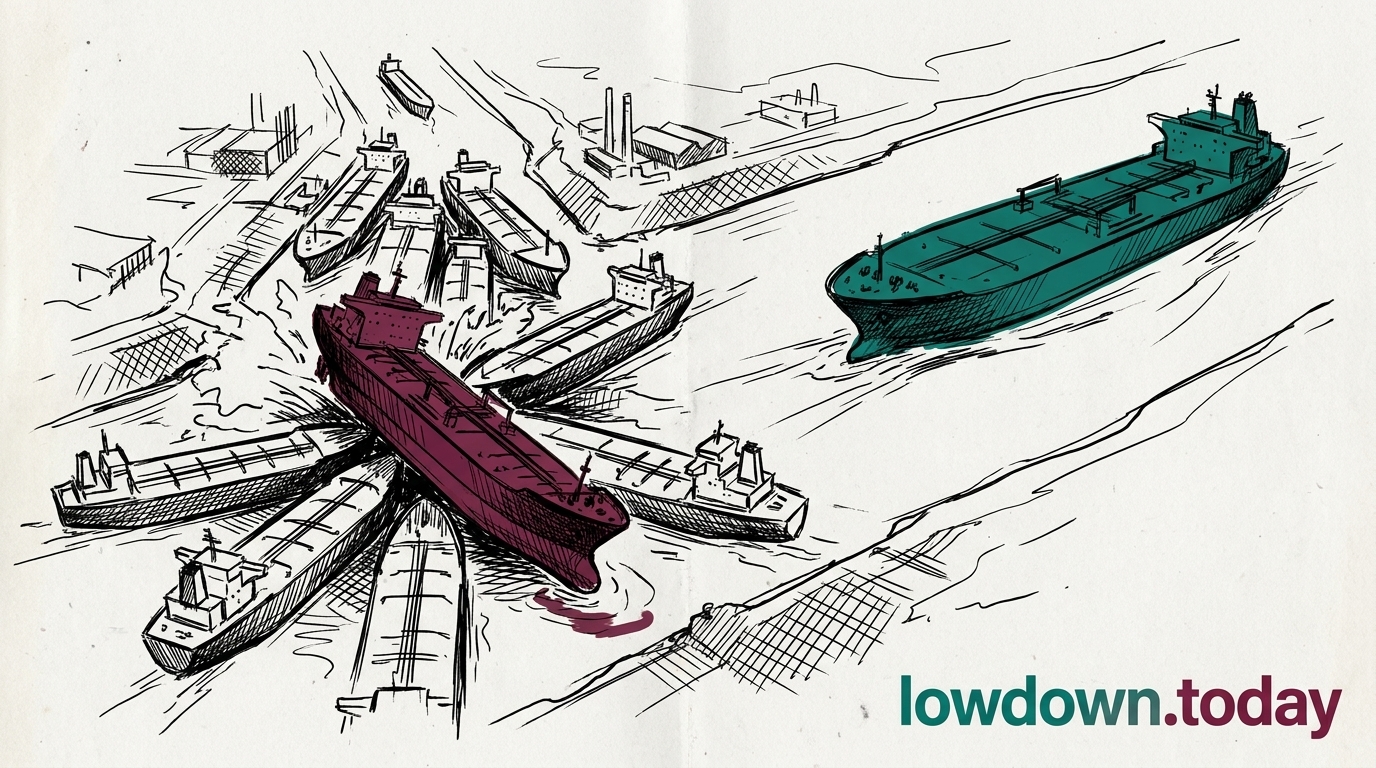
China's MOFCOM Announcement No. 21 names the five mainland refineries OFAC has spared across four SDN rounds; Ghalibaf's 18 May China envoy appointment locks the Tehran end.

EconomicDeveloping
Key takeaway

MOFCOM No. 21 and OFAC's SDN rounds protect 1.5 million barrels per day of Iran-China crude.

MOFCOM (China's Ministry of Commerce) published Announcement No. 21 on 2 May 2026 under the 2021 Anti-Foreign Sanctions Law, naming the five mainland refineries OFAC (the US Treasury's Office of Foreign Assets Control) has avoided across four consecutive SDN (Specially Designated Nationals) rounds 1. Hengli Petrochemical (Dalian), Shandong Shouguang Luqing, Shandong Jincheng, Hebei Xinhai and Shandong Shengxing are now under a domestic legal obligation to disregard US designations under Executive Orders 13902 and 13846.

OFAC's 15 May round designated twelve entities routing IRGC oil to China ; the 19 May round added more vessels and shells . Both spared the five mainland refineries MOFCOM had named two weeks earlier. Iran-China crude flow runs at roughly 1.5 million barrels per day through this corridor, and throughput at the protected refineries has not moved.

Mohammad Bagher Ghalibaf's 18 May appointment as Iran's China special representative , with dual sign-off by President Masoud Pezeshkian and Supreme Leader Mojtaba Khamenei, closes the dual-authority gap that allowed Chinese counterparts to question which Iranian voice controlled sanctions-evasion logistics. The MOFA readout of the Trump-Xi summit had pointedly omitted the Iran specifics Trump claimed Xi had pledged ; Ghalibaf's brief is to close that paper gap from Tehran's end.

Deep Analysis

In plain English

China buys large quantities of Iranian oil every day. The US has been trying to stop this by sanctioning the companies and ships involved in the trade. China has now formally told its oil refineries: ignore these US sanctions. This is legal under Chinese law because China passed a special rule in 2021 that allows it to block foreign sanctions from applying on its soil. The twist is that the US has been carefully avoiding sanctioning exactly the five refineries China just named. So both sides have effectively drawn the same line in different ways. The US sanctions the tankers and middlemen; China protects the buyers at the end of the chain.

Deep Analysis
Root Causes

China's 50% crude import dependency on Hormuz transits gives Beijing a structural incentive to maintain the Iran oil corridor regardless of the war's outcome. The 2021 Blocking Rules were drafted as a counter to Helms-Burton-style extraterritoriality but lay dormant for five years because no US sanctions programme had directly threatened Chinese domestic refinery capacity. OFAC's escalating SDN rounds in March-April 2026 moved close enough to mainland Chinese entities to trigger activation.

Ghalibaf's appointment closes the dual-authority gap that has complicated Chinese dealings with Tehran throughout the conflict. Previously, Chinese counterparts could claim uncertainty about which Iranian voice controlled sanctions-logistics decisions: Pezeshkian's civilian government or the IRGC. Dual sign-off from both Pezeshkian and Mojtaba Khamenei creates a single Iran contact point whose decisions carry cross-factional legitimacy.

What could happen next?
  • Precedent

    MOFCOM Announcement No. 21 is the first time China has activated its 2021 Blocking Rules; the precedent is now set for deploying the same mechanism against any future US secondary sanctions programme targeting Chinese firms.

    Long term · 0.88
  • Consequence

    Ghalibaf's China mandate with dual civilian-IRGC sign-off removes the institutional ambiguity that let Chinese counterparts defer commitments by claiming they needed a unified Iranian position.

    Short term · 0.78
  • Risk

    OFAC designation of one of the five named MOFCOM-protected refineries would trigger Beijing's private-right-of-action mechanism for the first time, creating a direct legal conflict between US and Chinese commercial courts.

    Medium term · 0.55
First Reported In

Update #103 · Senate 50-47; UNSC at Barakah; no US paper

China Ministry of Commerce· 20 May 2026
Read original
Causes and effects
This Event
MOFCOM No. 21 mirrors OFAC's blind spots
The two sanctions regimes are non-overlapping by design: Beijing shields the refineries that route 1.5 million barrels per day of Iranian crude, and Washington sanctions around them.
Different Perspectives
US money managers (CFTC-tracked)
US money managers had trimmed WTI net long positioning into July's rally, doubting the Hormuz premium would hold without freight or war-risk confirmation, and the crude stock build reported for the week to 17 July gives that scepticism a fundamentals basis. The 25 July CFTC data will show whether Brent's move above $100 changed their calculus.
Asian distillate buyers (Singapore)
Singapore's distillate holders kept retaining middle-distillate barrels as the East-West arbitrage window narrowed further this week, a pattern that sharpened as Fujairah light distillates hit a record low. Cargoes are being held rather than released west into the tightening Mediterranean market.
Bulgaria
Bulgaria
Bulgaria secured the removal of Lukoil founder Vagit Alekperov and Patriarch Kirill from the 21st package, with President Rumen Radev calling a personal listing 'shooting ourselves in the foot'. Sofia is protecting its position in Lukoil's EUR 3bn compensation claim over the 2023 Neftohim Burgas nationalisation.
Russia
Russia
Russia loses the roughly $14 a barrel of legal headroom the price-cap formula would have released toward $58, even as Urals continues trading below Moscow's $59 budget floor. The shadow-fleet insurance workaround that lets sanctioned crude clear above $44 in practice remains untouched by the freeze itself.
European Union
European Union
The EU adopted its 21st sanctions package on 23 July, freezing the $44 Russia oil cap for 12 months rather than letting the formula drift it toward $58, and listed shadow-fleet support vessels for the first time. The package cleared only after three failed Coreper votes.
Marine war-risk underwriters (Lloyd's-linked syndicates)
War-risk syndicates lifted southern Red Sea hull premiums 150% to about 0.75% of hull value after the 20 July blockade declaration, still a seventh of the roughly 5% Hormuz band. Underwriters reset on realised loss, not declared threat, so the 23 July Encelia and Layla strikes set up the next re-mark.
