Skip to content
You can now search across every topic, entity and event.What's new
European Oil Markets
23JUL

Hormuz goes dark as tankers flee

3 min read
19:27UTC

Hormuz transits fell to about two a day as three vessels were struck overnight, and Iran routed the strait's governance through Oman, yet Brent crude slipped to about $75.80.

EconomicDeveloping
Key takeaway

Ships have stopped crossing Hormuz, yet Brent fell to about $75.80, a physical crisis the oil price refuses to confirm.

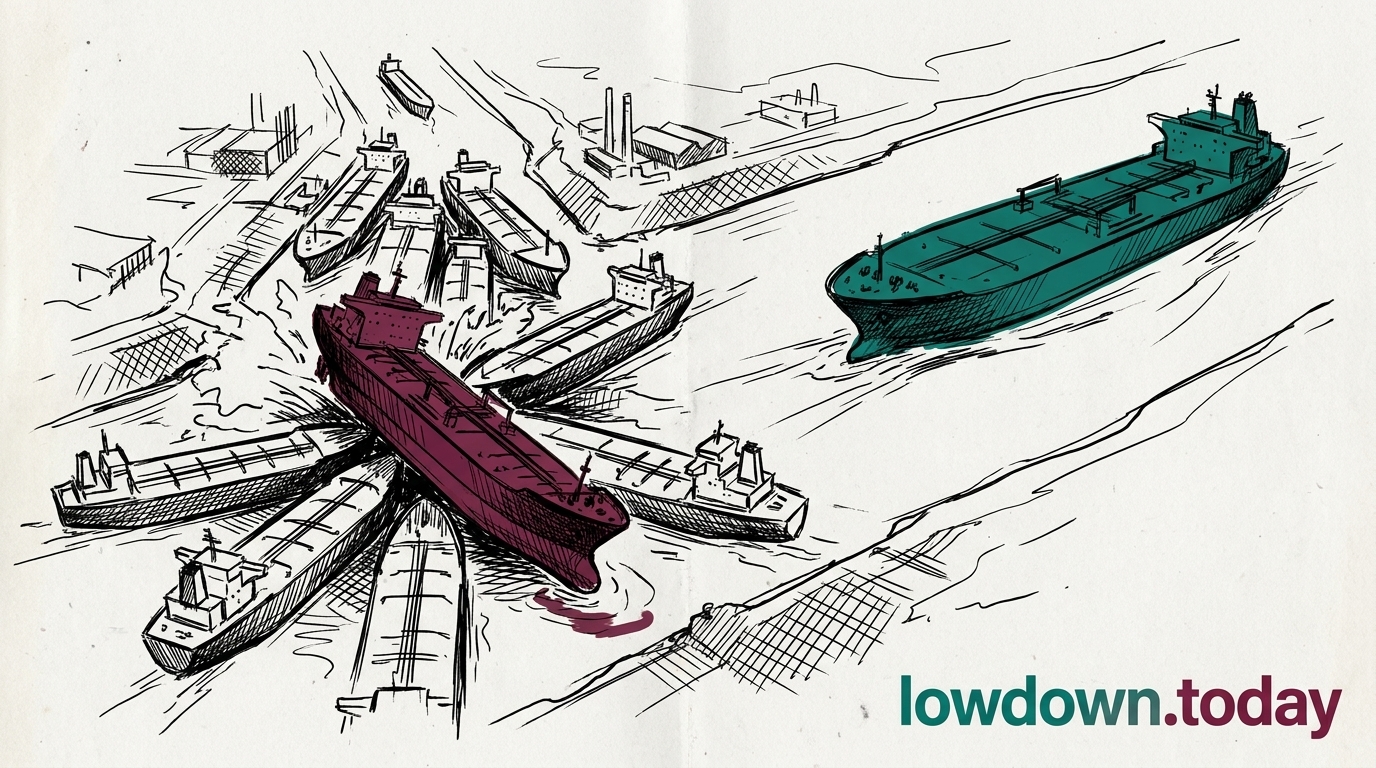
Tanker transits through the Strait of Hormuz collapsed to about two on 9 July, from a near-pre-war rhythm of 35 to 51 a day earlier in the month . 1 Three vessels were struck overnight as they ran outbound: the liquefied natural gas (LNG) carrier Al Rekayyat, already reported , and the crude tankers Wedyan and Cyprus Prosperity, which earlier coverage never named. 2 The 7 July strike was therefore a wider, multi-vessel attack than first recorded.

The Joint Maritime Information Center (JMIC), which advises commercial shipping, holds its Hormuz advisory at "severe", its highest tier. War-risk insurance now runs at 2 to 6 per cent of hull value, below a wartime peak near 10 per cent, but London brokers report fewer quote requests, not more. 3 Owners are abandoning the strait rather than paying to cross it: the cost is no longer a premium on a crossing but a route nobody will take.

Oil fell anyway. Brent went from $78.67 on 8 July to $76.97 on 9 July and about $75.80 on 10 July, handing back roughly a quarter of the strike gain. 4 Physical shipping data reads as crisis; the price reads as contained .

Article 5 of the ceasefire memorandum, over who controls Hormuz, is the sticking point stalling the Witkoff-Kushner Doha channel: Iran wants sole managerial authority, the US wants unrestricted transit. 5 With that channel frozen, Mohammad Bagher Ghalibaf, Iran's parliament speaker, says Iran and Oman have reached a separate Hormuz-management agreement based on the same memorandum, routing the strait's governance through Muscat rather than Washington. 6 That deal advances a bilateral Hormuz track Tehran and Muscat have been in continuous consultations over since May rather than opening a fresh one, and Ghalibaf had already declared the memorandum violated days earlier . The International Institute for Strategic Studies (IISS) assesses that no military option can reopen the strait for either side, only negotiation. 7

Deep Analysis

In plain English

The Strait of Hormuz is the narrow sea passage between Iran and Oman that roughly a fifth of the world's oil, and a third of its liquefied natural gas, has to pass through. Ships have almost stopped using it: only around two tankers a day are getting through, down from 35 to 51 a day earlier this month. Three ships were hit overnight, two crude oil tankers and one gas carrier, and insurance companies have made cover so expensive that most shipowners are choosing to avoid the route entirely rather than risk it. Iran's parliament speaker says Tehran has now struck a side deal with neighbouring Oman to manage traffic through the strait, separate from the wider ceasefire talks with the United States that remain frozen.

Deep Analysis
Root Causes

Iran's ability to contest transit at all rests on a legal gap: Tehran has never ratified the UN Convention on the Law of the Sea, the treaty that would otherwise guarantee foreign vessels transit passage through the strait, so its domestic maritime claims face no binding international constraint it has itself accepted.

The collapse in transits is also an insurance-market mechanism alongside the security one. War-risk cover at two to six per cent of hull value makes a single voyage prohibitively expensive without a state guarantee behind it, which is why owners are diverting rather than paying the premium and hoping.

Escalation

The Oman side-deal and the frozen Doha channel are now running as separate tracks. Whether Muscat's narrower arrangement de-escalates the maritime dimension while the wider ceasefire memorandum stays stalled, or whether owners hold out until both resolve, will show in the next transit-count reading.

What could happen next?
  • Consequence

    A bilateral Iran-Oman arrangement running outside the Doha channel means Hormuz's reopening no longer depends solely on US-Iran talks.

  • Risk

    War-risk premiums at two to six per cent of hull value keep the route commercially unviable regardless of any diplomatic deal, until underwriters see a sustained run of unstruck transits.

First Reported In

Update #151 · Iran widens war to Jordan; oil shrugs

U.S. News (Reuters wire)· 10 Jul 2026
Read original
Different Perspectives
US money managers (CFTC-tracked)
US money managers had trimmed WTI net long positioning into July's rally, doubting the Hormuz premium would hold without freight or war-risk confirmation, and the crude stock build reported for the week to 17 July gives that scepticism a fundamentals basis. The 25 July CFTC data will show whether Brent's move above $100 changed their calculus.
Asian distillate buyers (Singapore)
Singapore's distillate holders kept retaining middle-distillate barrels as the East-West arbitrage window narrowed further this week, a pattern that sharpened as Fujairah light distillates hit a record low. Cargoes are being held rather than released west into the tightening Mediterranean market.
Bulgaria
Bulgaria
Bulgaria secured the removal of Lukoil founder Vagit Alekperov and Patriarch Kirill from the 21st package, with President Rumen Radev calling a personal listing 'shooting ourselves in the foot'. Sofia is protecting its position in Lukoil's EUR 3bn compensation claim over the 2023 Neftohim Burgas nationalisation.
Russia
Russia
Russia loses the roughly $14 a barrel of legal headroom the price-cap formula would have released toward $58, even as Urals continues trading below Moscow's $59 budget floor. The shadow-fleet insurance workaround that lets sanctioned crude clear above $44 in practice remains untouched by the freeze itself.
European Union
European Union
The EU adopted its 21st sanctions package on 23 July, freezing the $44 Russia oil cap for 12 months rather than letting the formula drift it toward $58, and listed shadow-fleet support vessels for the first time. The package cleared only after three failed Coreper votes.
Marine war-risk underwriters (Lloyd's-linked syndicates)
War-risk syndicates lifted southern Red Sea hull premiums 150% to about 0.75% of hull value after the 20 July blockade declaration, still a seventh of the roughly 5% Hormuz band. Underwriters reset on realised loss, not declared threat, so the 23 July Encelia and Layla strikes set up the next re-mark.
