Skip to content
You can now search across every topic, entity and event.What's new
European Oil Markets
16JUL

IRGC declares Hormuz shut, vetoing Iran's own deal

4 min read
09:39UTC

The IRGC Navy posted an order on its Telegram channel on 11 June barring all traffic through the Strait of Hormuz, the first such declaration of the war and a military override of the deal its own government was negotiating.

EconomicDeveloping
Key takeaway

The corps declared Hormuz closed and overrode its government's deal, yet only the IRGC confirms any ship was hit.

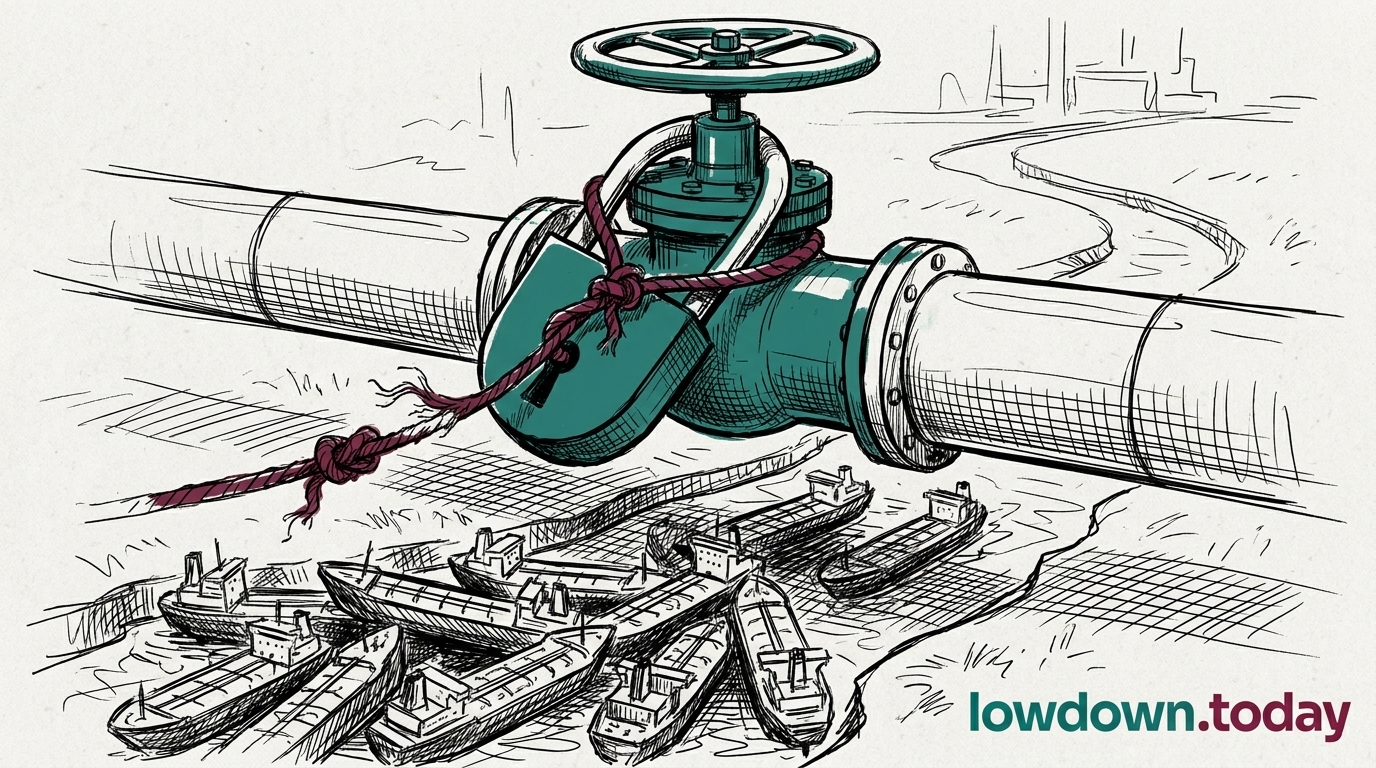
The IRGC Navy posted an order to its official Telegram channel on 11 June declaring the strait of Hormuz "closed to all vessels, including oil tankers and commercial ships" and warning that "any vessel attempting to transit will be targeted." The Navy claimed two ships had been struck for defying the order, naming none and confirming no casualties, so the only account of enforcement comes from the party that declared the closure. CENTCOM rejected it within hours, saying commercial shipping was continuing to transit normally and no US warship had been hit.

For the length of this war the chokepoint ran one way: CENTCOM blockaded from outside Iranian waters while the corps levied tolls from within. On 11 June the IRGC inverted that, and in doing so negated the first operative clause of the late-May MoU framework, under which Hormuz was to reopen and the tolls to end. the strait the corps declared shut also carries the China-bound crude that keeps Iran's economy breathing after exports fell below 300,000 barrels a day , which makes the order a cost to Tehran as much as a threat to anyone else.

No independent source has verified that the 33-kilometre passage is physically sealed, which leaves a closure that exists in a Telegram post but not in the transit data as a legal and insurance event before it is a naval one. The military wing chose escalation over the deal its government is still pursuing through Pakistani mediation, and announced the choice itself.


Deep Analysis

In plain English

The Strait of Hormuz is a 33-kilometre-wide waterway between Iran and Oman, and roughly one-fifth of all the oil traded at sea passes through it. Iran's Islamic Revolutionary Guard Corps (IRGC), its ideological military force, posted a message on the messaging app Telegram on 11 June declaring the strait closed to all ships and warning that any vessel trying to pass would be attacked. The problem is that Iran's own civilian government is in the middle of peace negotiations, and those negotiations require the strait to reopen. The military wing has now said the opposite of what the diplomatic wing was promising. The US military rejected the IRGC's announcement and said ships were still sailing through normally. CENTCOM, Indian naval sources, and commercial shipping trackers Kpler and Windward have not confirmed any vessel stoppage or strike in the hours following the declaration.

Deep Analysis
Root Causes

Iran signed and ratified the 1958 Convention on the Territorial Sea but never ratified UNCLOS, which establishes transit passage rights through international straits.

Tehran's 1964 Maritime Zones Act and its 2024 update claim jurisdiction over vessels it classes as 'hostile-linked', a category defined domestically and applied to any flag state that has sanctioned Iran. That legal gap gives the IRGC a domestic statute to cite when it stops ships, while CENTCOM and maritime law cite UNCLOS transit passage that Iran has never accepted.

The corps also controls what the body refers to as the Persian Gulf Strait Authority, the toll registration system launched in May 2026. Declaring Hormuz closed converts a revenue mechanism into a military-command instrument: the same institutional apparatus used to charge $2 million per VLCC can now be cited as the enforcement body for a formal closure order.

Escalation

Upward. The IRGC declaration, even if unenforceable, moves from the previous pattern of levying tolls on transiting vessels to an absolute prohibition on transit. It directly negates the first operative clause of the MoU framework. The corps and the civilian government are now giving opposite signals on the same day, which increases the probability that the diplomatic track collapses before a text is signed.

What could happen next?
  • Risk

    If two independent shipping data platforms (Kpler, Windward) record transit volumes falling below three vessels per day, the closure will shift from a legal event to a physical one, triggering automatic hull-and-cargo war-risk surcharges across Lloyd's, the Japanese and Korean P&I clubs.

    Immediate · Assessed
  • Consequence

    The MoU's reopening clause is now contradicted by a standing IRGC order. Any mediator presenting the deal to the IRGC command must either obtain a formal corps withdrawal of the Telegram closure post or accept that the deal's first clause is unenforceable from the moment of signing.

    Short term · Reported
  • Precedent

    An IRGC command that publicly vetoes its own government's negotiated framework in the middle of active talks establishes that corps authority over the strait exceeds civilian authority. Future mediators must address the corps directly, not through the foreign ministry.

    Medium term · Assessed
First Reported In

Update #124 · IRGC declares Hormuz shut; US strikes again

ANI / Tribune India / Business Standard· 11 Jun 2026
Read original
Causes and effects
This Event
IRGC declares Hormuz shut, vetoing Iran's own deal
A military command shut, on paper, the waterway its civilian negotiators had agreed to reopen. The declaration repriced legal and insurance risk regardless of whether the strait is physically sealed, and it set the corps openly against Iran's diplomatic track.
Different Perspectives
Indian refiners
Indian refiners
Indian refiners kept lifting discounted Urals as the India/Baltic price split widened past $9-10 a barrel, a gap that only grows as GL X1's Iranian wind-down cuts an alternative discounted grade off the market by 17 July. Cheaper Russian feedstock is being locked in while it lasts.
Chinese refiners
Chinese refiners
Chinese refiners gain leverage as the Urals-Brent discount widens, since Beijing's state buyers already source discounted Russian barrels near the fiscal floor unaffected by Western insurance costs. A wider discount, if it holds past 23 July, lets them lock in cheaper term contracts regardless of the cap's outcome.
US money managers (CFTC-tracked)
Managed money trimmed WTI net length into the rally, positioning that reflects doubt the Hormuz premium survives without freight or war-risk confirmation. The Brent-WTI spread widening almost entirely on the Brent leg supports that scepticism about a broad-based repricing.
OPEC+ (Saudi-led subgroup)
Saudi Arabia is defending market share through a fourth straight 188kbd August hike even as OPEC's own July MOMR cut 2026 demand growth for the fourth consecutive month. At a $108-111 fiscal breakeven, every added barrel costs Riyadh revenue it cannot recoup, so the hike reads as a positioning signal, not a demand bet.
Greek shipping registries
Greece, backed by Cyprus and Malta, is pushing a three-month cap-freeze compromise against the Commission's freeze to January 2027 ahead of the 23 July vote. Athens' and Valletta's combined tanker registrations mean a shorter review gives their insurers more frequent chances to reprice risk on Russian cargoes.
Russia (Deputy PM Alexander Novak)
Novak extended the diesel export restriction to producers on 8 July, the first producer-binding curb of the war, protecting the domestic pump price ahead of any refinery repair timeline. Urals still trades below Russia's $59 budget floor even as Brent gained, so the ban trades export revenue for fiscal stability at home.