Skip to content
You can now search across every topic, entity and event.What's new
European Oil Markets
16JUL

Iran walks out of talks at 09:56

3 min read
09:39UTC

Iran formally suspended all mediated talks with the United States at 09:56 on 1 June, citing Israel's Lebanon strikes; foreign minister Abbas Araghchi called a violation on one front a violation on all.

EconomicDeveloping
Key takeaway

Iran's formal walkout moved Washington in four hours; the Bab el-Mandeb threat stays a threat for now.

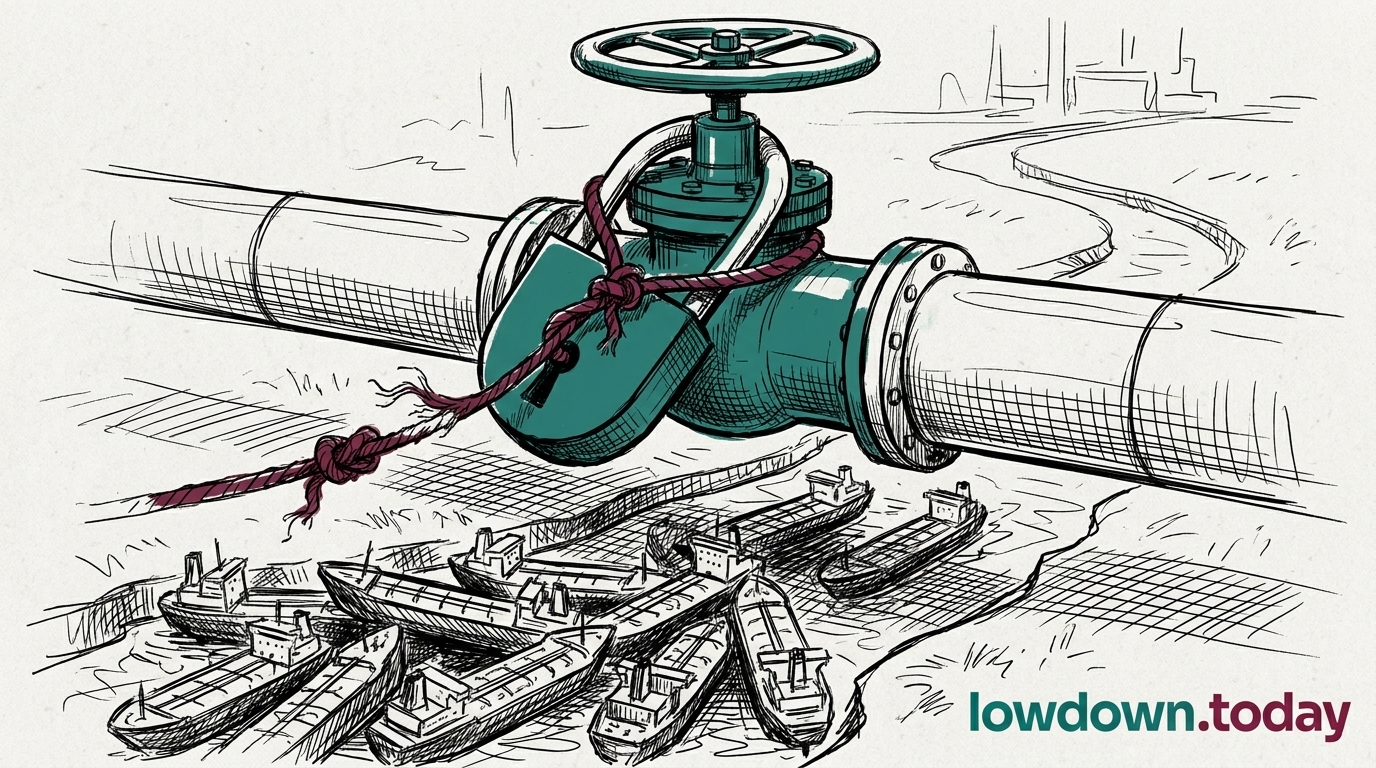
Iran formally suspended all negotiations through mediators with the United States at 09:56 on Monday 1 June, citing Israel's continuing strikes in Lebanon as a ceasefire breach. Foreign Minister Abbas Araghchi posted that "a violation on one front is a violation of the ceasefire on all fronts", the Foreign Ministry line relayed through the IRGC-affiliated Tasnim news agency, an outlet tied to the Islamic Revolutionary Guard Corps (IRGC), Iran's ideological military branch 1. Tehran acted through a formal diplomatic channel rather than a statement, and that act forced Trump to phone Netanyahu and halt Israel's Beirut strikes four hours later .

Speaker Mohammad Bagher Ghalibaf accused Washington of breaching the MOU, the unsigned Iran-US memorandum of understanding, through its naval blockade, hardening a pre-refusal of ratification he had issued the same morning . IRGC Major General Mohsen Rezaei went further: "the strait of Hormuz is under Iran's control. We will not allow the naval blockade to continue" 2. At 10:04 Tasnim authorised activating "other fronts including the Bab el-Mandeb strait", the Red Sea chokepoint between Yemen and the Horn of Africa through which roughly 6% of global oil trade passes.

Tehran authorised the second front but has not yet acted on it. No vessel has been interdicted at Bab el-Mandeb in this wave, and the Yemen-based Houthis have not formally moved 3. Khamenei's office, not parliament, controls the IRGC and the nuclear file, which is why a Tasnim release carries the weight a ministry podium would not, and why the suspension could be ordered and reversed inside a day without institutional friction.


Deep Analysis

In plain English

Iran and the United States have been trying to negotiate through intermediary countries, primarily Pakistan. On 1 June, Iran's Foreign Minister Abbas Araghchi announced Iran was stopping all those intermediary talks, blaming Israel's continued military operations in Lebanon. At the same time, Iran's military wing, the Islamic Revolutionary Guard Corps (IRGC), signalled it could activate a second shipping bottleneck: the Bab el-Mandeb strait, a narrow passage between Yemen and Djibouti that connects the Red Sea to the Gulf of Aden. About 6% of global oil and a large portion of container shipping passes through it. The Houthis, a Yemen-based armed group backed by Iran, previously blocked this strait in 2023-24 during the Gaza war. As of 2 June, no formal Houthi blockade had started, but the threat had been issued.

Deep Analysis
Root Causes

Iran's suspension mechanism has a specific structural basis in its 2026 ceasefire architecture. Araghchi's 1 June statement, 'a violation on one front is a violation of the ceasefire on all fronts', draws directly on Iran's three-phase ceasefire proposal submitted on 27 April, which explicitly demanded Lebanon be included in Phase 1 guarantees.

When Israel excluded Lebanon from the Iran-US ceasefire on day one, Tehran reserved the right to treat multi-front violations as a single breach. The 1 June suspension therefore rests on a legal position Iran had publicly stated, not improvised.

The second structural driver is the IRGC's decentralised launch authority, established after the February 2026 strikes. With 31 autonomous provincial units holding independent activation capacity, the IRGC can threaten Bab el-Mandeb without transmitting an order through channels that Araghchi's diplomatic reversal could intercept. The Houthis were placed on standby via an authorisation already delegated down the chain before talks began.

What could happen next?
  • Risk

    A Houthi activation of Bab el-Mandeb would add a second simultaneous chokepoint closure to the Strait of Hormuz blockade, compressing roughly 26% of global seaborne oil through the Cape of Good Hope route and adding 10-14 days to Asian-bound cargo transit times.

  • Consequence

    Ghalibaf's simultaneous pre-refusal of MOU ratification eliminates the possibility of a back-channel Araghchi compromise that the parliament later endorses, which was the mechanism that produced the 2015 JCPOA.

First Reported In

Update #115 · Iran moves first, Trump moves by phone

Euronews· 2 Jun 2026
Read original
Different Perspectives
Indian refiners
Indian refiners
Indian refiners kept lifting discounted Urals as the India/Baltic price split widened past $9-10 a barrel, a gap that only grows as GL X1's Iranian wind-down cuts an alternative discounted grade off the market by 17 July. Cheaper Russian feedstock is being locked in while it lasts.
Chinese refiners
Chinese refiners
Chinese refiners gain leverage as the Urals-Brent discount widens, since Beijing's state buyers already source discounted Russian barrels near the fiscal floor unaffected by Western insurance costs. A wider discount, if it holds past 23 July, lets them lock in cheaper term contracts regardless of the cap's outcome.
US money managers (CFTC-tracked)
Managed money trimmed WTI net length into the rally, positioning that reflects doubt the Hormuz premium survives without freight or war-risk confirmation. The Brent-WTI spread widening almost entirely on the Brent leg supports that scepticism about a broad-based repricing.
OPEC+ (Saudi-led subgroup)
Saudi Arabia is defending market share through a fourth straight 188kbd August hike even as OPEC's own July MOMR cut 2026 demand growth for the fourth consecutive month. At a $108-111 fiscal breakeven, every added barrel costs Riyadh revenue it cannot recoup, so the hike reads as a positioning signal, not a demand bet.
Greek shipping registries
Greece, backed by Cyprus and Malta, is pushing a three-month cap-freeze compromise against the Commission's freeze to January 2027 ahead of the 23 July vote. Athens' and Valletta's combined tanker registrations mean a shorter review gives their insurers more frequent chances to reprice risk on Russian cargoes.
Russia (Deputy PM Alexander Novak)
Novak extended the diesel export restriction to producers on 8 July, the first producer-binding curb of the war, protecting the domestic pump price ahead of any refinery repair timeline. Urals still trades below Russia's $59 budget floor even as Brent gained, so the ban trades export revenue for fiscal stability at home.