Skip to content
You can now search across every topic, entity and event.What's new
European Energy Markets
31JUL

Record UN resolution condemns Iran

3 min read
09:44UTC

The Security Council's most co-sponsored resolution in history condemns Iran's attacks on seven states — but the US-Israeli campaign that provoked them does not appear in the text.

EconomicDeveloping
Key takeaway

Record co-sponsorship gives the US-Israeli campaign multilateral legitimacy that the Congressional war powers vote could not provide.

The Security Council adopted Resolution 2817 on Wednesday, condemning Iran's attacks on Bahrain, Kuwait, Oman, Qatar, Saudi Arabia, the UAE, and Jordan. The vote was 13-0-2, with Russia and China abstaining. 135 states co-sponsored the text — surpassing the 134 behind the 2014 Ebola resolution to become the most co-sponsored Security Council resolution in UN history.

Russia's Ambassador Vassily Nebenzia explained Moscow's abstention: Russia would not block protection for Gulf States under fire but would not endorse a text that ignored the US-Israeli campaign provoking the attacks. Iran's Ambassador Amir Saeid Iravani called the resolution "a manifest injustice against my country, the main victim of a clear act of aggression." The abstention — rather than veto — follows a pattern: Russia and China allowed Libya's Resolution 1973 through in 2011 on the same logic, registering dissent while avoiding the diplomatic cost of blocking humanitarian protection, then spent years characterising the resulting NATO intervention as a betrayal of the resolution's stated purpose.

The resolution addresses one direction of fire in a multi-directional war. Iran's strikes on seven neighbours — which began as retaliation for the US-Israeli campaign launched on 28 February — are formally condemned. The campaign itself appears nowhere in the text. This outcome is structural, not incidental: the veto ensures that a permanent member's allies remain beyond the Council's reach. The same asymmetry prevented Council action on Israeli operations in Gaza across 2023–2024, when the US vetoed multiple ceasefire resolutions. The institution acts where its permanent members permit, and only there.

The co-sponsor count — 135 states — does represent genuine breadth of opposition to striking seven sovereign states simultaneously, regardless of provocation. The Arab League emergency session had already labelled Iran's attacks "treacherous" , a term in Arabic diplomatic register implying betrayal of the trust extended through the 2023 China-brokered rapprochement. The resolution translates that anger into the Council's formal record — an unusual degree of unanimity from states that spent three years rebuilding ties with Tehran and now consider that investment squandered.


Deep Analysis

In plain English

The UN Security Council is the world's most powerful diplomatic body for managing conflict. This vote had 135 countries formally sign on to condemning Iran's missile attacks — a record. Russia and China chose not to block it, even though they broadly support Iran. That signals near-universal agreement that Iran crossed a line. The catch is that this resolution condemns Iran's retaliation without addressing what caused it. The significance for ordinary people is that this vote makes it harder for countries to side with Iran diplomatically — and easier for the US to build coalitions for further pressure, including sanctions that affect global energy supply.

Deep Analysis
Synthesis

The 135 co-sponsors figure simultaneously legitimises the US campaign diplomatically and exposes its limits. Washington secured broad support for condemning Iran but has not built comparable consensus for the offensive military campaign itself. The resolution provides diplomatic cover without constituting endorsement of the war's conduct or objectives.

Root Causes

The GCC's co-sponsorship reflects accumulated grievances from two decades of Iranian proxy pressure: Houthi attacks on Saudi infrastructure, IRGC-linked strikes on UAE facilities, and Iranian support for Iraqi militias that struck Gulf interests. Wednesday's vote formalises resentments that substantially predate this conflict.

Escalation

The resolution's passage without veto removes a potential blocking mechanism for follow-on coercive measures. Russia and China's abstention — rather than veto — preserves their diplomatic flexibility while avoiding the reputational cost of blocking Gulf state protection. The 135 co-sponsors creates a ready-made coalition for expanded sanctions or asset freezes against Iranian entities.

What could happen next?
  • Precedent

    135 co-sponsors creates the largest multilateral diplomatic record against any single state since the post-9/11 resolutions, providing a ready legal basis for escalated sanctions.

    Short term · Assessed
  • Meaning

    The US has secured multilateral legal cover for a conflict that Congress never formally authorised through the war powers process.

    Immediate · Assessed
  • Consequence

    Russia and China's abstention rather than veto signals calibrated restraint, preserving their diplomatic flexibility while avoiding the reputational cost of blocking Gulf state protection.

    Immediate · Assessed
  • Risk

    Record condemnation without addressing root causes risks cementing the Security Council as a legitimation mechanism for stronger parties rather than a conflict resolution forum.

    Long term · Suggested
First Reported In

Update #32 · UN condemns Iran 13-0; ceasefire blocked

United Nations· 12 Mar 2026
Read original
Causes and effects
This Event
Record UN resolution condemns Iran
The most co-sponsored resolution in UN history formalises broad international opposition to Iran's regional strikes while leaving the US-Israeli campaign entirely unaddressed — an outcome determined by which side's allies hold permanent vetoes, not by the merits of either side's conduct.
Different Perspectives
Spain's LNG terminal operators
Spain's 9,145 GWh terminal inventory is the largest single stock in the EU LNG network, an option value that can reroute cargoes wherever the winter strip pays best rather than a cavern gas obligation tied to a fixed date. That flexibility matters more as Germany's cavern shortfall pushes more of the winter security question onto import infrastructure.
European Commission
European Commission
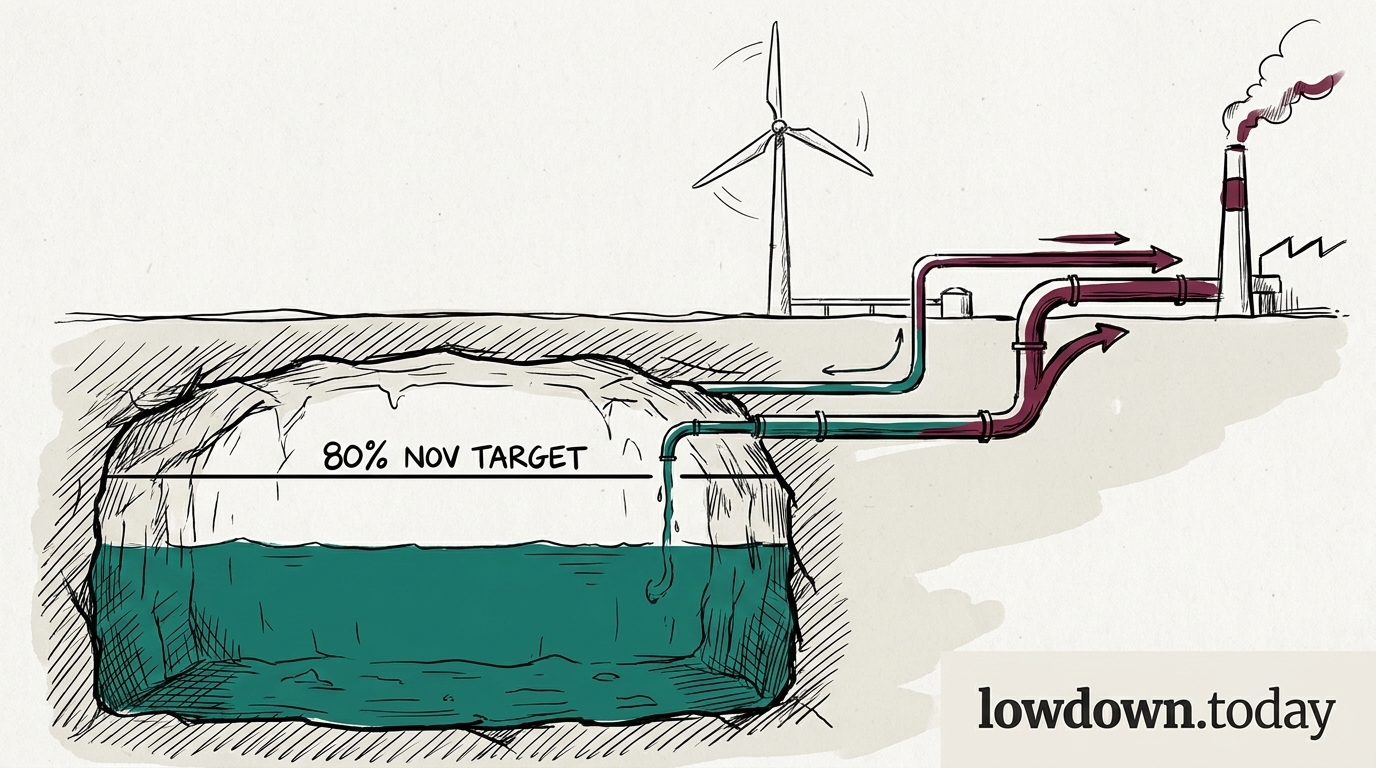
Brussels holds the bloc to 90% on a flexible window while Germany, holding roughly a quarter of EU storage capacity, tracks toward missing its own lower 80% figure by 21 points. A national shortfall this size in the anchor market matters more to bloc security than the flexible timetable alone can absorb.
French power exporters and CRE
French day-ahead rose in step with Germany but by less, reopening a EUR 7-17 premium that makes northward export flows commercially attractive again after the EUR 43.09 discount evaporated in days. CRE separately authorised RTE and Enedis to buy flexibility locally, betting the coming winter's binding constraint is grid congestion rather than a shortage of firm capacity.
TTF trading desk
TTF trading desk
A visible national shortfall like Germany's 21-point gap is a directional signal, not noise, for a desk holding the summer-winter spread. TTF's flat EUR 58-60 range through this week's German price swings says the market has not yet chosen to reprice refill risk into the front of the curve.
German cavern and CCGT operators
German caverns kept buying prompt gas at TTF near EUR 58-60 through the inversion; the wind collapse to 2.4 GW then flipped the spark spread to plus EUR 29 and put turbines back in the same queue. Every day turbines win that bid, injection at a third of the 877 GWh/day pace needed falls further behind.
Slovakia
Slovakia
Slovakia says it dropped its hold-out on the 21st sanctions package only after Ursula von der Leyen personally signed written gas-price and supply guarantees. The Council of the European Union's own 17,238-character release on the package names neither Slovakia nor any guarantee, leaving Bratislava's account unconfirmed by the institutional record.



