Skip to content
You can now search across every topic, entity and event.What's new
European Energy Markets
31JUL

Kuwait invokes Article 51 after strike

3 min read
09:44UTC

Kuwait made the first formal self-defence claim by a Gulf state in the war after Iran struck Ali Al Salem Air Base on 28 May; CENTCOM struck back near Bandar Abbas and denied a fresh Iranian downing claim.

EconomicDeveloping
Key takeaway

Kuwait made the first Gulf self-defence claim of the war, short of invoking its US pact.

Kuwait invoked Article 51 of the UN Charter, the individual right of self-defence, after Iran struck Ali Al Salem Air Base on 28 May, the first formal legal self-defence claim by a Gulf state in the war. 1 Article 51 is the Charter clause preserving a state's right to defend itself against an armed attack, and it is the doorway to collective defence: the provision Kuwait would cite to ask allies, including the United States, to act on its behalf. The strike was heavier than the single ballistic missile first reported . One aggregated account describes multiple ballistic and cruise missiles and drones aimed at the US-used base; 2 US Central Command, CENTCOM, the US military command for the Middle East, put the count lower, at one intercepted missile with two shrapnel injuries. 3 The true scale sits between those claims and is not yet settled.

Whether Kuwait has the standing to invoke Article 51 against a state that denies responsibility is contested, and it has not yet triggered its bilateral US defence pact. CENTCOM struck a drone-control station near Bandar Abbas in response, the same complex it had hit days earlier , and on 29 May denied Iran's claim to have downed a US aircraft near Qeshm, calling it a repeat of the false MQ-9 Reaper claim from earlier in the week . 4

The legal claim raises the ceiling for allied involvement without compelling it. The real escalation trigger is a second strike, which Article 51 now pre-justifies a response to. Iran's posture compounds the risk: claiming a downed US jet while disputing the missile scale, it is banking propaganda victories its own footage cannot support, which erodes the credibility it needs when it makes a claim that is true.


Deep Analysis

In plain English

Ali Al Salem Air Base in Kuwait is used by both Kuwait and the United States. On 28 May Iran fired at least one ballistic missile at the base; Kuwait's air defences shot it down, with two people lightly wounded. Kuwait then formally invoked Article 51 of the UN Charter, which is the provision that lets countries say 'we have the right to defend ourselves' in front of the world. Article 51 matters because it opens the door to asking allies for help. If Kuwait were to formally request US military action under its 1994 defence pact, Article 51 would be the legal foundation. The US military (CENTCOM) hit a drone-control site at the Iranian port city of Bandar Abbas in response and denied Iran's claim to have shot down a US aircraft nearby.

Deep Analysis
Root Causes

Iran's decision to strike Ali Al Salem Air Base, a US-used Kuwaiti facility, rather than a purely US-flagged target reflects a shift in IRGC target logic since the Decentralised Mosaic Defence devolved launch authority to 31 provincial units. A Gulf Arab base hosting US forces presents a target that complicates US response: striking back risks appearing to defend a Gulf monarchy rather than US personnel, which has distinct domestic US political costs that a strike on a US Navy vessel would not.

The false claim of downing a US aircraft near Qeshm on 29 May, the second such false claim after the Reaper-drone downing claim, reflects a separate IRGC information-operations logic: the IRGC gains domestic propaganda credit for alleged victories without requiring the technical capability to produce them.

CENTCOM's denials confirm the falsity but also amplify the claims, creating a cycle where each false claim requires a CENTCOM response that itself provides Iranian state media with coverage.

What could happen next?
  • Precedent

    Kuwait's individual Article 51 invocation goes beyond the collective GCC statement of 6 April, creating a state-specific legal record that directly enables a future bilateral defence-pact activation against Iran.

  • Risk

    IRGC's repeated false-downing claims, each denied by CENTCOM, create an information cycle that boosts domestic Iranian morale without requiring actual capability, potentially lowering the political cost of further strikes.

First Reported In

Update #112 · Treasury opens a second Iran sanctions front

GlobalSecurity.org· 30 May 2026
Read original
Causes and effects
This Event
Kuwait invokes Article 51 after strike
Article 51 is the legal doorway to collective defence, raising the ceiling for allied involvement without yet compelling it.
Different Perspectives
Spain's LNG terminal operators
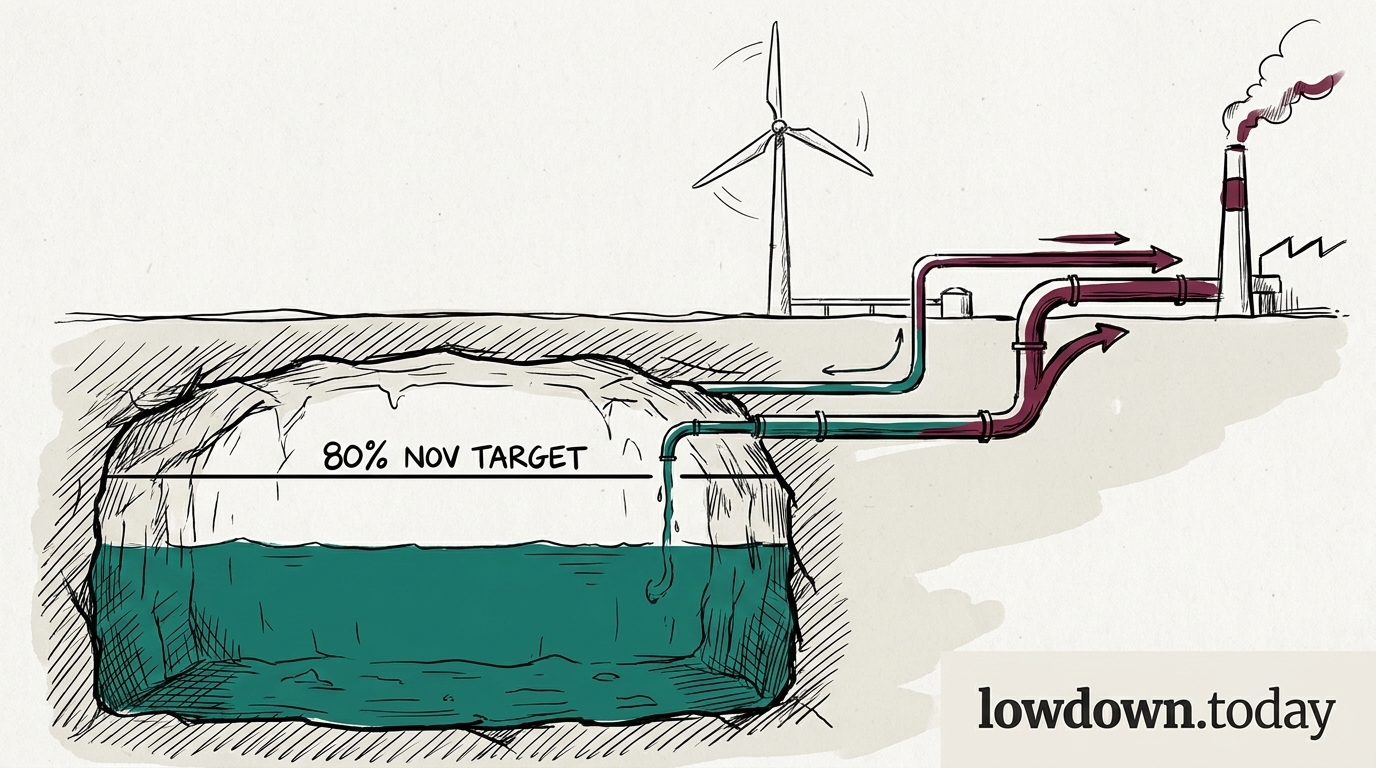
Spain's 9,145 GWh terminal inventory is the largest single stock in the EU LNG network, an option value that can reroute cargoes wherever the winter strip pays best rather than a cavern gas obligation tied to a fixed date. That flexibility matters more as Germany's cavern shortfall pushes more of the winter security question onto import infrastructure.
European Commission
European Commission
Brussels holds the bloc to 90% on a flexible window while Germany, holding roughly a quarter of EU storage capacity, tracks toward missing its own lower 80% figure by 21 points. A national shortfall this size in the anchor market matters more to bloc security than the flexible timetable alone can absorb.
French power exporters and CRE
French day-ahead rose in step with Germany but by less, reopening a EUR 7-17 premium that makes northward export flows commercially attractive again after the EUR 43.09 discount evaporated in days. CRE separately authorised RTE and Enedis to buy flexibility locally, betting the coming winter's binding constraint is grid congestion rather than a shortage of firm capacity.
TTF trading desk
TTF trading desk
A visible national shortfall like Germany's 21-point gap is a directional signal, not noise, for a desk holding the summer-winter spread. TTF's flat EUR 58-60 range through this week's German price swings says the market has not yet chosen to reprice refill risk into the front of the curve.
German cavern and CCGT operators
German caverns kept buying prompt gas at TTF near EUR 58-60 through the inversion; the wind collapse to 2.4 GW then flipped the spark spread to plus EUR 29 and put turbines back in the same queue. Every day turbines win that bid, injection at a third of the 877 GWh/day pace needed falls further behind.
Slovakia
Slovakia
Slovakia says it dropped its hold-out on the 21st sanctions package only after Ursula von der Leyen personally signed written gas-price and supply guarantees. The Council of the European Union's own 17,238-character release on the package names neither Slovakia nor any guarantee, leaving Bratislava's account unconfirmed by the institutional record.



