Skip to content
You can now search across every topic, entity and event.What's new
European Energy Markets
31JUL

Islamabad Accord was already a corpse

3 min read
09:44UTC

Qatar walked away from mediation two weeks before the Pakistan framework was held up as a ceasefire route, and Iran had already refused to attend the venue.

EconomicDeveloping
Key takeaway

The accord exists as a document, not a process, and was constructed to label the deadline-extension cycle.

Qatar's Ministry of Foreign Affairs publicly declined the central mediator role on 24 March, when Dr. Majid Al Ansari, advisor to the Qatari Prime Minister, stated that Qatar "wasn't engaging in any direct mediation efforts between the United States of America and Iran" 1. Qatar is the only Gulf state with active back-channels to both Tehran and Washington. It walked away from the role two weeks before the Islamabad framework was held up as the ceasefire route.

The Wall Street Journal then reported on 3 April, citing two regional officials familiar with the talks, that the Pakistan-led mediation had already hit a dead end: Iran had refused to attend the proposed Islamabad meetings and called Washington's conditions "unacceptable" 2. Three days after that report, the "Islamabad Accord" was publicly announced. The framework that yesterday's coverage treated as a ceasefire breakthrough functioned, on the documentary record, as face-saving extension cover for Trump and a regional credibility play for Field Marshal Asim Munir.

The IRGC's prior block on Pezeshkian sits behind Tehran's refusal to attend; the men who would have had to authorise the venue were already procedurally walled off from anyone who could deliver a ceasefire signal. Pakistan got the press conference, Trump got the extension, and the actual mechanics of a ceasefire stayed exactly where they were. We led on the Pakistan framework yesterday. We are correcting the framing today: with Qatar out and Iran refusing the venue, the Islamabad Accord exists on paper without a room behind it.


Deep Analysis

In plain English

The Islamabad Accord was presented in recent coverage as a hopeful ceasefire framework brokered through Pakistan. Today's reporting establishes that it was announced after the process behind it had already collapsed. Qatar , the only Gulf state with active lines to both Tehran and Washington , publicly said it was not mediating, two weeks before the accord was named. Iran had already refused to attend the proposed meetings. Pakistan's army chief got a press conference; no one got a ceasefire room. The accord exists as a document, not a process.

Deep Analysis
Synthesis

The accord's exposure as hollow is itself a diplomatic fact with consequences: it removes the US administration's preferred extension framing without replacing it with a credible alternative, narrowing the space between another naked extension and a genuine escalation decision.

Root Causes

Qatar's withdrawal reflects the risk calculus of a state that hosts the largest US airbase in the Middle East (Al Udeid) while maintaining active back-channels to Tehran.

Being named as central mediator would have exposed Doha to pressure from both sides without giving it meaningful control over the outcome.

Iran's refusal to attend the Islamabad meetings stems from the IRGC's prior veto on Pezeshkian's negotiating mandate, documented at and , the apparatus that would have had to authorise the venue is the same apparatus blocking civilian access to Khamenei.

What could happen next?
  • Consequence

    With the Islamabad framework exposed as hollow, the US administration loses its principal extension-labelling tool, making the choice between a seventh naked extension and a genuine escalation decision more visible domestically.

  • Risk

    If neither side names a credible replacement channel, the absence of any functioning diplomatic architecture makes misreading of Iranian signals , or US strike escalation , more likely over the next deadline cycle.

First Reported In

Update #61 · Carriers retreat; Iran codifies Hormuz

Fraunhofer ISE energy-charts (redistributing Bundesnetzagentur SMARD under CC BY 4.0)· 7 Apr 2026
Read original
Different Perspectives
Spain's LNG terminal operators
Spain's 9,145 GWh terminal inventory is the largest single stock in the EU LNG network, an option value that can reroute cargoes wherever the winter strip pays best rather than a cavern gas obligation tied to a fixed date. That flexibility matters more as Germany's cavern shortfall pushes more of the winter security question onto import infrastructure.
European Commission
European Commission
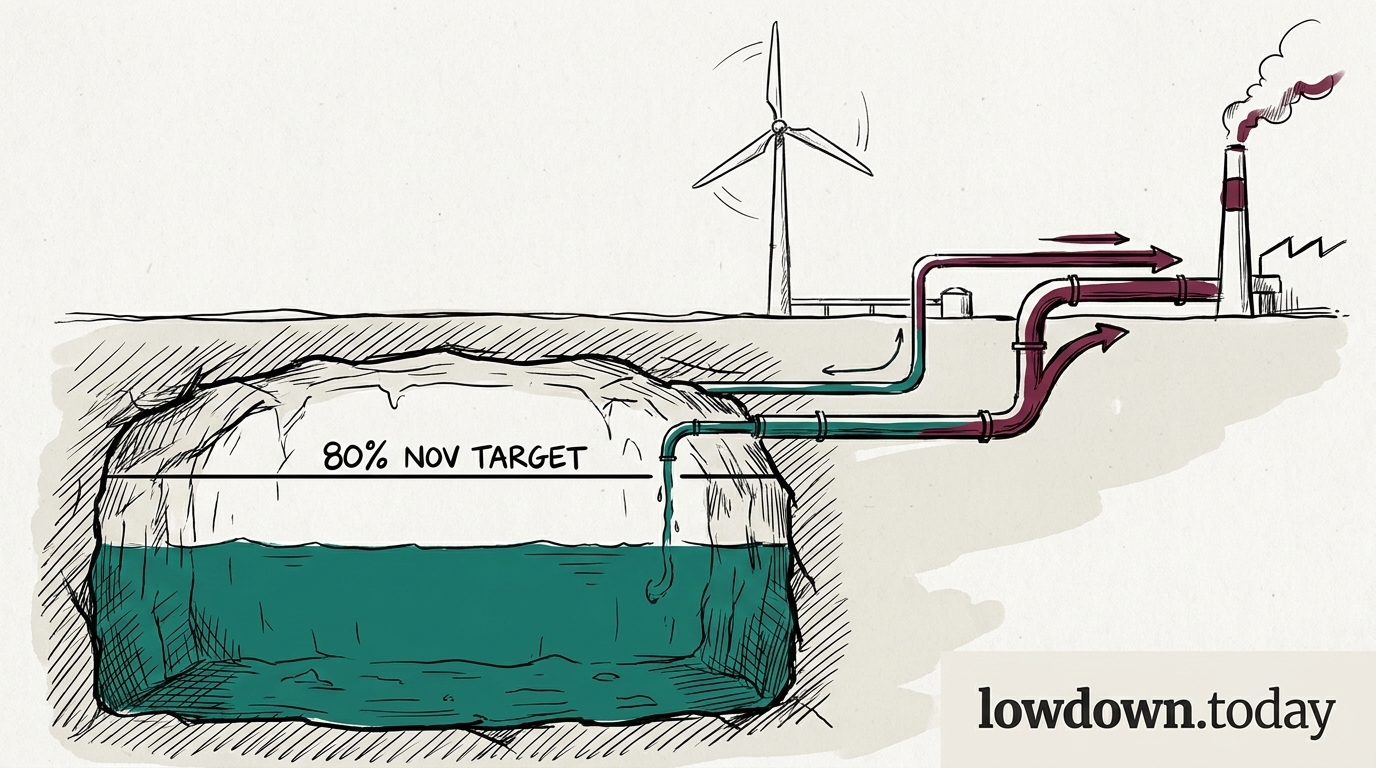
Brussels holds the bloc to 90% on a flexible window while Germany, holding roughly a quarter of EU storage capacity, tracks toward missing its own lower 80% figure by 21 points. A national shortfall this size in the anchor market matters more to bloc security than the flexible timetable alone can absorb.
French power exporters and CRE
French day-ahead rose in step with Germany but by less, reopening a EUR 7-17 premium that makes northward export flows commercially attractive again after the EUR 43.09 discount evaporated in days. CRE separately authorised RTE and Enedis to buy flexibility locally, betting the coming winter's binding constraint is grid congestion rather than a shortage of firm capacity.
TTF trading desk
TTF trading desk
A visible national shortfall like Germany's 21-point gap is a directional signal, not noise, for a desk holding the summer-winter spread. TTF's flat EUR 58-60 range through this week's German price swings says the market has not yet chosen to reprice refill risk into the front of the curve.
German cavern and CCGT operators
German caverns kept buying prompt gas at TTF near EUR 58-60 through the inversion; the wind collapse to 2.4 GW then flipped the spark spread to plus EUR 29 and put turbines back in the same queue. Every day turbines win that bid, injection at a third of the 877 GWh/day pace needed falls further behind.
Slovakia
Slovakia
Slovakia says it dropped its hold-out on the 21st sanctions package only after Ursula von der Leyen personally signed written gas-price and supply guarantees. The Council of the European Union's own 17,238-character release on the package names neither Slovakia nor any guarantee, leaving Bratislava's account unconfirmed by the institutional record.



