Skip to content
You can now search across every topic, entity and event.What's new
European Energy Markets
31JUL

Iran defers nuclear talks past ceasefire

3 min read
09:44UTC

Pakistan delivered Iran's revised ceasefire proposal to Washington on 28 April; nuclear talks now sit in a post-war Phase 3, and Marco Rubio called the offer 'better than we thought'.

EconomicDeveloping
Key takeaway

Iran routed a two-phase ceasefire through Pakistan; Rubio called the offer 'better than we thought'.

Pakistan delivered Iran's revised two-phase ceasefire proposal to Washington on 28 April 2026. Phase 1 calls for full cessation of hostilities and binding guarantees against renewed attacks on Iran and Lebanon; Phase 2 covers Strait of Hormuz management and security. Nuclear talks are deferred entirely to a post-war Phase 3, a substantive change from the three-phase document Pakistan carried on 27 April which placed nuclear sequencing as a pre-ceasefire condition. Al Jazeera confirmed the text via the Pakistani government channel.

Marco Rubio, the US Secretary of State, called the offer 'better than we thought' but raised verification concerns. The assessment is the most positive US public signal yet on a ceasefire text, and arrives 24 hours before the War Powers Resolution (WPR) 60-day clock expires . Iranian Foreign Minister Abbas Araghchi ran a three-day shuttle through Islamabad twice, Muscat, and St Petersburg, where he met Vladimir Putin at the Boris Yeltsin Library . Donald Trump rejected the earlier three-phase version on Truth Social; the cancelled Steve Witkoff and Jared Kushner Pakistan trip leaves Pakistan as the sole active mediator, displacing Oman's bilateral track that ran the early war.

Deferring nuclear talks to the post-war period is the same procedural move JCPOA (Joint Comprehensive Plan of Action) negotiators used in 2013 to break a sequencing impasse: settle the politics first, settle the verification later. The 2013 framework had a P5+1 structure to carry the verification weight; this proposal has Pakistan and one Truth Social rejection. Phase 1's binding guarantees against renewed attacks on Lebanon expand the geographic scope of the ceasefire beyond Iran itself, recognising Hezbollah's operational entanglement with Iranian command. The verification gap Rubio flagged is the procedural lever Washington can use to slow the text without rejecting it, particularly if Senator Lisa Murkowski's AUMF lands on Congress.gov before the deadline and forces the executive into adversarial-text territory.

The revised text now sits at the State Department alongside a 60-day US signing column that has remained empty throughout the conflict.


Deep Analysis

In plain English

Pakistan handed a written ceasefire proposal from Tehran to Washington on 28 April, acting as the go-between because Iran and the United States have no direct diplomatic channel. Iran's offer has two stages. First: stop the fighting and give Iran guarantees that neither the US nor Israel will attack again. Second, once the war is over: figure out the Hormuz shipping rules. The most controversial issue, Iran's nuclear programme, has been moved entirely off the table for now. Secretary of State Marco Rubio called this version better than the previous one, the most positive thing Washington has said publicly about any Iranian proposal since the war began on 28 February.

Deep Analysis
Root Causes

Pakistan's emergence as the sole active mediating channel after the Witkoff-Kushner trip cancellation reflects a structural asymmetry in the diplomatic architecture: Islamabad has civilian and military buy-in on the Iranian side that no Western interlocutor has achieved. Army Chief Asim Munir's April meetings secured Iranian agreement in principle to outside nuclear monitoring. The Foreign Ministry channel through Araghchi runs in parallel, not subordinate to, the IRGC's operational posture.

The revision from three phases to two reflects Iranian domestic politics as much as diplomatic flexibility. The three-phase structure that Pakistan carried on 27 April included nuclear sequencing as a pre-war condition, a position that the IRGC hardline faction, led by Ahmad Vahidi, had publicly endorsed.

Dropping nuclear sequencing to a post-war track removes a point of IRGC-Foreign Ministry alignment, suggesting Araghchi won an internal argument about what is negotiable without Khamenei's written position moving.

What could happen next?
  • Opportunity

    Rubio's positive public signal creates the first credible diplomatic window for a signed ceasefire instrument before the War Powers Resolution deadline at 12:01 EDT on 1 May, which would remove the WPR's legally awkward teeth before they need to be applied.

    Immediate · 0.65
  • Risk

    Pakistan's role as sole mediating channel is structurally fragile: Islamabad has no enforcement mechanism if either party rejects the next text, and the cancellation of the Witkoff-Kushner trip means there is no US-side backup channel if Pakistan's mediation stalls.

    Short term · 0.8
  • Consequence

    Deferring nuclear talks to the post-war period leaves Iran's 440.9 kg of 60% enriched uranium unaddressed under any ceasefire text, which means European signatories to a potential peace framework would need to accept a nuclear ambiguity clause with no IAEA verification scheduled.

    Medium term · 0.75
First Reported In

Update #83 · UAE quits OPEC, war signs nothing

Al Jazeera· 29 Apr 2026
Read original
Different Perspectives
Spain's LNG terminal operators
Spain's 9,145 GWh terminal inventory is the largest single stock in the EU LNG network, an option value that can reroute cargoes wherever the winter strip pays best rather than a cavern gas obligation tied to a fixed date. That flexibility matters more as Germany's cavern shortfall pushes more of the winter security question onto import infrastructure.
European Commission
European Commission
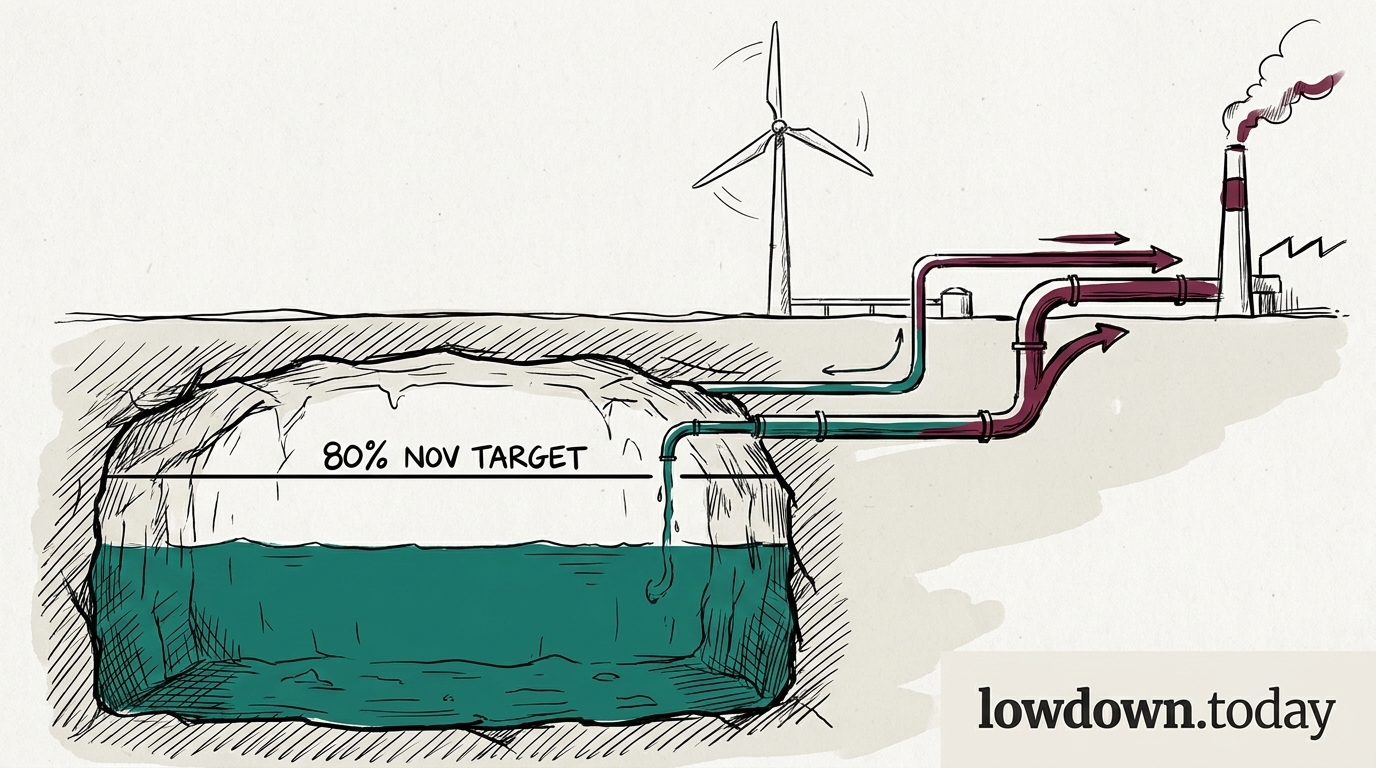
Brussels holds the bloc to 90% on a flexible window while Germany, holding roughly a quarter of EU storage capacity, tracks toward missing its own lower 80% figure by 21 points. A national shortfall this size in the anchor market matters more to bloc security than the flexible timetable alone can absorb.
French power exporters and CRE
French day-ahead rose in step with Germany but by less, reopening a EUR 7-17 premium that makes northward export flows commercially attractive again after the EUR 43.09 discount evaporated in days. CRE separately authorised RTE and Enedis to buy flexibility locally, betting the coming winter's binding constraint is grid congestion rather than a shortage of firm capacity.
TTF trading desk
TTF trading desk
A visible national shortfall like Germany's 21-point gap is a directional signal, not noise, for a desk holding the summer-winter spread. TTF's flat EUR 58-60 range through this week's German price swings says the market has not yet chosen to reprice refill risk into the front of the curve.
German cavern and CCGT operators
German caverns kept buying prompt gas at TTF near EUR 58-60 through the inversion; the wind collapse to 2.4 GW then flipped the spark spread to plus EUR 29 and put turbines back in the same queue. Every day turbines win that bid, injection at a third of the 877 GWh/day pace needed falls further behind.
Slovakia
Slovakia
Slovakia says it dropped its hold-out on the 21st sanctions package only after Ursula von der Leyen personally signed written gas-price and supply guarantees. The Council of the European Union's own 17,238-character release on the package names neither Slovakia nor any guarantee, leaving Bratislava's account unconfirmed by the institutional record.



