Skip to content
You can now search across every topic, entity and event.What's new
European Energy Markets
31JUL

Iran charts Hormuz with formal PGSA coordinates

4 min read
09:44UTC

Iran's Persian Gulf Strait Authority published the formal coordinates of its Hormuz controlled zone on 20 May: eastern boundary from Kuh-e Mubarak to Fujairah, western boundary from Qeshm to Umm Al-Quwain, with all vessels inside required to obtain authorisation.

EconomicDeveloping
Key takeaway

Once coordinates are published, neighbours and underwriters must respond on paper or accept by silence. Tehran has forced that choice.

Iran's Persian Gulf Strait Authority (PGSA, the Iranian maritime body administering the toll architecture) published the formal coordinates of its "controlled maritime zone" on Wednesday 20 May 1. The eastern boundary runs from Kuh-e Mubarak on the Iranian coast to southern Fujairah in the UAE; the western boundary runs from the tip of Qeshm Island in Iran to Umm Al-Quwain in the UAE. All vessels inside the zone, per the Iran International notice, must coordinate with the authority and obtain authorisation. PGSA has opened its vessel-submission portal four days earlier and is still withholding the fee schedule it promised .

The coordinates convert what had been operational practice and the Majlis's earlier toll bill into a cartographic-legal claim. Verbal declarations of authority can be walked back; published coordinates cannot, because they trigger a written obligation on neighbours and flag states. The United Arab Emirates has not, as of writing, published a counter-coordinate set, which leaves Emirati silence as a maritime-law response.

The insurance consequence runs through Lloyd's of London. Until Wednesday, underwriters had a verbal toll claim and a portal whose fee schedule remained unwritten. With coordinates on a chart, the boundary can be modelled: tanker routes can be plotted against the zone, war-risk premium tiers can be drawn against entry and exit lines, and the structural insurance layer Goldman Sachs and Morgan Stanley flagged on 12 May now has the cartographic input it needs to price.

Tehran chose to publish coordinates while withholding the fee, and the asymmetry reads as deliberate. The chart converts the zone into a legal fact; the missing fee preserves Iranian discretion over what compliance actually costs. Flag states and underwriters now have to accept or reject the cartography on paper, while Tehran retains the room to set the price later.


Deep Analysis

In plain English

Iran's newly formed Persian Gulf Strait Authority published precise GPS-style boundary coordinates for the maritime zone it says it controls at the Strait of Hormuz. This is the narrow waterway through which roughly 20% of the world's oil passes. Before this, Iran had made verbal statements claiming it had authority over ships passing through. Publishing exact coordinates is a significant step up: it creates a written, mappable boundary that other countries and shipping companies now have to formally respond to or ignore on the record. Iran is saying: all ships inside this zone need to get our permission. It has not yet published what it will charge for that permission, which appears deliberate; Iran gets the legal claim on paper while keeping flexibility on the price. Shipping insurers and naval commanders now have a specific map they must account for, even if they do not accept its legal validity.

What could happen next?
  • Precedent

    Flag states that do not publish formal counter-coordinates within 90 days risk having their silence interpreted as acquiescence under customary international law. The UAE, as a state whose own coastline provides two of the PGSA zone's four boundary reference points, faces the most immediate pressure to respond on paper.

    Short term · Suggested
  • Consequence

    Lloyd's of London underwriters now have the cartographic input needed to model war-risk premiums against specific vessel entry and exit points in the declared zone. The coordinate publication enables tiered premium structures; vessels transiting the zone pay a higher premium than vessels skirting the boundary; which partially implements the insurance-layer effect of the PGSA architecture without Iranian enforcement.

    Immediate · Assessed
  • Risk

    The withheld fee schedule creates a second-stage legal moment: when PGSA publishes its tariff, flag states and Rubio's 'completely illegal' position will face a concrete enforcement test. The coordinate publication without a fee is a deliberate staging that preserves Iranian discretion on timing.

    Short term · Assessed
First Reported In

Update #105 · Khamenei keeps the uranium; House pulls the vote

Iran International· 22 May 2026
Read original
Different Perspectives
Spain's LNG terminal operators
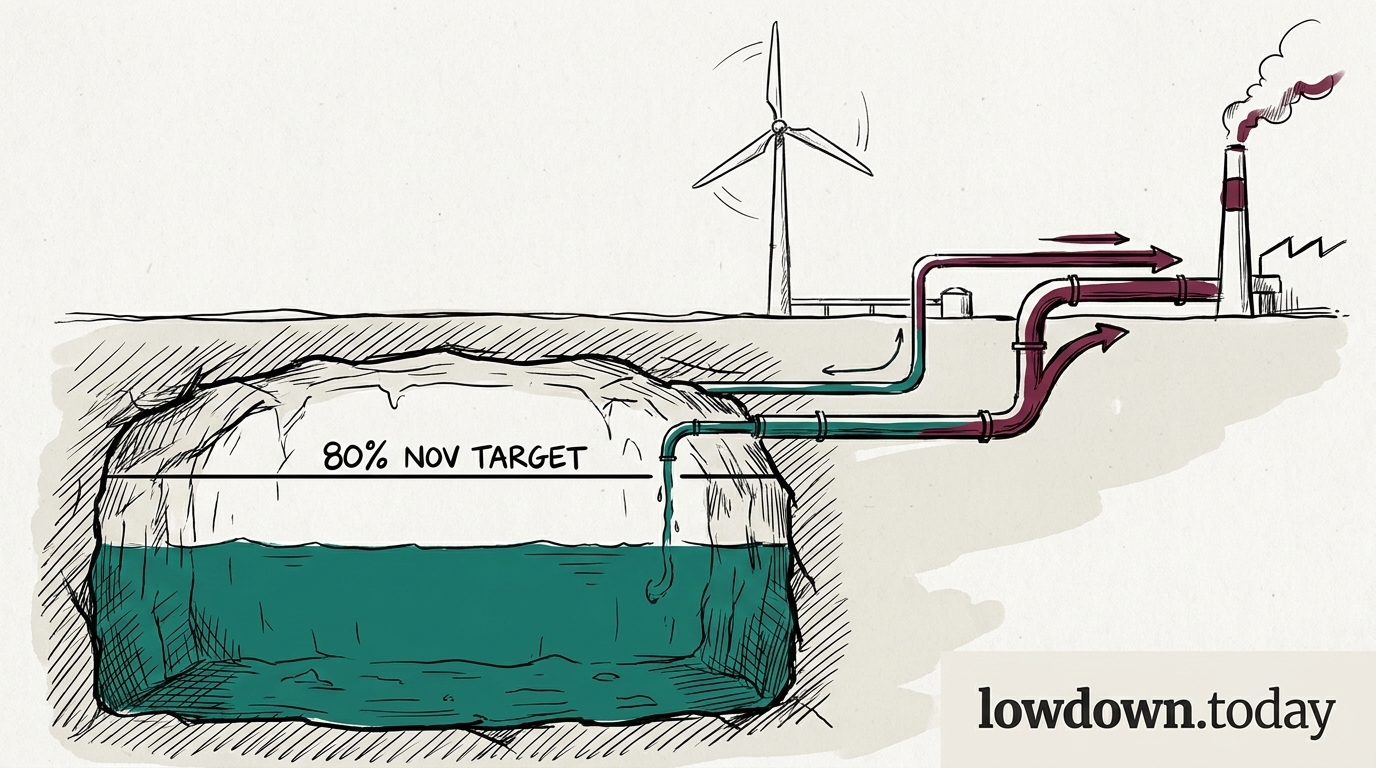
Spain's 9,145 GWh terminal inventory is the largest single stock in the EU LNG network, an option value that can reroute cargoes wherever the winter strip pays best rather than a cavern gas obligation tied to a fixed date. That flexibility matters more as Germany's cavern shortfall pushes more of the winter security question onto import infrastructure.
European Commission
European Commission
Brussels holds the bloc to 90% on a flexible window while Germany, holding roughly a quarter of EU storage capacity, tracks toward missing its own lower 80% figure by 21 points. A national shortfall this size in the anchor market matters more to bloc security than the flexible timetable alone can absorb.
French power exporters and CRE
French day-ahead rose in step with Germany but by less, reopening a EUR 7-17 premium that makes northward export flows commercially attractive again after the EUR 43.09 discount evaporated in days. CRE separately authorised RTE and Enedis to buy flexibility locally, betting the coming winter's binding constraint is grid congestion rather than a shortage of firm capacity.
TTF trading desk
TTF trading desk
A visible national shortfall like Germany's 21-point gap is a directional signal, not noise, for a desk holding the summer-winter spread. TTF's flat EUR 58-60 range through this week's German price swings says the market has not yet chosen to reprice refill risk into the front of the curve.
German cavern and CCGT operators
German caverns kept buying prompt gas at TTF near EUR 58-60 through the inversion; the wind collapse to 2.4 GW then flipped the spark spread to plus EUR 29 and put turbines back in the same queue. Every day turbines win that bid, injection at a third of the 877 GWh/day pace needed falls further behind.
Slovakia
Slovakia
Slovakia says it dropped its hold-out on the 21st sanctions package only after Ursula von der Leyen personally signed written gas-price and supply guarantees. The Council of the European Union's own 17,238-character release on the package names neither Slovakia nor any guarantee, leaving Bratislava's account unconfirmed by the institutional record.



