Skip to content
You can now search across every topic, entity and event.What's new
European Energy Markets
31JUL

Houthis widen their strikes to Yanbu

2 min read
09:44UTC

Aramco-linked sites on Saudi Arabia's Red Sea coast were struck on 25 July, after Reuters recorded IRGC personnel and equipment flying into Yemen on 13 July.

EconomicDeveloping
Key takeaway

Iranian personnel in Yemen give Tehran a hand in a Saudi escalation it cannot fully control.

Houthi forces struck Aramco-linked sites at Yanbu and Jazan on 25 July, widening a target set that had reached only Jazan's industrial city the previous day 1. CNN's geolocated video showed large fires in the Jazan industrial district; Saudi Arabia issued security alerts for both cities without confirming the strikes 2.

Yanbu sits on the Red Sea north of Jeddah and handles crude arriving by pipeline from the Eastern Province, the route Saudi exports take when the Gulf is unsafe. Striking it reaches the workaround rather than the chokepoint, and it puts a Houthi weapon on the far side of The Kingdom from Yemen. The analyst Mohammed Basha said the strikes end a "recent restraint in targeting strategic infrastructure inside Saudi Arabia" 3.

Between 10 and 21 Islamic Revolutionary Guard Corps personnel, including senior commanders, flew from Tehran into Yemen on 13 July along with missile and drone-related equipment, Reuters reported citing four sources 4. A Houthi media official who said he was aboard the flight denied any military experts were on it. Secretary of State Marco Rubio said the Houthis had been "snookered" by Iran into joining the war 5.

Tehran has treated the Houthis as a deniable instrument since the group took Sanaa in 2015, supplying matériel from a distance. Personnel physically embedded with Houthi forces narrows that deniability, and it cuts both ways: Washington and Riyadh acquire a sourced Iranian hand to point at, while Iran acquires a front it can neither disown convincingly nor call off on demand. The sequence already ran once this week, from the strike on the Saudi tanker NCC Masa to Saudi air strikes near Hodeidah . If Aramco damage is confirmed at Yanbu, the pressure on Riyadh to answer at a scale beyond Hodeidah becomes the war's next moving part.


Deep Analysis

In plain English

The Houthis, a Yemen-based armed group aligned with Iran, widened the list of places they attack on 25 July, hitting oil-industry sites at Jazan and Yanbu inside Saudi Arabia. Reuters reports Iran flew somewhere between 10 and 21 military personnel and equipment into Yemen on 13 July, shortly before this escalation, suggesting Iranian involvement even though Iran does not directly control the Houthis. US Secretary of State Marco Rubio said the Houthis had been "snookered", tricked, into joining a war on Iran's behalf.

Deep Analysis
Root Causes

Iran's use of the Houthis as a deniable front rests on a structural feature of the relationship: Tehran supplies personnel, equipment and targeting expertise without exercising direct operational command, letting it escalate pressure on Saudi Arabia while retaining plausible deniability if the strikes draw a direct US or Saudi response.

Secretary of State Marco Rubio's characterisation of the Houthis as "snookered" inverts that logic, casting them as the party losing agency rather than Iran's instrument, which matters for whether any retaliation lands on Tehran or on Sanaa.

What could happen next?
  • Consequence

    A documented Iranian personnel presence in Yemen gives Washington grounds to attribute Houthi escalation to Tehran when deciding on any response.

  • Risk

    Targeting Aramco-linked infrastructure directly, rather than shipping, raises the stakes for Saudi Arabia's own restraint, which had held since March.

First Reported In

Update #162 · Munitions, not Iran, halted US bombing

CNN· 26 Jul 2026
Read original
Different Perspectives
Spain's LNG terminal operators
Spain's 9,145 GWh terminal inventory is the largest single stock in the EU LNG network, an option value that can reroute cargoes wherever the winter strip pays best rather than a cavern gas obligation tied to a fixed date. That flexibility matters more as Germany's cavern shortfall pushes more of the winter security question onto import infrastructure.
European Commission
European Commission
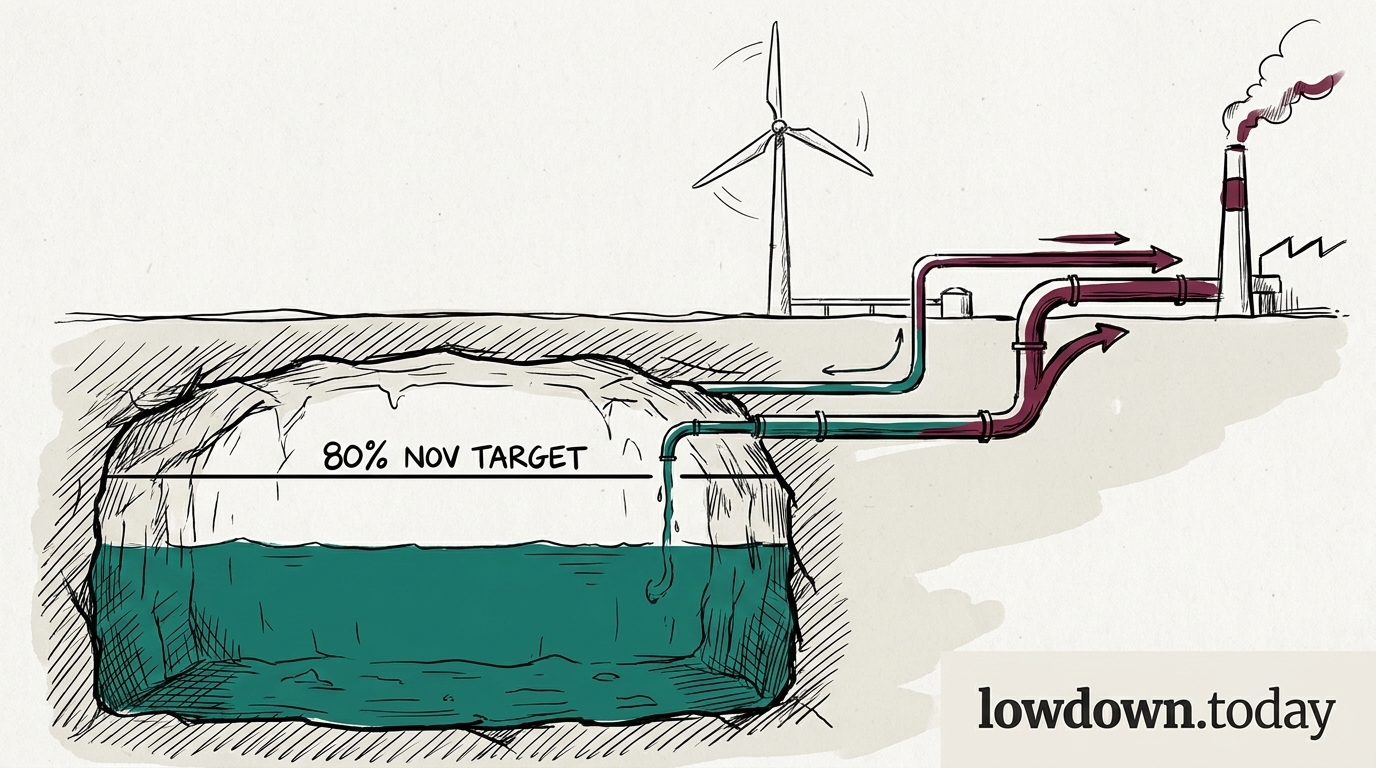
Brussels holds the bloc to 90% on a flexible window while Germany, holding roughly a quarter of EU storage capacity, tracks toward missing its own lower 80% figure by 21 points. A national shortfall this size in the anchor market matters more to bloc security than the flexible timetable alone can absorb.
French power exporters and CRE
French day-ahead rose in step with Germany but by less, reopening a EUR 7-17 premium that makes northward export flows commercially attractive again after the EUR 43.09 discount evaporated in days. CRE separately authorised RTE and Enedis to buy flexibility locally, betting the coming winter's binding constraint is grid congestion rather than a shortage of firm capacity.
TTF trading desk
TTF trading desk
A visible national shortfall like Germany's 21-point gap is a directional signal, not noise, for a desk holding the summer-winter spread. TTF's flat EUR 58-60 range through this week's German price swings says the market has not yet chosen to reprice refill risk into the front of the curve.
German cavern and CCGT operators
German caverns kept buying prompt gas at TTF near EUR 58-60 through the inversion; the wind collapse to 2.4 GW then flipped the spark spread to plus EUR 29 and put turbines back in the same queue. Every day turbines win that bid, injection at a third of the 877 GWh/day pace needed falls further behind.
Slovakia
Slovakia
Slovakia says it dropped its hold-out on the 21st sanctions package only after Ursula von der Leyen personally signed written gas-price and supply guarantees. The Council of the European Union's own 17,238-character release on the package names neither Slovakia nor any guarantee, leaving Bratislava's account unconfirmed by the institutional record.



