Skip to content
You can now search across every topic, entity and event.What's new
European Energy Markets
31JUL

461 kg of uranium no one can verify

3 min read
09:44UTC

The Institute for Science and International Security read 265 to 287 kg of highly enriched uranium in Esfahan's backfilled tunnels from satellite imagery, against the 440.9 kg the memorandum commits Iran to destroy under inspectors who cannot enter the country.

EconomicDeveloping
Key takeaway

Inspectors cannot enter Iran, so the uranium the deal commits Iran to destroy stays uncounted.

The Institute for Science and International Security, a Washington non-proliferation think tank, used June 2026 satellite imagery to place Iran's 60 per cent enriched uranium across three hardened sites: 265 to 287 kg in backfilled tunnels at Esfahan, 80 kg at Fordow and 74 to 96 kg at Natanz. That totals as much as 461 kg, against the 440.9 kg the Islamabad memorandum commits Iran to destroy under international supervision. 1

Each figure comes from satellite imagery, not from an on-site count. The International Atomic Energy Agency (IAEA), the UN's nuclear watchdog, has had no inspector access to Iran for more than 100 days, and the Esfahan tunnel entrances are backfilled. Its director-general Rafael Grossi, speaking at Fukushima on 26 June, said access "is going to happen" and that work on modalities and dates would begin soon, but named no date and holds no signed access instrument. 2

Iran's deputy foreign minister Kazem Gharibabadi the same day ruled out access before a final deal and the lifting of all sanctions, deepening the impasse Grossi described . US envoy Steve Witkoff's claim that Iran had sent the IAEA a letter clearing inspectors stayed unconfirmed by both Iran and the agency. The memorandum names the IAEA to supervise the destruction of the stockpile, yet the inspectors it names cannot enter the country to begin. 3


Deep Analysis

In plain English

The International Atomic Energy Agency, the United Nations body that monitors nuclear programmes worldwide, has been unable to enter Iran's nuclear facilities for more than 100 days. The only information available about Iran's stockpile of highly enriched uranium comes from commercial satellite photos taken from space, not from inspectors on the ground. A June 2026 analysis by a US non-proliferation think tank estimated Iran holds around 460 kg of uranium enriched to weapons-capable levels, mostly in tunnels at a site called Esfahan. On 26 June, Iran's deputy foreign minister said there are no plans to let inspectors back in until a final deal is completely agreed and all sanctions are lifted. That condition makes the inspection practically impossible before the Islamabad agreement's 60-day window expires in mid-August.

What could happen next?
  • Risk

    Gharibabadi's sequencing, inspection access only after a completed final deal and full sanctions termination, means the 21 August General Licence X expiry arrives before the conditions for inspection can be met, and the entire Islamabad disarmament architecture collapses by default rather than by decision.

    Short term · Assessed
  • Meaning

    The gap between the MOU's 440.9 kg commitment and the Bulletin of the Atomic Scientists' 540 kg satellite estimate means the deal may have been written to a stockpile figure Iran itself cannot verify, creating a potential compliance dispute even if inspectors re-enter.

    Medium term · Reported
  • Precedent

    A 100-day verification blackout during a formal nuclear disarmament window establishes that the IAEA's monitoring framework can be suspended without triggering an automatic consequence, reducing the deterrent value of future safeguards agreements with states that have domestic political capacity to weather international pressure.

    Long term · Reported
First Reported In

Update #140 · US bombs Iran, and the oil market shrugs

Al Jazeera· 28 Jun 2026
Read original
Different Perspectives
Spain's LNG terminal operators
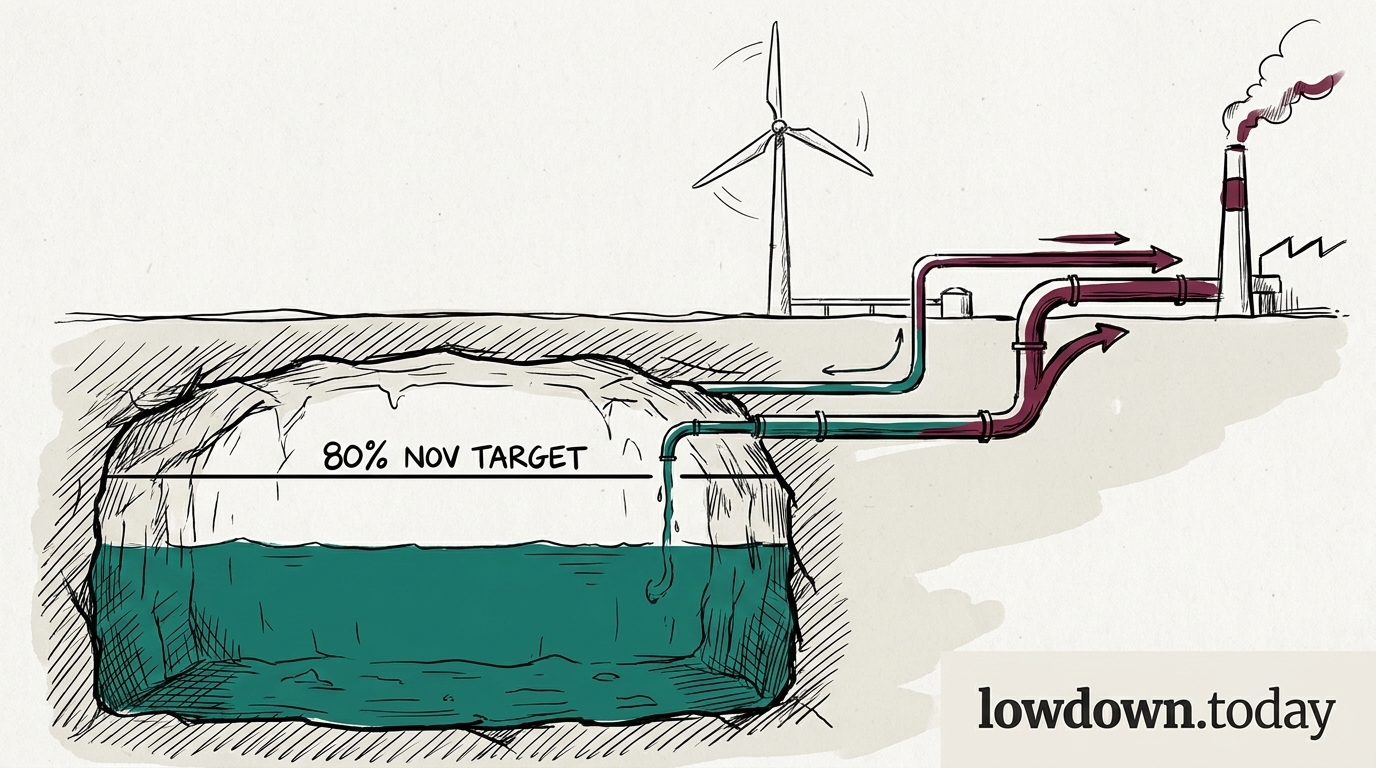
Spain's 9,145 GWh terminal inventory is the largest single stock in the EU LNG network, an option value that can reroute cargoes wherever the winter strip pays best rather than a cavern gas obligation tied to a fixed date. That flexibility matters more as Germany's cavern shortfall pushes more of the winter security question onto import infrastructure.
European Commission
European Commission
Brussels holds the bloc to 90% on a flexible window while Germany, holding roughly a quarter of EU storage capacity, tracks toward missing its own lower 80% figure by 21 points. A national shortfall this size in the anchor market matters more to bloc security than the flexible timetable alone can absorb.
French power exporters and CRE
French day-ahead rose in step with Germany but by less, reopening a EUR 7-17 premium that makes northward export flows commercially attractive again after the EUR 43.09 discount evaporated in days. CRE separately authorised RTE and Enedis to buy flexibility locally, betting the coming winter's binding constraint is grid congestion rather than a shortage of firm capacity.
TTF trading desk
TTF trading desk
A visible national shortfall like Germany's 21-point gap is a directional signal, not noise, for a desk holding the summer-winter spread. TTF's flat EUR 58-60 range through this week's German price swings says the market has not yet chosen to reprice refill risk into the front of the curve.
German cavern and CCGT operators
German caverns kept buying prompt gas at TTF near EUR 58-60 through the inversion; the wind collapse to 2.4 GW then flipped the spark spread to plus EUR 29 and put turbines back in the same queue. Every day turbines win that bid, injection at a third of the 877 GWh/day pace needed falls further behind.
Slovakia
Slovakia
Slovakia says it dropped its hold-out on the 21st sanctions package only after Ursula von der Leyen personally signed written gas-price and supply guarantees. The Council of the European Union's own 17,238-character release on the package names neither Slovakia nor any guarantee, leaving Bratislava's account unconfirmed by the institutional record.



