Skip to content
You can now search across every topic, entity and event.What's new
European Energy Markets
31JUL

Three inspection claims, no signed paper

3 min read
09:44UTC

Grossi said IAEA inspections of Iran 'going to happen' on 24 June; Gharibabadi tied access to sanctions relief first; Trump claimed Iran 'completely agreed', and Tehran denied it within hours.

EconomicDeveloping
Key takeaway

Grossi, Gharibabadi and Trump describe three inspection regimes, with no signed instrument behind any of them.

Rafael Grossi, director-general of the International Atomic Energy Agency (IAEA), said in Japan on Wednesday 24 June that inspections of Iran's enrichment sites are "going to happen" and that the agency would work on "the modalities, dates, procedures, places, very soon" 1. The IAEA is the UN nuclear watchdog that verifies what states hold; it has been locked out of Iran for more than 100 days, with 440.9 kilograms of 60 per cent enriched uranium unverified since February. Grossi moved from whether to how, his firmest language since the Islamabad memorandum, though he named no date.

Iran answered in the opposite direction the same day. Deputy Foreign Minister Kazem Gharibabadi said access would follow only a final deal and practical sanctions relief, not precede them 2. That contradicts the recitals of OFAC's General License X , which assumed IAEA access, and follows spokesman Esmail Baghaei's flat refusal on 23 June . The civilian government cannot concede the point, because the inspection block is an IRGC deterrent posture, not a negotiating chip the foreign ministry controls.

Then the claims widened. Donald Trump, the US President, told Fox News on Thursday that US inspectors would join the IAEA mission and that Iran had "completely agreed" to inspections 3. Iran's foreign ministry denied any such agreement within hours, the identical sequence to his 23 June claim and Baghaei's denial . No instrument backs the assertion. OFAC's only 24 June action was Russia-related removals 4, and The White House logged a single Senate nomination 5; no Iran instrument has followed General License X. The strongest signal in the file is the absence of any signed paper to settle which of the three accounts is true.


Deep Analysis

In plain English

International inspectors from the atomic energy watchdog, the IAEA, have not been allowed into Iran's nuclear sites for over 100 days. They need to check what Iran holds, specifically 440.9 kilograms of uranium enriched to 60% purity, material that is close to weapons-grade. On Wednesday, the IAEA's chief said inspections will happen and the agency is working out the details. On the same day, Iran's deputy foreign minister said no, access only comes after a final deal and after sanctions relief, not before. Then on Thursday, President Trump said on Fox News that Iran had 'completely agreed' to inspections and US inspectors would even join. Iran's government denied that within hours. None of the three actors contradicted each other accidentally. The IAEA chief wants to preserve the agency's role. Iran's deputy FM is relaying the IRGC position. Trump's claim has no paperwork behind it; the official US government record shows zero Iran instruments signed since 22 June.

What could happen next?
  • Risk

    GL X's recitals assumed IAEA access that Iran has now refused three times; if the 21 August expiry arrives with the IAEA still locked out, the sanctions relief mechanism loses its stated legal justification, creating grounds for Congress to challenge the licence.

  • Consequence

    The 440.9 kg of 60%-enriched uranium remains unverified beyond 100 days; without a baseline restart, any future IAEA inspection begins without a confirmed starting stockpile, meaning any diversion between February and inspection-day is permanently unaccountable.

First Reported In

Update #138 · Three flags over Hormuz, none enforced

Euronews· 25 Jun 2026
Read original
Different Perspectives
Spain's LNG terminal operators
Spain's 9,145 GWh terminal inventory is the largest single stock in the EU LNG network, an option value that can reroute cargoes wherever the winter strip pays best rather than a cavern gas obligation tied to a fixed date. That flexibility matters more as Germany's cavern shortfall pushes more of the winter security question onto import infrastructure.
European Commission
European Commission
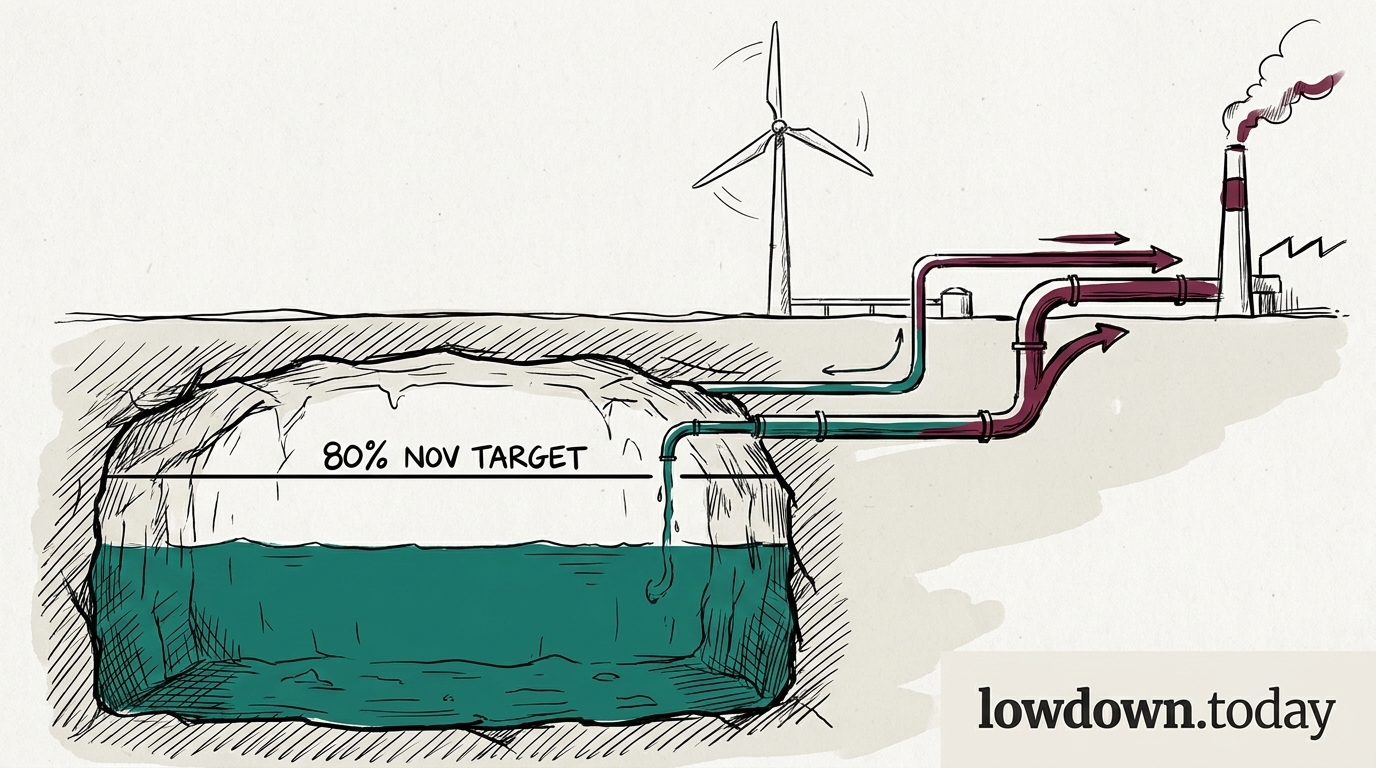
Brussels holds the bloc to 90% on a flexible window while Germany, holding roughly a quarter of EU storage capacity, tracks toward missing its own lower 80% figure by 21 points. A national shortfall this size in the anchor market matters more to bloc security than the flexible timetable alone can absorb.
French power exporters and CRE
French day-ahead rose in step with Germany but by less, reopening a EUR 7-17 premium that makes northward export flows commercially attractive again after the EUR 43.09 discount evaporated in days. CRE separately authorised RTE and Enedis to buy flexibility locally, betting the coming winter's binding constraint is grid congestion rather than a shortage of firm capacity.
TTF trading desk
TTF trading desk
A visible national shortfall like Germany's 21-point gap is a directional signal, not noise, for a desk holding the summer-winter spread. TTF's flat EUR 58-60 range through this week's German price swings says the market has not yet chosen to reprice refill risk into the front of the curve.
German cavern and CCGT operators
German caverns kept buying prompt gas at TTF near EUR 58-60 through the inversion; the wind collapse to 2.4 GW then flipped the spark spread to plus EUR 29 and put turbines back in the same queue. Every day turbines win that bid, injection at a third of the 877 GWh/day pace needed falls further behind.
Slovakia
Slovakia
Slovakia says it dropped its hold-out on the 21st sanctions package only after Ursula von der Leyen personally signed written gas-price and supply guarantees. The Council of the European Union's own 17,238-character release on the package names neither Slovakia nor any guarantee, leaving Bratislava's account unconfirmed by the institutional record.



