Skip to content
You can now search across every topic, entity and event.What's new
European Energy Markets
31JUL

Qom clerics draw Tehran's red line

2 min read
09:44UTC

Qom Seminary and the Assembly of Experts, two of Iran's most senior clerical bodies, came out against the US agreement within days of each other, giving Tehran's negotiators cover to deny any deal in Doha.

EconomicDeveloping
Key takeaway

Iran's top clerical bodies publicly oppose the US deal, capping how far Tehran's negotiators can concede in Doha.

Qom seminary's Center for Management of Seminaries said on 1 July that the US-Iran agreement, "despite its positive aspects, does not cover all the demands of the Supreme Leader and the people" 1. It urged officials to "quickly and decisively withdraw from negotiations" if the adversary breaks its commitments 2. Qom is the theological centre of Shia Iran and the seat of its senior clergy, so a statement from its seminary management carries weight the foreign ministry cannot ignore.

The Assembly of Experts, the clerical body that appoints and can in principle remove the Supreme Leader, had issued a similar statement shortly before 3. Neither has reached English-language wires. The sequence explains Tehran's public caution in Doha: spokesmen Esmaeil Baghaei and Kazem Gharibabadi are disowning any US meeting while the clerical establishment watches for concessions beyond the memorandum's asset clauses. Gharibabadi had already ruled out returning IAEA (International Atomic Energy Agency) inspectors before a final deal , the same ceiling the clerics now state in public. Mojtaba Khamenei's authority runs through these institutions, which is why a negotiator cannot simply pocket a deal they reject.


Deep Analysis

In plain English

Qom is Iran's centre of religious scholarship, home to the seminaries that train and influence the country's clerics. On 1 July, one of its governing bodies said the Iran-US agreement doesn't meet all of Iran's Supreme Leader's demands and urged officials to walk away if the US breaks its side of the deal. The Assembly of Experts, a separate clerical body that formally selects and can remove Iran's Supreme Leader, made a similar statement just before. Together these give Iran's negotiators a domestic shield: they can keep talking to mediators in Doha while pointing to clerical pressure at home as proof they haven't given anything away.

Deep Analysis
Root Causes

Iran's Assembly of Experts and the Qom seminaries hold no formal veto over the negotiating text. The constitution routes ratification through the Supreme Leader's office, not clerical bodies, so their statements function as reputational pressure aimed at that office rather than a legal block on Pezeshkian's negotiators.

That pressure lands in a vacuum. Mojtaba Khamenei has not appeared publicly since 8 March 2026 and is reachable only by sealed courier with a three-to-five-day lag , so a clerical objection raised on 1 July cannot get an authoritative response inside the same news cycle it was issued.

What could happen next?
  • Risk

    With Mojtaba Khamenei reachable only by courier on a three-to-five-day lag, a clerical objection raised on 1 July cannot get an authoritative answer before Iran's Doha delegation is due back at the table.

  • Meaning

    The Assembly of Experts speaking before the Qom seminaries, rather than after, suggests the clerical objection was coordinated rather than a spontaneous reaction to the MOU's terms.

First Reported In

Update #142 · Doha: three stories, no signed paper

Sharq Daily· 1 Jul 2026
Read original
Different Perspectives
Spain's LNG terminal operators
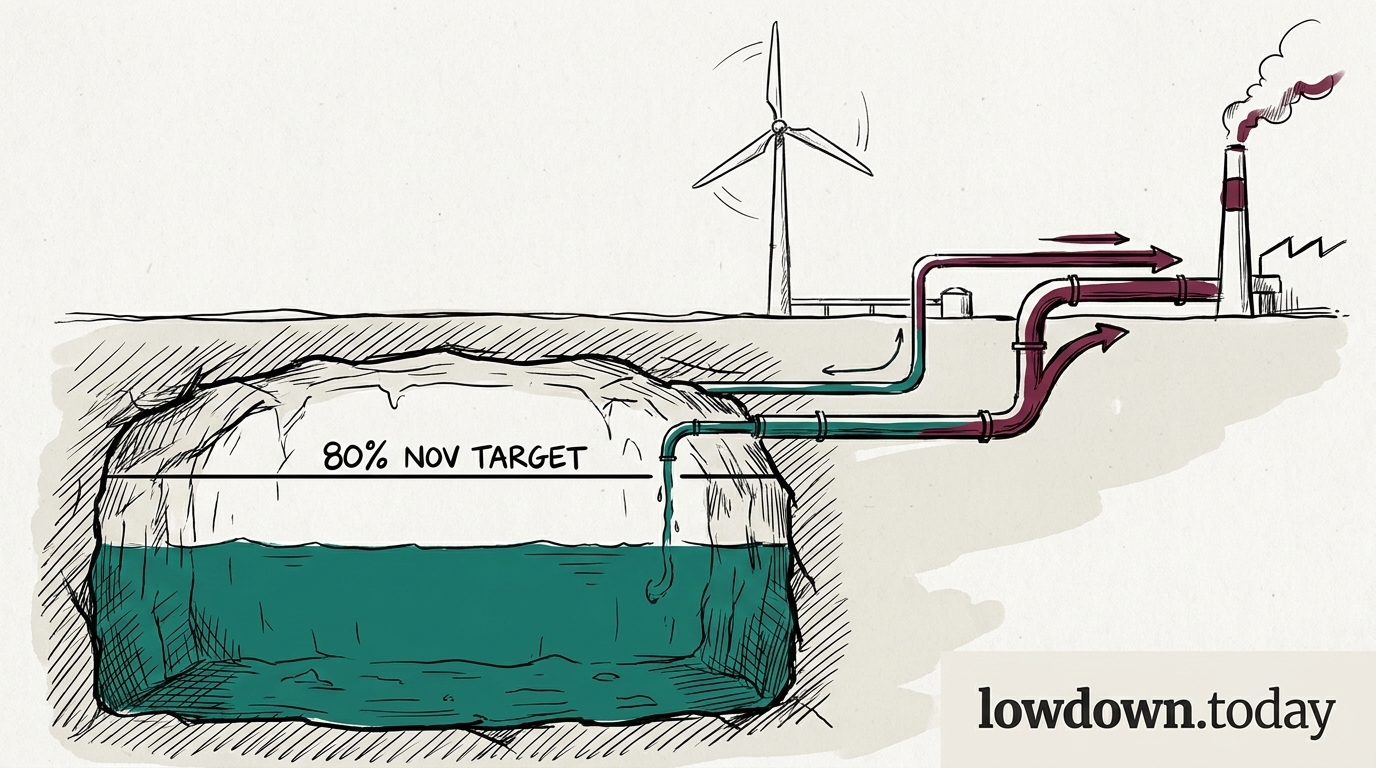
Spain's 9,145 GWh terminal inventory is the largest single stock in the EU LNG network, an option value that can reroute cargoes wherever the winter strip pays best rather than a cavern gas obligation tied to a fixed date. That flexibility matters more as Germany's cavern shortfall pushes more of the winter security question onto import infrastructure.
European Commission
European Commission
Brussels holds the bloc to 90% on a flexible window while Germany, holding roughly a quarter of EU storage capacity, tracks toward missing its own lower 80% figure by 21 points. A national shortfall this size in the anchor market matters more to bloc security than the flexible timetable alone can absorb.
French power exporters and CRE
French day-ahead rose in step with Germany but by less, reopening a EUR 7-17 premium that makes northward export flows commercially attractive again after the EUR 43.09 discount evaporated in days. CRE separately authorised RTE and Enedis to buy flexibility locally, betting the coming winter's binding constraint is grid congestion rather than a shortage of firm capacity.
TTF trading desk
TTF trading desk
A visible national shortfall like Germany's 21-point gap is a directional signal, not noise, for a desk holding the summer-winter spread. TTF's flat EUR 58-60 range through this week's German price swings says the market has not yet chosen to reprice refill risk into the front of the curve.
German cavern and CCGT operators
German caverns kept buying prompt gas at TTF near EUR 58-60 through the inversion; the wind collapse to 2.4 GW then flipped the spark spread to plus EUR 29 and put turbines back in the same queue. Every day turbines win that bid, injection at a third of the 877 GWh/day pace needed falls further behind.
Slovakia
Slovakia
Slovakia says it dropped its hold-out on the 21st sanctions package only after Ursula von der Leyen personally signed written gas-price and supply guarantees. The Council of the European Union's own 17,238-character release on the package names neither Slovakia nor any guarantee, leaving Bratislava's account unconfirmed by the institutional record.



