Skip to content
You can now search across every topic, entity and event.What's new
European Energy Markets
31JUL

11.7m barrels of Iran oil reach China

4 min read
09:44UTC

Satellite tracking reveals half of all Hormuz transits in March are shadow fleet vessels carrying Iranian crude to China — protected by PLA Navy escort and formal Tehran-Beijing negotiations.

EconomicDeveloping
Key takeaway

China imports Iranian oil at a discount while competitors pay the war premium — a compounding competitive advantage.

11.7 million barrels of Iranian crude have transited the strait of Hormuz since 28 February, all bound for China, according to Samir Madani, co-founder of TankerTrackers.com, using satellite tracking. Shadow fleet vessels — tankers operating outside mainstream insurance and regulatory frameworks — account for half of all Hormuz transits in March. Chinese-operated ships systematically broadcast AIS messages emphasising Chinese ownership and crew composition, a practice that began in the conflict's first week and became systematic as the PLA Navy's 48th fleet, including the 30,000-tonne signals intelligence vessel Liaowang-1 , took position in The Gulf.

What began as individual captains broadcasting Chinese identity to avoid interdiction has become an organised arrangement. Reuters reported that China entered direct formal negotiations with Iran to guarantee safe passage for crude and Qatari LNG through the strait . Fortune documented that vessels claiming Chinese or "Muslim" ownership receive de facto IRGC protection from interdiction . The progression — from improvised flag-switching to negotiated safe passage to PLA Navy escort — produced a two-tier energy order in under a fortnight.

The economics are direct. Europe, Japan, South Korea, and India pay the war premiumBrent has risen 41% from $67.41 on 27 February to the $90–95 corridor. China does not. Beijing receives discounted Iranian crude through a protected corridor while its commercial rivals face a 90% reduction in Hormuz tanker traffic and war risk insurance costs that make remaining shipments prohibitively expensive. Iran decides who transits and who does not, and the sorting criterion is diplomatic alignment: Beijing abstained on Resolution 2817 rather than opposing it, and receives energy security in return.

The arrangement has a precedent. During the 1980–88 Tanker War, Iran granted passage to vessels it deemed friendly while attacking Iraqi-linked and neutral shipping — the same selective enforcement principle. The difference is the scale of the beneficiary. In the 1980s, no single buyer dominated Gulf crude flows. In 2026, China imports more oil from the Persian Gulf than any other nation. A two-tier strait controlled by Tehran and navigated primarily by Chinese-linked vessels restructures global energy trade around a Beijing-Tehran axis — not through formal alliance, but through the practical geometry of who is allowed to buy and who is not.


Deep Analysis

In plain English

A shadow fleet is a collection of tankers — typically old, uninsured, and owned through opaque corporate structures — that specialise in moving oil from sanctioned countries without being easily traced or stopped. Iran built this network over five years of US sanctions. The ships falsify or switch off their GPS tracking signals to hide their routes and identities. Now, in wartime, the same fleet is moving Iranian oil through the very strait Iran claims to have closed — but only to China. Chinese-operated ships are broadcasting their national identity as a signal to Iranian authorities that they are the protected party. It is a sophisticated, pre-built system now running at full capacity, creating a two-tier energy order in which China pays less and everyone else pays more.

Deep Analysis
Synthesis

The oil corridor to China is not merely a revenue stream — it is the material basis for Iranian strategic endurance. Without Chinese purchases, Iran's war economy faces hard constraints within months. Beijing's continuation of purchases under active wartime conditions transforms it from a diplomatic supporter into a co-enabler of the conflict's duration. The selective blockade and the Chinese oil corridor are operationally the same instrument: one closes the strait to adversaries; the other keeps it open for the patron that makes the closure economically sustainable.

Escalation

The systematic AIS nationality-broadcasting by Chinese vessels creates an explicit, public test for US enforcement policy. Each week of tolerated Chinese shadow transits strengthens the precedent that China holds a formal Hormuz exemption. If the US intercepts a Chinese-linked vessel, it risks the first direct US-China naval confrontation in the Persian Gulf — a threshold neither side has previously crossed. Washington has so far chosen not to test this line, allowing the two-tier order to harden.

What could happen next?
  • Meaning

    China is simultaneously receiving discounted energy and geopolitical leverage — the war is, for now, net economically advantageous for Beijing.

    Immediate · Assessed
  • Risk

    Any US interdiction of Chinese-linked shadow vessels triggers the first direct US-China naval confrontation in the Persian Gulf, with escalation pathways extending beyond the current conflict.

    Short term · Suggested
  • Consequence

    The competitive energy cost gap between China and import-dependent economies widens materially if the $90–95 price corridor persists beyond four to six weeks.

    Medium term · Assessed
  • Precedent

    The shadow fleet model demonstrates that a determined state actor can effectively defeat Western sanctions enforcement given a single sufficiently powerful patron willing to absorb all exports.

    Long term · Assessed
First Reported In

Update #32 · UN condemns Iran 13-0; ceasefire blocked

CNBC· 12 Mar 2026
Read original
Causes and effects
This Event
11.7m barrels of Iran oil reach China
Satellite tracking data from TankerTrackers.com confirms a two-tier passage system where Chinese-linked vessels transit freely while all others are excluded. Backed by PLA Navy presence and direct negotiations between Beijing and Tehran, the arrangement gives China discounted Iranian crude through a protected corridor while Europe, Japan, South Korea, and India pay a 41% war premium on energy. Gulf energy flows are being reorganised around Beijing-Tehran alignment.
Different Perspectives
Spain's LNG terminal operators
Spain's 9,145 GWh terminal inventory is the largest single stock in the EU LNG network, an option value that can reroute cargoes wherever the winter strip pays best rather than a cavern gas obligation tied to a fixed date. That flexibility matters more as Germany's cavern shortfall pushes more of the winter security question onto import infrastructure.
European Commission
European Commission
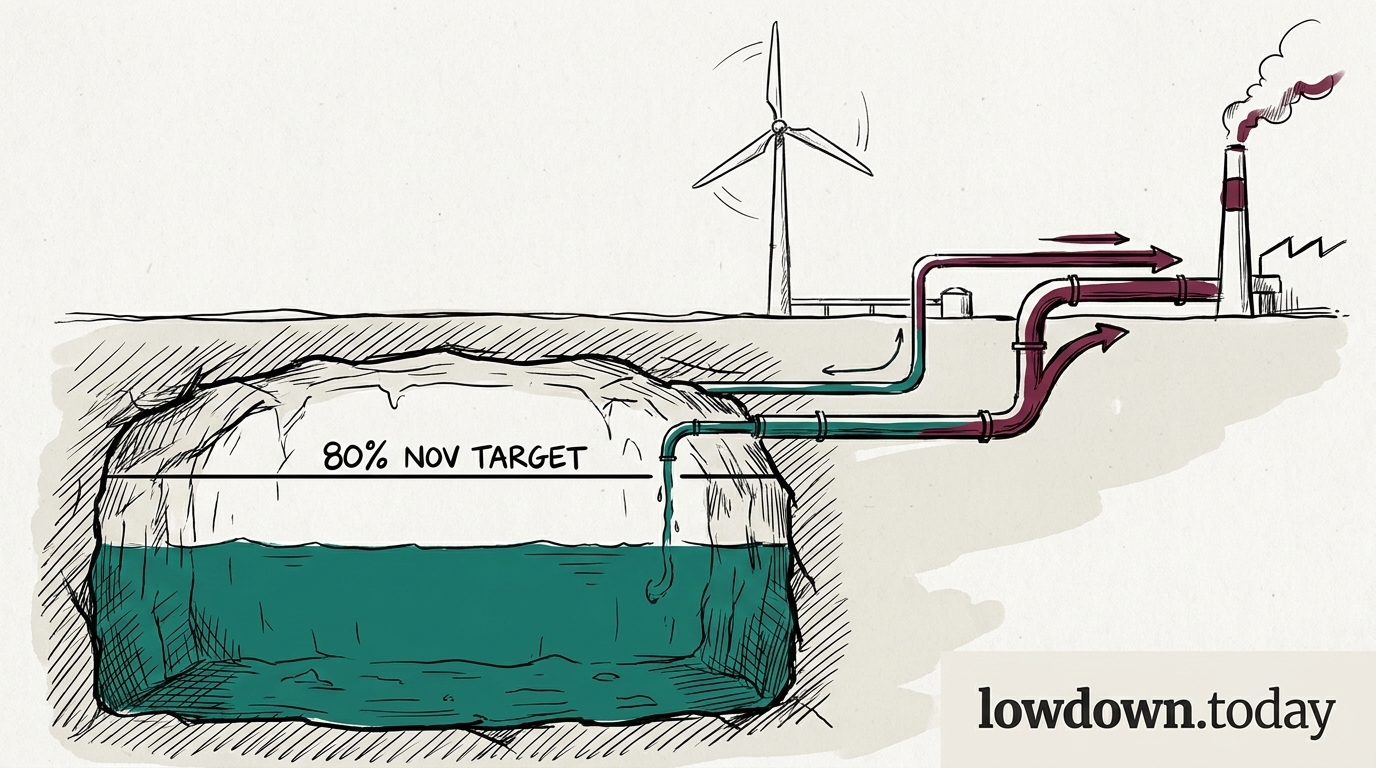
Brussels holds the bloc to 90% on a flexible window while Germany, holding roughly a quarter of EU storage capacity, tracks toward missing its own lower 80% figure by 21 points. A national shortfall this size in the anchor market matters more to bloc security than the flexible timetable alone can absorb.
French power exporters and CRE
French day-ahead rose in step with Germany but by less, reopening a EUR 7-17 premium that makes northward export flows commercially attractive again after the EUR 43.09 discount evaporated in days. CRE separately authorised RTE and Enedis to buy flexibility locally, betting the coming winter's binding constraint is grid congestion rather than a shortage of firm capacity.
TTF trading desk
TTF trading desk
A visible national shortfall like Germany's 21-point gap is a directional signal, not noise, for a desk holding the summer-winter spread. TTF's flat EUR 58-60 range through this week's German price swings says the market has not yet chosen to reprice refill risk into the front of the curve.
German cavern and CCGT operators
German caverns kept buying prompt gas at TTF near EUR 58-60 through the inversion; the wind collapse to 2.4 GW then flipped the spark spread to plus EUR 29 and put turbines back in the same queue. Every day turbines win that bid, injection at a third of the 877 GWh/day pace needed falls further behind.
Slovakia
Slovakia
Slovakia says it dropped its hold-out on the 21st sanctions package only after Ursula von der Leyen personally signed written gas-price and supply guarantees. The Council of the European Union's own 17,238-character release on the package names neither Slovakia nor any guarantee, leaving Bratislava's account unconfirmed by the institutional record.



