Skip to content
Briefings are running a touch slower this week while we rebuild the foundations.See roadmap
European Energy Markets
4JUN

Project Freedom moves TTF only 1.48%

4 min read
10:45UTC

Trump announced a 15,000-personnel Hormuz shipping escort on 3-4 May. TTF moved from EUR 45.77/MWh on Friday 1 May to EUR 46.44/MWh on Monday 4 May, a 1.48% session gain.

EconomicDeveloping
Key takeaway

Trump's 15,000-personnel Hormuz escort moved TTF only 1.48%; markets price the operation as risk, not supply unlock.

Donald Trump announced Project Freedom on Sunday 3 to Monday 4 May, a US military escort for stranded shipping through the Strait of Hormuz backed by 15,000 personnel, more than 100 aircraft, warships, and drones 1. Iran's Abdollahi warned that any US forces approaching the strait "will be attacked". Fars claimed two missiles were fired at a US warship, denied by the US side. The UK MTCO (Marine Transit Coordination Office) classified the Hormuz threat level as critical on Monday 4 May. The iran-conflict-2026 desk owns the operation itself ; the European angle sits in the TTF price response.

TTF moved from EUR 45.77/MWh on Friday 1 May to EUR 46.44/MWh on Monday 4 May, a +1.48% session gain on the announcement day. That is not the move a real supply unlock would produce. A credible US escort actually resuming Hormuz LNG transits would normally compress TTF by EUR 5 to 8/MWh on the news; the muted print indicates traders read the operation as a risk event and not a route by which European cargoes return.

The Mubaraz transit on 27 April , the first loaded LNG run through Hormuz since the war began, headed to Asia, not Europe. That precedent now anchors the read on Project Freedom: even with US escort credibility added to the route, the cargoes that move first move east. Iran's 18 April re-closure and the IRGC seizures of Epaminondas and MSC Francesca on 22 April established the risk premium the market now prices durably, and Project Freedom does not displace that premium.


Deep Analysis

In plain English

The Strait of Hormuz is a narrow waterway between Iran and Oman through which roughly a fifth of the world's oil and a large share of its liquefied natural gas travels. Iran has been restricting shipping there since March 2026 as part of a wider conflict. On 3 and 4 May, US President Donald Trump announced a military escort programme called Project Freedom, sending warships and aircraft to protect cargo vessels trying to pass through. European gas prices rose only slightly on the news. Traders concluded that even if the escort works and ships start moving again, the first cargoes of gas will likely go to Asia, where buyers are paying more, not to Europe.

What could happen next?
  • Risk

    If Project Freedom triggers a direct US-Iran naval confrontation, TTF would spike well above the EUR 46/MWh current level as Hormuz LNG transit closes entirely rather than partially; the market's +1.48% move suggests traders have not priced this tail.

    Immediate · 0.6
  • Consequence

    Even if Project Freedom successfully escorts LNG carriers, the JKM-TTF arbitrage routes first movers to Asia; European supply relief may lag a Hormuz reopening by four to six weeks.

    Short term · 0.72
  • Precedent

    The 1987 Earnest Will precedent suggests sustained US naval presence eventually deters Iran from direct attacks on escorted vessels, but requires Iran to absorb one or two confrontations first; that escalation window is when European gas prices face the most upside risk.

    Short term · 0.65
First Reported In

Update #7 · Storage pace 0.21 vs 0.257; floor not yet met

Trading Economics / ICE· 4 May 2026
Read original
Different Perspectives
TTF traders / Amsterdam hub desks
TTF broke its 38-session EUR 46-47 band on 2 June to EUR 48.9 on stalled Iran diplomacy and an unconfirmed Troll A restart; Dutch EBN mandates carry storage trajectory while commercial injection books nothing. The 17 June pipeline expiry is the next binary level: Central European hub premium above EUR 2/MWh widens sharply on any physical step-down.
Red Electrica / Spanish grid operators
Spain logged 397 negative-price hours in Q1 2026, eight times the 48 hours of Q1 2025, documenting midday solar surplus now embedding structurally into Continental pricing. Spain is four to six quarters ahead of France and Germany on the solar-penetration curve, making it the clearest forward indicator of where Continental midday clearing is heading.
Equinor
Equinor
Equinor issued no Troll A restart notice through 4 June despite extending the combined outage to 31 May, keeping up to 51 mcm/day of Norwegian supply offline alongside Hammerfest LNG dark since 22 April. The company's silence follows its 2025 Hammerfest pattern, which ran 24 days past target, and each day without a notice sustains the TTF supply premium.
European Commission / GMTF
SWD(2026)147 found EU gas spot and derivatives markets functioning well on 2 June, recommending MiFID-REMIT legislative alignment rather than emergency intervention. The GMTF verdict addressed derivatives-market integrity, not the physical injection mechanism FNB Gas declared broken five days earlier: the Commission's immediate next step is a legislative proposal, not an emergency storage order.
FNB Gas / Bundesnetzagentur
FNB Gas declared the storage-refill mechanism broken on 27 May after zero bookings in January 2026 auctions, and German day-ahead cleared EUR 102.64 on 3 June on a CCGT stack set by TTF near EUR 49 plus EUA near EUR 78. Winter storage fill now depends on state mandates with no commercial self-correction.
EDF / French government
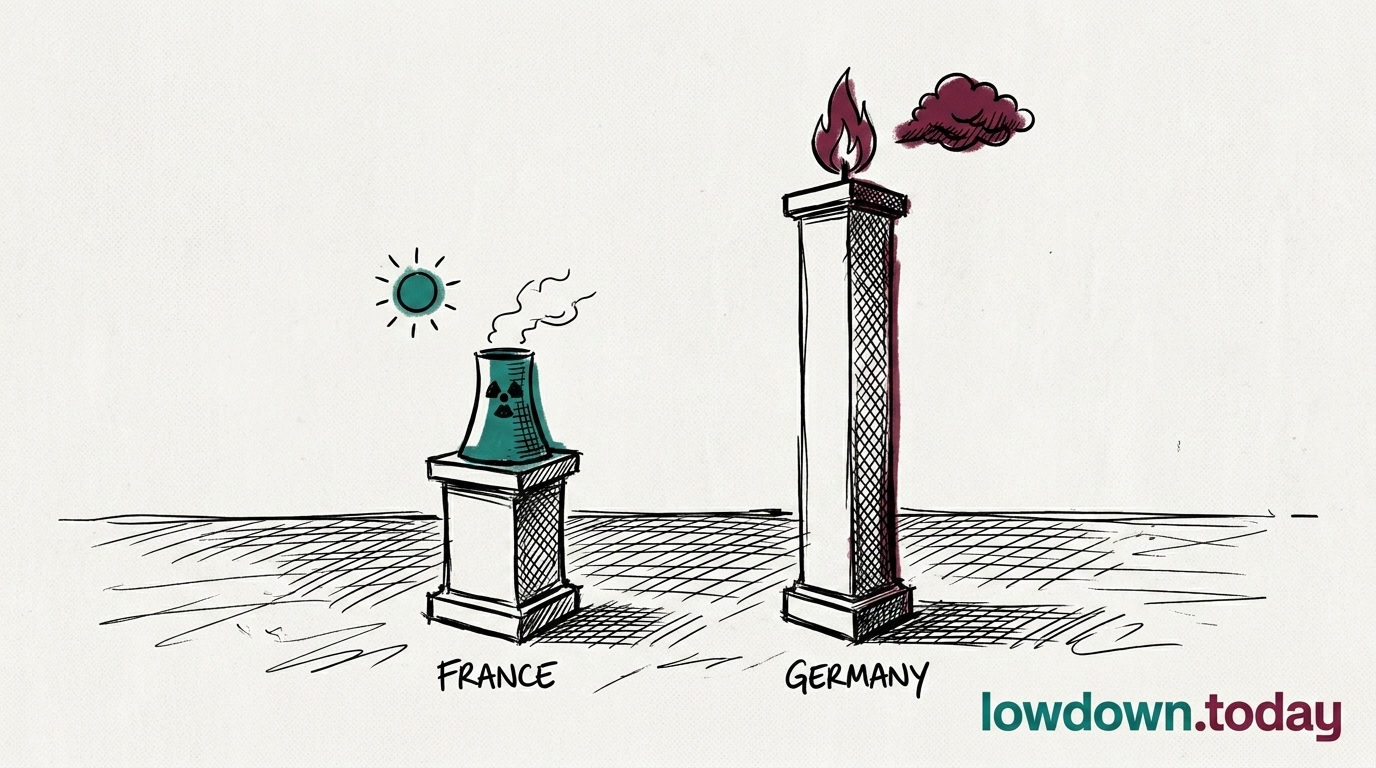
EDF held full-year nuclear guidance at 350-370 TWh after April output of 29.3 TWh, anchoring the surplus that collapsed French day-ahead to EUR 8.96 on 3 June and passed that price to VNU industrials. Flamanville-3's September overhaul removes 1.6 GW at heating-season onset, reversing the nuclear surplus that made VNU pricing competitive.
