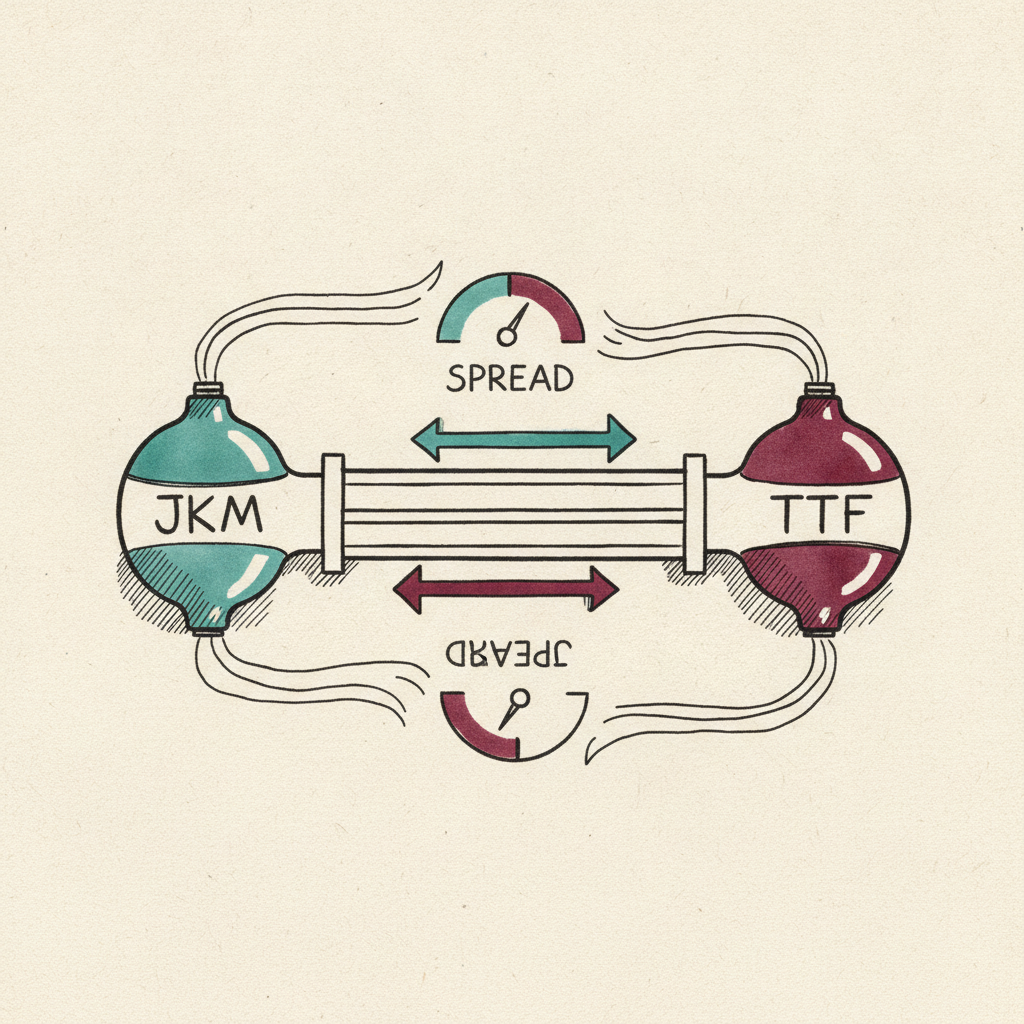
JKM-TTF arbitrage
Price spread between Asian LNG benchmark JKM and European benchmark TTF; determines whether flexible cargoes flow east or west.
Last refreshed: 3 July 2026
At what TTF price level does Europe start winning the LNG arbitrage from Asia?
Timeline for JKM-TTF arbitrage
Mentioned in: Hormuz stand-down has not reopened the strait
European Energy MarketsMentioned in: June injections trail last year by 16%
European Energy MarketsMentioned in: Goldman and OIES split the winter
European Energy MarketsBackground
The JKM-TTF arbitrage is the price differential between JKM (Japan Korea Marker, the leading Northeast Asia spot LNG price benchmark) and TTF (Title Transfer Facility, the European natural gas hub benchmark). Because LNG is a globally traded commodity and a proportion of each month's cargoes are not locked to a fixed destination, cargo owners compare the netback from selling into Europe against selling into Asia. When JKM exceeds TTF by more than the all-in freight and canal cost of routing to Asia (approximately USD 2.50-3.00/MMBtu on The Atlantic-to-Asia route), the rational decision is to divert Atlantic Basin cargoes east. When the spread is below this threshold, Europe competes effectively and draws the marginal cargo. The arbitrage is therefore the principal short-run mechanism determining how much flexible LNG reaches Europe in any given month.
The JKM-TTF arbitrage has been a primary determinant of European LNG supply adequacy throughout the 2026 Hormuz crisis. On 12 June 2026, JKM spiked to USD 18.86/MMBtu against a TTF equivalent near USD 13.60, pushing the spread to USD 5.26/MMBtu, well above the diversion threshold. At that level, essentially all flexible Atlantic Basin cargoes routed to Asia, deepening Europe's injection deficit. Following the 17-18 June US-Iran memorandum on Hormuz mine-clearing, TTF fell faster than JKM on diplomacy news, compressing the spread to approximately USD 4.35/MMBtu by 18 June; still above the diversion threshold. The OIES June 2026 Comment treated the arbitrage dynamics as one of the structural reasons why even a Hormuz reopening would not immediately restore European supply, because Asian buyers were first in the queue and the spread rewarded eastern routing. For the spread to revert to Europe-favouring territory, either TTF must rise to reflect the full storage risk or JKM must soften on lower Asian demand.
By early July 2026, four days after the 29 June Hormuz stand-down, the constraint shifted from price to physical throughput: IMF PortWatch counted only 27-43 daily transits against an 84-transit pre-crisis baseline, and QatarEnergy's restart ran at roughly 35% of its 77 MTPA nameplate, capped by an escort-convoy limit of three to four tankers a day. Even where the spread narrows enough to favour European cargoes, the escort bottleneck means Qatari volumes cannot reach the market fast enough to test that pricing signal.