Skip to content
Briefings are running a touch slower this week while we rebuild the foundations.See roadmap
Drones: Industry & Defence
21MAY

10,000 drones diverted from Ukraine

4 min read
11:11UTC

The US diverted 10,000 AI interceptor drones from Ukraine's front lines — the first cross-theatre weapons transfer of the war, built by an Eric Schmidt-backed venture.

TechnologyDeveloping
Key takeaway

Ukraine has become a proving ground for systems redeployable globally in days, fundamentally changing military procurement timelines.

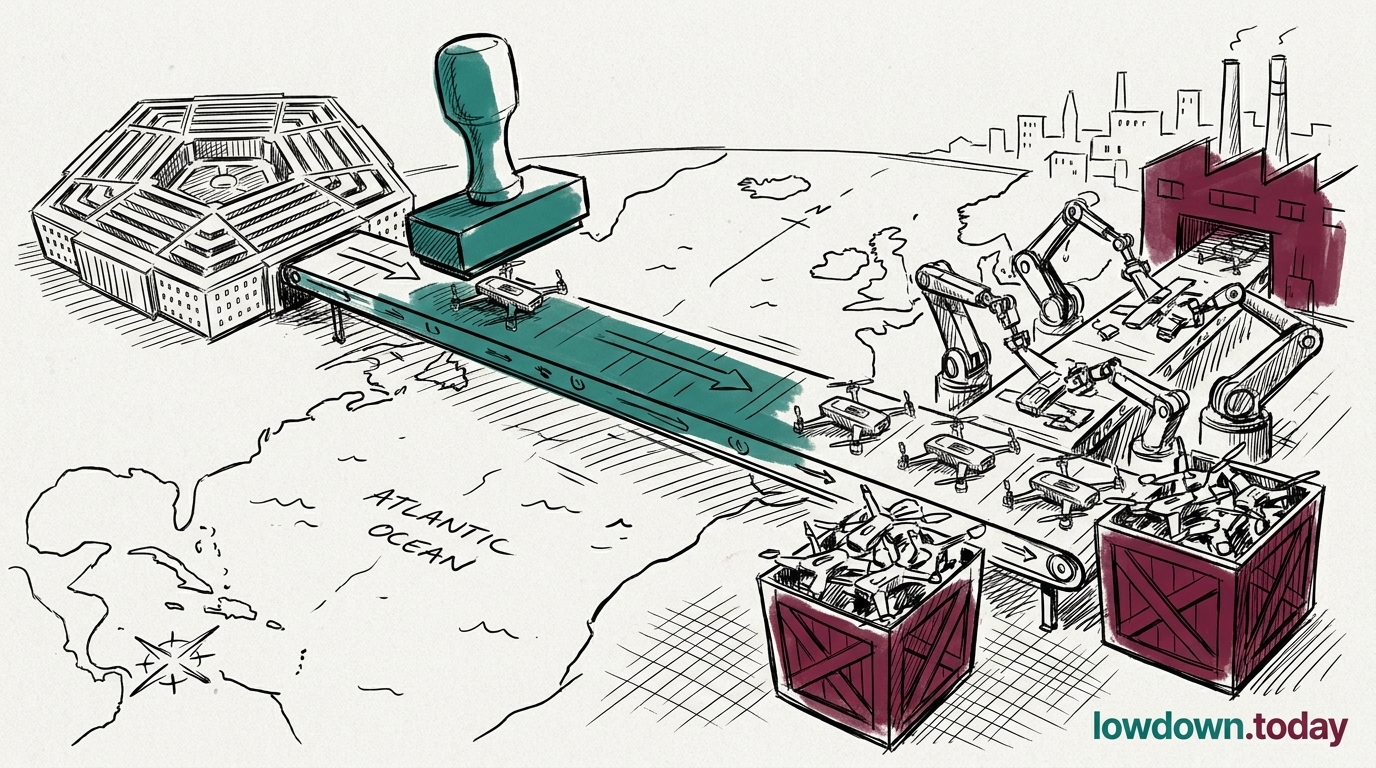
The US Army shipped 10,000 Merops interceptor drones to the Middle East within five days of the war's start, diverted directly from the Ukraine supply pipeline 1. The system was developed by Project Eagle, a defence venture backed by former Google CEO Eric Schmidt. US Brigadier General Curtis King credited it with 40% of all Shahed drone destruction in Ukraine 2.

Each Merops unit costs $14,000–15,000 — less than the $20,000-plus price of a single Iranian Shahed. At scale, the unit cost drops to $3,000–5,000. The ratio favours the defender, which is unusual in drone warfare where cheap attacking swarms typically exhaust expensive interceptors. A Patriot missile costs roughly $4 million; even at full Merops price, the interceptor is 260 times cheaper. The system fits in a pickup truck and uses AI-driven autonomous targeting when communications are jammed — a capability designed for Ukraine's electronic warfare environment now applied to IRGC operations in The Gulf.

The transfer creates a direct resource competition between theatres. Ukraine's front lines have consumed Merops units since deployment, and Kyiv depends on the system for the same Shahed defence now being redirected. The Pentagon has not disclosed whether Ukraine's allocation will be backfilled or reduced. The demand is clear on both fronts: Saudi Arabia intercepted 51 drones in a single day last week ; the IRGC has announced its 48th wave of Operation True Promise 4; Gulf air defences have intercepted over 3,100 Iranian missiles and drones since 28 February. Conventional interceptors cannot sustain that expenditure rate.

Iranian Shaheds, whether launched at Odesa or Riyadh, now meet the same AI-guided interceptor — the same manufacturer's drones countered by the same system in two separate wars. The Merops deployment also marks the first time a counter-drone weapon proven in one active conflict has been redeployed mid-war to another. The Ukraine pipeline, built over two years to keep Kyiv's air defences operational, is now feeding a second front. How long it can feed both without degrading either is a question neither the Pentagon nor Project Eagle has publicly addressed.

Deep Analysis

In plain English

The US military normally takes years to adopt new weapons — testing, contracting, regulatory approval, training. This system was built by a private tech company backed by Google's former CEO, proven in Ukraine against the same Iranian drones now hitting Gulf states, and shipped to a completely different war zone in under a week. It uses artificial intelligence to hunt and destroy enemy drones autonomously, even when the enemy is jamming communications. Think of it as a robotic guard dog that keeps working even after someone cuts your phone lines. Ten thousand of them have just arrived in the Gulf.

Deep Analysis
Synthesis

The Merops transfer establishes Ukraine as a global defence R&D proving ground whose outputs are redeployable wherever the US has strategic interests — in days rather than years. Future adversary investment in cheap drone-swarm strategies now faces a mature, cost-competitive counter-capability that can be rapidly cross-deployed. At $3,000–5,000 per unit at scale, the Merops threatens the economic logic underpinning Iran's entire drone-swarm doctrine, which depends on attacker cost remaining below defender intercept cost.

The AI-autonomous targeting in comms-denied environments also raises unresolved questions under international humanitarian law about meaningful human control over lethal force — questions the UN Group of Governmental Experts on Lethal Autonomous Weapons Systems has debated since 2014 without producing binding standards. Large-scale battlefield deployment will create facts on the ground faster than the legal process can respond.

Root Causes

The IRGC's transfer of Shahed drones to Russia created an unintended strategic consequence: it gave the US and Ukraine a shared adversary using identical hardware, compressing counter-drone R&D from a decade-long procurement cycle to approximately two years. The Merops was built specifically to kill Shaheds in Ukraine. It is now deployed against their original source. Tehran's drone-export policy inadvertently funded and accelerated the development of its own most effective counter-capability.

What could happen next?
1 precedent1 consequence1 risk1 opportunity1 meaning
  • Precedent

    Ukraine has become a global proving ground for redeployable battlefield systems — the five-day transfer timeline permanently changes allied military procurement expectations.

    Long term · Assessed
  • Consequence

    Ukraine's counter-drone capacity is reduced by the 10,000-unit diversion; Shahed penetration rates in Ukrainian cities may increase during the Gulf deployment period.

    Short term · Suggested
  • Risk

    AI-autonomous targeting in comms-denied environments sets a legal normalisation precedent that adversaries will cite to legitimise their own autonomous weapons programmes.

    Medium term · Suggested
  • Opportunity

    At $3,000–5,000 per unit at scale, the Merops creates an economically sustainable counter-drone capability that undermines the cost advantage underpinning Iran's drone-swarm doctrine.

    Medium term · Suggested
  • Meaning

    Commercial venture-backed defence procurement has outpaced traditional government acquisition for a critical battlefield capability — redefining the US defence industrial model in wartime.

    Immediate · Assessed
First Reported In

Update #36 · Israel plans full Litani seizure

Bloomberg· 15 Mar 2026
Read original
Causes and effects
This Event
10,000 drones diverted from Ukraine
The first cross-theatre transfer of battlefield-tested weapons from Ukraine to the Gulf introduces an AI-autonomous, cost-effective counter-drone system that inverts the typical economic advantage of drone swarms, while exposing a direct resource competition between the two conflicts.
Different Perspectives
Institutional investors and defence-sector equity markets
Perennial's IDIQ gives revenue-visibility that earlier Schmidt ventures lacked; Northrop's dual award places a heritage prime on the attritable-payload standard-setting layer analysts had reserved for startups. Rheinmetall at €650 per share, up from €500 in January, prices auto-grade drone conversion as margin-accretive; DroneShield's ASIC probe introduces a governance-discount variable proxy advisers will apply at the 29 May AGM.
Korean defence-industrial sector (LIG Nex1, Hanwha Aerospace)
LIG Nex1's $2.2 billion Cheongung-III win and the KUS-FS service introduction together close Seoul's sovereign layered air-defence stack; both firms face multi-year backlog revisions on the Korea Exchange. The unresolved sensor-to-shooter integration risk between Hanwha's LAMD sensors and LIG Nex1's Cheongung-III engagement layer sits publicly unaddressed ahead of the 2029 fielding date.
Ukrainian export regulator (SSEC)
Ukraine's wartime export ban blocks Gulf sales of combat-proven interceptors at $2,100 to $2,500 per unit while Perennial Autonomy, built on Ukrainian combat data, wins a $500 million US IDIQ. Perennial's Merops, credited with 4,000-plus Russian drone kills in Ukraine, can now reach NATO allies via Munich; a direct Ukrainian sale to those same buyers remains legally blocked.
DJI and Autel Robotics
Autel's Ralls Corp filing attacks the classified-evidence foundation of its Covered List designation; DJI's parallel Ninth Circuit case has quantified $1.56 billion in 2026 regulatory losses. Both companies are now betting the D.C. Circuit will extend due-process protections to FCC product certification, a constitutional route that does not require contesting the intelligence allegations directly.
US Pentagon defence-industrial-base policy
JIATF-401's IDIQ names Perennial the benchmark holder while Anduril's $20 billion Lattice vehicle and Northrop's Drone Dominance payload role run in parallel lanes; the DoD bet is that named holders at each tier cut order-to-delivery cycles. The Section 232 clock 54 days overdue signals the administration treats FCC and FAR exclusions as sufficient to manage Chinese market access.
European defence procurement community
Germany's three-tier award demonstrates that EU member states can fund loitering-munition production at scale without single-supplier dependency, and Perennial's Munich line gives procurement offices a domestic-source justification for Merops orders outside US Foreign Military Sales channels. The Bundeswehr's split across Helsing, Stark and Rheinmetall has become the reference architecture other European buyers are mapping their own industrial bases against.
