
Skip to content
Briefings are running a touch slower this week while we rebuild the foundations.See roadmap
Drones: Industry & Defence
21MAY

Schmidt's Perennial wins $500M drone deal

3 min read
11:11UTC

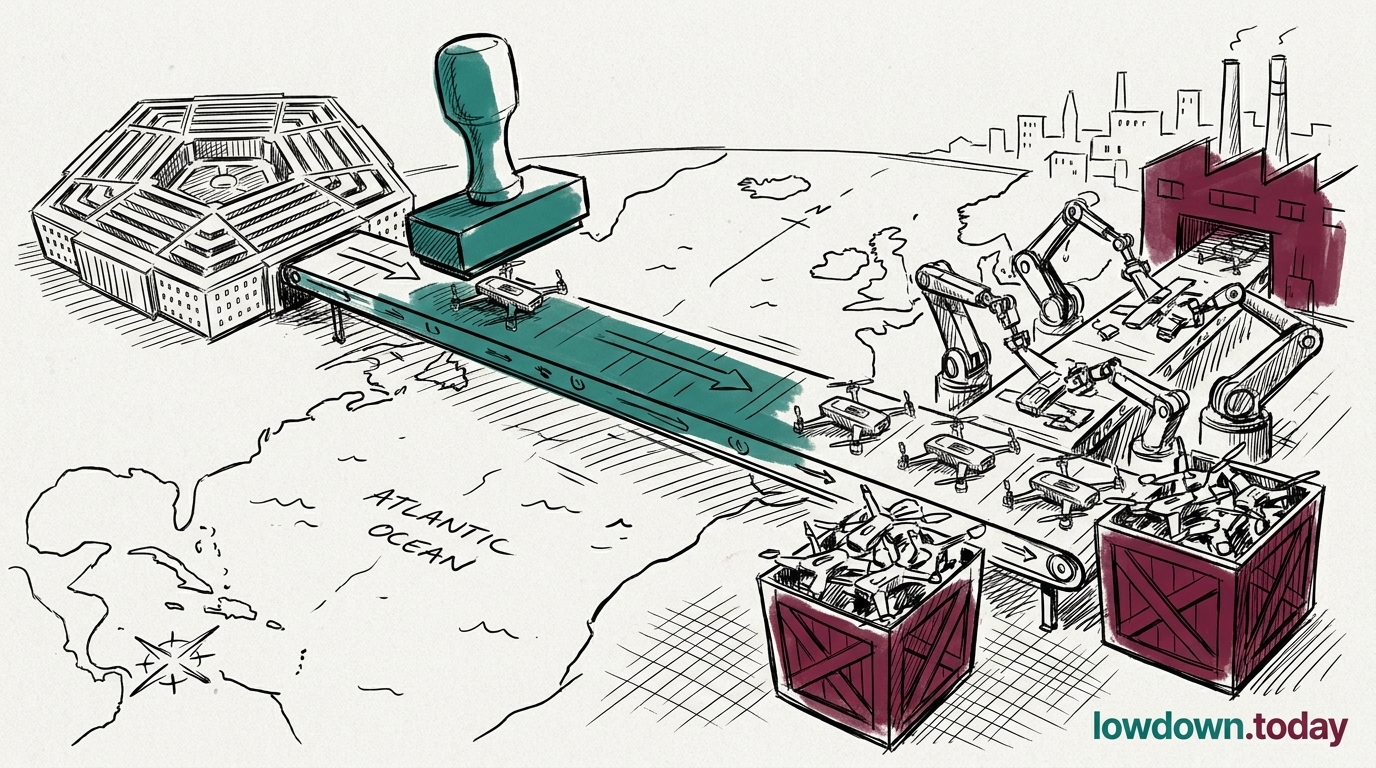
Joint Interagency Task Force 401 named Perennial Autonomy its first counter-drone IDIQ holder on Tuesday, a $500M ceiling for Eric Schmidt's three-year-old Merops outfit. Twenty-four hours later, Perennial put a Munich production line on the deal. Germany awarded €840M+ across three loitering-munition contracts, and Northrop banked two drone awards in one week.

Key takeaway

May 2026 named the winners at every tier of the drone-industrial map; the structure that will fight the next conflict is now locked in.

This briefing mapped
Loading map…
Competitive
Economic
Legal
Regulatory
Military

Joint Interagency Task Force 401 named Perennial Autonomy its first counter-drone IDIQ holder on Tuesday 19 May, a $500 million three-year ceiling for Eric Schmidt's three-year-old Merops outfit. Twenty-four hours later, Perennial put a Munich production line on the deal.

Sources profile:This story draws on neutral-leaning sources from United States
United States

On 19 May, a US joint task force gave Perennial Autonomy a $500 million, three-year contract covering its Merops interceptor drone at $15,000 per unit. The next day, Perennial announced a production line in Munich.

The contract formalises the Merops emergency deployment from earlier this year into a repeatable procurement track. European allies can now buy Merops from the Munich facility without routing orders through the US. 

Briefing analysis

Rheinmetall's conversion of the Neuss auto plant for FV-014 production sits in a recognisable European lineage. Primary parallel: West Germany's 1960s Marder infantry-fighting-vehicle production used the same redirected-industrial-capacity model, drawing on existing automotive metal-forming and assembly lines. Counter-parallel: the UK's 2010s attempt to use BAE's Hawk and Eurofighter assembly capacity for next-generation programmes underdelivered, because aerospace manufacturing tolerances do not scale down to attritable munitions cleanly. The Neuss conversion bets that loitering-munition tolerances sit closer to automotive than to aerospace; if that bet holds, Rheinmetall's 10,000-unit FV-014 run becomes the template for Hensoldt, KMW and Diehl reuse of redundant civilian capacity across Germany's Mittelstand.

The Bundeswehr has now placed more than €840 million across three loitering-munition contracts since late February: Helsing's HX-2, Stark Defence's Virtus and Rheinmetall's FV-014. Rheinmetall is retooling a Neuss car plant to build them.

Sources profile:This story draws on neutral-leaning sources

Germany awarded more than €840 million in loitering-munition contracts across Helsing (4,300 HX-2 units, €270M), Stark Defence (2,200 Virtus units, €270M), and Rheinmetall (10,000-plus FV-014 units, €300M call-off from a multi-billion framework). Rheinmetall is converting a Neuss car factory to build them, with deliveries beginning in the first half of 2027.

All three programmes arm the German brigade in Lithuania. Rheinmetall converting auto-grade industrial capacity to drone production confirms that European heritage primes, not only startups, are committing to attritable-scale manufacturing. 

Northrop Grumman won a $325.5 million Army contract for RangeHawk on Friday 15 May, then was named a preferred payload provider for the Pentagon's 200,000-drone Common UAS Payload programme three days later. The bookends sit at opposite ends of the capability spectrum.

Sources profile:This story draws on mixed-leaning sources
LeftRight

Northrop Grumman won a $325.5 million Army contract on 15 May for RangeHawk, a high-altitude drone based on the Global Hawk airframe, built to track hypersonic weapon tests. Three days later, Northrop was named a preferred effects-module supplier for the Pentagon's 200,000-drone programme at around $5,000 per unit.

The two contracts sit at opposite ends of the capability scale. Together they suggest that heritage defence primes are not ceding the cheap-drone era to startups; they are entering both ends of the market at once. 

Sources:CSIS·DroneLife

The Australian Securities and Investments Commission has opened an investigation into DroneShield's November 2025 market announcements and the share sales by its departing founder-CEO and chairman, eight days before shareholders vote on the new CEO's pay and the new chairman's ratification.

Sources profile:This story draws on neutral-leaning sources

Australia's financial regulator ASIC opened an investigation into DroneShield's November 2025 contract announcements and the share sales by its departing founder-CEO and former chairman. The probe surfaced eight days before shareholders vote on the new CEO's pay and the new chairman's formal ratification.

DroneShield's quarterly revenue hit A$74 million in Q1 2026, the strongest result in company history. The governance and operating narratives are running in opposite directions heading into the 29 May meeting. 

Baykar signed its first export contract for the Kızılelma unmanned combat aircraft at SAHA 2026 in Istanbul on Tuesday 5 May. Indonesia takes 12 aircraft from 2028, an option for four further fleets, and a local production line. Saudi Arabia signed a parallel Akinci deal in the same window.

Sources profile:This story draws on centre-right-leaning sources from United States
United States

Baykar signed its first export of the Kızılelma unmanned combat aircraft at the SAHA 2026 defence fair in Istanbul on 5 May. Indonesia takes 12 aircraft from 2028, with an option for four further fleets and a local production and maintenance centre. Saudi Arabia signed a parallel deal for the larger Akinci, described as Turkey's biggest-ever aviation export.

The Indonesia deal follows the Brazil Gripen model: a production centre attached to the purchase, giving Jakarta a route to sovereign UCAV manufacturing rather than pure dependency on Turkish supply. 

Autel Robotics filed its FCC reply on Tuesday 19 May, arguing the Covered List designation rests on classified evidence Autel has never seen, and invoking a 2014 D.C. Circuit ruling to claim a Fifth Amendment due-process right to examine it.

Sources profile:This story draws on neutral-leaning sources

Autel Robotics filed a legal reply with the FCC on 19 May arguing that its placement on the US restricted-drone list violated its constitutional rights, because the decision was based on classified evidence Autel has never seen. Autel cited a 2014 court ruling that requires the government to at least provide an unclassified summary of national-security evidence used against a company.

If Autel's argument succeeds, the FCC may have to publish a non-classified justification for the restriction, a process that could take years and that would give DJI a parallel legal opening in its own Ninth Circuit challenge. 

Seoul has accelerated the Korean Iron Dome to a 2029 deployment, introduced the KUS-FS as its first medium-altitude long-endurance drone into service, and awarded LIG Nex1 a roughly $2.2 billion next-generation surface-to-air missile contract over Hanwha.

South Korea accelerated its LAMD low-altitude missile defence programme to 2029, introduced the KUS-FS as its first home-built medium-altitude surveillance drone into service, and gave LIG Nex1 a roughly $2.2 billion contract for Cheongung-III, a next-generation air-defence missile with a defended area four times larger than the system it replaces.

The three decisions together represent Seoul closing its sovereign air-defence stack against North Korean artillery and drone threats, ending dependence on US Global Hawk leases for high-altitude surveillance and buying domestic coverage from low altitude through medium range. 

DHS staged $250 million in FEMA counter-drone grants across 11 World Cup host states on Thursday 14 May. Five days later, Shield AI was contracted onto LUCAS for an autumn swarm demo. The Section 232 UAS tariff decision passed 54 days overdue with no Commerce report.

Sources profile:This story draws on neutral-leaning sources

Three US counter-drone actions ran in the same week. FEMA distributed $250 million to 11 World Cup host states for counter-drone equipment on 14 May. Shield AI was contracted on 19 May to connect its autonomous flight software to LUCAS, a $35,000 American attack drone, for an autumn swarm demo. The Section 232 UAS tariff decision sat 54 days past its legal deadline with no Commerce report.

Taken together, the week shows the US building domestic event security, testing attritable-swarm autonomy, and quietly shelving the tariff lever in favour of regulatory exclusion tools that are already doing the policy work. 

Closing comments

Sideways-to-up, with a specific ratchet mechanism. The procurement closure this week is structurally stabilising in the near term: named IDIQs, named frameworks, and named export buyers replace the speculative procurement competition that characterised Q1 2026. The ratchet is the Autel Fifth Amendment challenge: if the D.C. Circuit extends Ralls Corp to the FCC context, the regulatory exclusion architecture that has cleared Chinese drone makers from the US federal market since December 2025 faces an 18-to-24-month legal delay, reopening market access questions that procurement officials have been treating as settled. The Section 232 investigation sitting 54 days overdue is a parallel signal that the executive branch is managing this as a regulatory, not tariff, question; a court ruling that slows the regulatory route would force the tariff question back onto the agenda.

Different Perspectives
European defence procurement community
Germany's three-tier award demonstrates that EU member states can fund loitering-munition production at scale without single-supplier dependency, and Perennial's Munich line gives procurement offices a domestic-source justification for Merops orders outside US Foreign Military Sales channels. The Bundeswehr's split across Helsing, Stark and Rheinmetall has become the reference architecture other European buyers are mapping their own industrial bases against.
US Pentagon defence-industrial-base policy
JIATF-401's IDIQ names Perennial the benchmark holder while Anduril's $20 billion Lattice vehicle and Northrop's Drone Dominance payload role run in parallel lanes; the DoD bet is that named holders at each tier cut order-to-delivery cycles. The Section 232 clock 54 days overdue signals the administration treats FCC and FAR exclusions as sufficient to manage Chinese market access.
DJI and Autel Robotics
Autel's Ralls Corp filing attacks the classified-evidence foundation of its Covered List designation; DJI's parallel Ninth Circuit case has quantified $1.56 billion in 2026 regulatory losses. Both companies are now betting the D.C. Circuit will extend due-process protections to FCC product certification, a constitutional route that does not require contesting the intelligence allegations directly.
Ukrainian export regulator (SSEC)
Ukraine's wartime export ban blocks Gulf sales of combat-proven interceptors at $2,100 to $2,500 per unit while Perennial Autonomy, built on Ukrainian combat data, wins a $500 million US IDIQ. Perennial's Merops, credited with 4,000-plus Russian drone kills in Ukraine, can now reach NATO allies via Munich; a direct Ukrainian sale to those same buyers remains legally blocked.
Korean defence-industrial sector (LIG Nex1, Hanwha Aerospace)
LIG Nex1's $2.2 billion Cheongung-III win and the KUS-FS service introduction together close Seoul's sovereign layered air-defence stack; both firms face multi-year backlog revisions on the Korea Exchange. The unresolved sensor-to-shooter integration risk between Hanwha's LAMD sensors and LIG Nex1's Cheongung-III engagement layer sits publicly unaddressed ahead of the 2029 fielding date.
Institutional investors and defence-sector equity markets
Perennial's IDIQ gives revenue-visibility that earlier Schmidt ventures lacked; Northrop's dual award places a heritage prime on the attritable-payload standard-setting layer analysts had reserved for startups. Rheinmetall at €650 per share, up from €500 in January, prices auto-grade drone conversion as margin-accretive; DroneShield's ASIC probe introduces a governance-discount variable proxy advisers will apply at the 29 May AGM.