Skip to content
Briefings are running a touch slower this week while we rebuild the foundations.See roadmap
Drones: Industry & Defence
21MAY

CSIS: Russia's AI drones run mostly on US chips

4 min read
11:11UTC

A 17 April CSIS analysis found 69% of memory and 57% of processors in Russia's AI-enabled drones come from US firms, against 9% from China.

TechnologyAssessed
Key takeaway

Russia's drones run on US chips, not Chinese; the US regulatory stack targets the wrong supply chain.

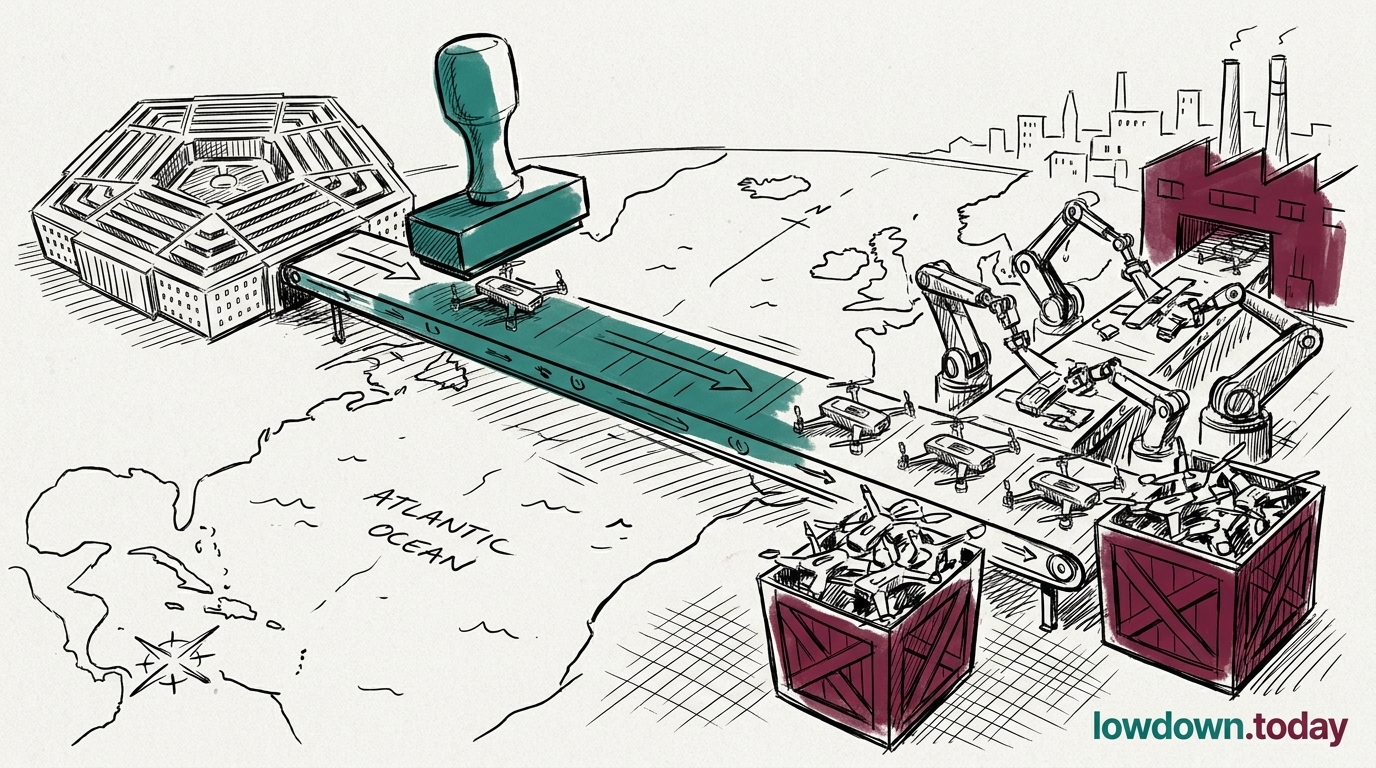
CSIS published an analysis on 17 April finding that 69% of the memory hardware and 57% of the processors in Russia's AI-enabled drone ecosystem are sourced from US firms, with only 9% from Chinese suppliers. That inverts the working assumption behind the FCC Covered List , which targets Chinese componentry as the primary national-security threat. Russia's V2U autonomous UAS runs on an Nvidia Jetson Orin module and uses YOLOv5 for target recognition, both US-origin technologies reaching Russian factories through third-country re-export routes.

The same CSIS report profiles Russia's Molniya-2 loitering munition at roughly $300 per unit against the Lancet at $50,000, a cost-per-effect ratio that reframes attritable mass economics. Russia is targeting 130,000 large UAS annually by 2030 and 350,000 by 2035, production volumes that only hold together if compute and memory supply keeps flowing from Western vendors.

The Merops deployment showed US battlefield capability flowing from Ukrainian lessons into Gulf operations as a deliberate tech-from-Ukraine pipeline. CSIS has now documented its dark-mirror version: Western chips crossing the other way into Russian drones at industrial scale. Regulators face an uncomfortable reading of the data. The FCC Covered List and Section 232 UAS Investigation both assume Chinese hardware is the primary risk in sensitive US drone applications; CSIS's numbers suggest the more acute risk is US componentry leaking into adversary production lines.

British exporters also face a diagnostic problem. Any Ukrainian supply line carrying British components faces the mirror-image problem of re-export to Russia, and any counter-drone solution procured in London needs to assume the adversary's compute stack looks more like a Bay Area datacentre than a Shenzhen consumer workshop.

Deep Analysis

In plain English

Russia uses drones to attack Ukraine. A Washington DC think-tank called CSIS looked inside captured Russian drones and found something surprising: most of the computer chips powering their artificial intelligence targeting systems came from American companies, not Chinese ones. Specifically, chips from Nvidia, the same company that makes graphics cards for PC gamers, were found in Russian combat drones. Those chips reach Russia through middlemen in places like Kazakhstan and the UAE, where export rules are looser. This matters because the US government has spent two years trying to block Chinese drone technology from entering American markets, citing national security. CSIS's finding suggests the US has been looking in the wrong direction: American chips in Russian weapons are the more immediate problem.

Deep Analysis
Root Causes

Three independent drivers explain why US-origin chips dominate rather than Chinese alternatives.

Nvidia's Jetson Orin module, found in Russia's V2U autonomous UAS, has no direct Chinese equivalent at equivalent power-efficiency for edge AI inference in a constrained payload. Huawei's Ascend 310 and 910 chips can perform similar tasks at higher power draw, but the V2U's battery-life and weight constraints favour Jetson's 10-watt active power envelope. Russia's engineers chose the best available chip for the application, not the most geopolitically convenient one.

Second, YOLOv5's prevalence as a target-recognition framework reflects an open-source default: it is widely used, extensively documented in English and Russian, and runs efficiently on Jetson hardware. Chinese vision AI frameworks like Baidu's PaddlePaddle have not achieved the same developer penetration in Russian engineering communities.

Third, US export-control architecture until 2024 treated Jetson-class AI processors as dual-use commercial items rather than military-grade semiconductors, meaning they shipped through standard distribution channels with less scrutiny than weapons-system components. The 2023 Commerce Department tightening of export controls on advanced computing chips was designed for data-centre GPUs, not embedded-AI modules, leaving a category gap that Russian procurement exploited.

What could happen next?
  • Consequence

    Treasury and Commerce Department pressure to impose secondary sanctions on identified Central Asian and UAE chip re-exporters will intensify within six months of the CSIS publication.

    Short term · 0.75
  • Risk

    The FCC Covered List and Section 232 UAS investigation's focus on Chinese components may be challenged in Congressional hearings as misdirected, potentially stalling both regulatory instruments.

    Medium term · 0.65
  • Consequence

    Nvidia faces pressure to introduce hardware-level end-use verification on Jetson modules, a technical requirement that would increase unit cost and reduce commercial availability of the platform.

    Medium term · 0.6
First Reported In

Update #6 · Britain's £752M Ukraine drone package

Center for Strategic and International Studies (CSIS)· 18 Apr 2026
Read original
Causes and effects
This Event
CSIS: Russia's AI drones run mostly on US chips
CSIS has inverted the policy logic underpinning two years of US counter-drone regulation. If the majority of AI compute powering Russia's autonomous drone ecosystem flows from US suppliers through re-export channels, then regulatory instruments aimed at Chinese componentry are addressing the wrong supply chain. For the drone-industry beat this is a structural finding: it reshapes the threat model US and allied procurement frameworks should be designed against, and it puts direct pressure on export-control frameworks, the FCC Covered List process, and the Commerce Department Section 232 investigation.
Different Perspectives
Institutional investors and defence-sector equity markets
Perennial's IDIQ gives revenue-visibility that earlier Schmidt ventures lacked; Northrop's dual award places a heritage prime on the attritable-payload standard-setting layer analysts had reserved for startups. Rheinmetall at €650 per share, up from €500 in January, prices auto-grade drone conversion as margin-accretive; DroneShield's ASIC probe introduces a governance-discount variable proxy advisers will apply at the 29 May AGM.
Korean defence-industrial sector (LIG Nex1, Hanwha Aerospace)
LIG Nex1's $2.2 billion Cheongung-III win and the KUS-FS service introduction together close Seoul's sovereign layered air-defence stack; both firms face multi-year backlog revisions on the Korea Exchange. The unresolved sensor-to-shooter integration risk between Hanwha's LAMD sensors and LIG Nex1's Cheongung-III engagement layer sits publicly unaddressed ahead of the 2029 fielding date.
Ukrainian export regulator (SSEC)
Ukraine's wartime export ban blocks Gulf sales of combat-proven interceptors at $2,100 to $2,500 per unit while Perennial Autonomy, built on Ukrainian combat data, wins a $500 million US IDIQ. Perennial's Merops, credited with 4,000-plus Russian drone kills in Ukraine, can now reach NATO allies via Munich; a direct Ukrainian sale to those same buyers remains legally blocked.
DJI and Autel Robotics
Autel's Ralls Corp filing attacks the classified-evidence foundation of its Covered List designation; DJI's parallel Ninth Circuit case has quantified $1.56 billion in 2026 regulatory losses. Both companies are now betting the D.C. Circuit will extend due-process protections to FCC product certification, a constitutional route that does not require contesting the intelligence allegations directly.
US Pentagon defence-industrial-base policy
JIATF-401's IDIQ names Perennial the benchmark holder while Anduril's $20 billion Lattice vehicle and Northrop's Drone Dominance payload role run in parallel lanes; the DoD bet is that named holders at each tier cut order-to-delivery cycles. The Section 232 clock 54 days overdue signals the administration treats FCC and FAR exclusions as sufficient to manage Chinese market access.
European defence procurement community
Germany's three-tier award demonstrates that EU member states can fund loitering-munition production at scale without single-supplier dependency, and Perennial's Munich line gives procurement offices a domestic-source justification for Merops orders outside US Foreign Military Sales channels. The Bundeswehr's split across Helsing, Stark and Rheinmetall has become the reference architecture other European buyers are mapping their own industrial bases against.
