Skip to content
Briefings are running a touch slower this week while we rebuild the foundations.See roadmap
Drones: Industry & Defence
21MAY

FCC adds Chinese drones to banned list

4 min read
11:11UTC

DJI and Autel Robotics can no longer certify new products for American sale after the FCC designated all foreign-manufactured drones as covered equipment — and the Commerce Department stepped aside to let it stick.

TechnologyDeveloping
Key takeaway

The FCC ban converts a patchwork of agency restrictions into a single, durable template for excluding dual-use Chinese hardware.

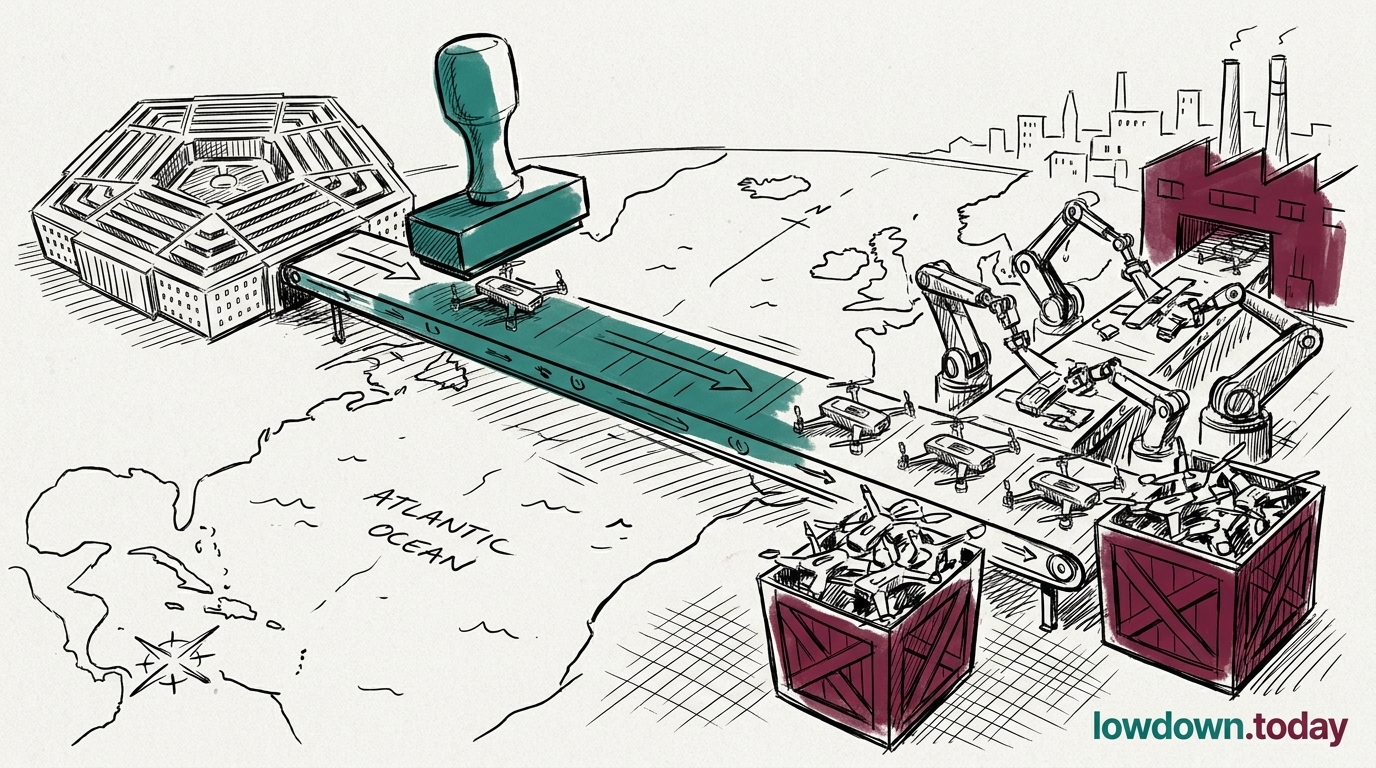
The Federal Communications Commission added all foreign-manufactured drones and critical components to its Covered List on 22 December 2025, invoking Section 1709 of the FY25 National Defence Authorisation Act 1. DJI and Autel Robotics — which together account for the majority of US commercial drone sales — can no longer receive equipment authorisation for new products on the American market.

The Commerce Department had been developing separate restrictions under its own authority but withdrew them in January 2026, concluding the FCC action was sufficient 2. The consolidation avoided competing regulatory frameworks but introduced a transition gap: the ban targets new certifications, not existing inventory. Drones already in retail and distributor channels remain legal to sell and operate. The practical market closure begins when shelf stock depletes — a window measured in months, not years, given DJI's inventory turnover rates.

DJI holds an estimated 70–80% of the global consumer and commercial drone market and has built an integrated hardware-software ecosystem no single US manufacturer replicates. For agricultural surveyors, infrastructure inspectors, emergency responders, and filmmakers who depend on DJI products, the ban removes their primary supplier without a domestic alternative at comparable price or capability. Industry groups warned of higher costs and reduced functionality for smaller operators 3.

The regulatory rationale centres on supply chain security. Chinese-manufactured drones transmit flight telemetry and sensor data that, under China's 2017 National Intelligence Law, could be compelled for state intelligence purposes. DJI has consistently denied any unauthorised data exfiltration and offers local data processing modes in its products 4. The FCC did not adjudicate the technical dispute — it applied a supply chain exclusion framework that treats manufacturing origin as a proxy for risk, the same logic used against Huawei's telecommunications equipment in 2019. The approach is efficient from a regulatory standpoint but imposes real costs on an American drone sector that had no adequate domestic substitute ready at the point of implementation.

Deep Analysis

In plain English

The US government has blocked Chinese drone makers DJI and Autel from certifying new products for the American market. FCC certification is required to sell any wireless electronic device in the US, so without it, DJI cannot legally sell new products here — even though existing drones already in consumers' hands remain legal to use. Separately, the Commerce Department withdrew its own parallel ban, leaving the FCC as the sole mechanism. This consolidation matters because it sets a replicable template: any wireless hardware from a covered Chinese firm can be excluded through the same process.

Deep Analysis
Synthesis

The Commerce Department's withdrawal — deferring entirely to the FCC — consolidates domestic market exclusion authority under a single agency with a lighter administrative burden than Commerce's entity-list process. This is not merely procedural tidying: it creates a lower-friction pathway for future hardware bans and signals that the FCC, rather than Commerce, will be the primary instrument for domestic market exclusion of Chinese tech hardware. The two agencies retain distinct roles — Commerce for export controls, FCC for domestic market access — but the division of labour is now clearer and more operationally efficient for future restrictions.

Root Causes

The FCC's Section 1709 mechanism was originally designed for telecoms equipment but its wireless-device scope was always broad enough to cover any networked hardware. The FY25 NDAA explicitly expanded this scope to drones, reflecting a congressional consensus that drone data-collection and RF-emission capabilities constitute equivalent security risks to telecoms infrastructure — a threat-model extension that prior Congresses had not formally codified for hardware outside the telecoms sector.

Escalation

The consolidation of drone restrictions under the FCC Covered List rather than Commerce's entity list is architecturally significant beyond the DJI case. The FCC mechanism applies to any wireless device and involves a simpler administrative process than Commerce's entity-list procedures. The template for extending restrictions to other categories of Chinese consumer electronics with wireless connectivity is now established and operationally tested.

What could happen next?
1 precedent1 risk1 opportunity2 consequence
  • Precedent

    The FCC Covered List mechanism, initially designed for telecoms, is now established as the primary US instrument for domestic market exclusion of Chinese consumer electronics hardware with wireless capability.

    Long term · Assessed
  • Risk

    Chinese manufacturers may route production through third-country subsidiaries to circumvent FCC certification restrictions, as occurred with solar panels and telecoms equipment under earlier US restrictions.

    Medium term · Suggested
  • Opportunity

    US, European, and allied drone manufacturers face structurally reduced Chinese competition in the world's largest defence and commercial drone market, with the revenue transfer running into the billions annually.

    Immediate · Assessed
  • Consequence

    US industries dependent on affordable drone hardware — agriculture, infrastructure inspection, cinematography, insurance — face near-term cost increases until domestic alternatives achieve price parity with former DJI products.

    Short term · Assessed
  • Consequence

    The component-level scope of the ban raises manufacturing costs for all US drone producers sourcing Chinese-made parts, compressing margins across the domestic industry even as headline revenues grow.

    Short term · Suggested
First Reported In

Update #2 · UK startup tops Pentagon's drone gauntlet

CBS News· 19 Mar 2026
Read original
Different Perspectives
Institutional investors and defence-sector equity markets
Perennial's IDIQ gives revenue-visibility that earlier Schmidt ventures lacked; Northrop's dual award places a heritage prime on the attritable-payload standard-setting layer analysts had reserved for startups. Rheinmetall at €650 per share, up from €500 in January, prices auto-grade drone conversion as margin-accretive; DroneShield's ASIC probe introduces a governance-discount variable proxy advisers will apply at the 29 May AGM.
Korean defence-industrial sector (LIG Nex1, Hanwha Aerospace)
LIG Nex1's $2.2 billion Cheongung-III win and the KUS-FS service introduction together close Seoul's sovereign layered air-defence stack; both firms face multi-year backlog revisions on the Korea Exchange. The unresolved sensor-to-shooter integration risk between Hanwha's LAMD sensors and LIG Nex1's Cheongung-III engagement layer sits publicly unaddressed ahead of the 2029 fielding date.
Ukrainian export regulator (SSEC)
Ukraine's wartime export ban blocks Gulf sales of combat-proven interceptors at $2,100 to $2,500 per unit while Perennial Autonomy, built on Ukrainian combat data, wins a $500 million US IDIQ. Perennial's Merops, credited with 4,000-plus Russian drone kills in Ukraine, can now reach NATO allies via Munich; a direct Ukrainian sale to those same buyers remains legally blocked.
DJI and Autel Robotics
Autel's Ralls Corp filing attacks the classified-evidence foundation of its Covered List designation; DJI's parallel Ninth Circuit case has quantified $1.56 billion in 2026 regulatory losses. Both companies are now betting the D.C. Circuit will extend due-process protections to FCC product certification, a constitutional route that does not require contesting the intelligence allegations directly.
US Pentagon defence-industrial-base policy
JIATF-401's IDIQ names Perennial the benchmark holder while Anduril's $20 billion Lattice vehicle and Northrop's Drone Dominance payload role run in parallel lanes; the DoD bet is that named holders at each tier cut order-to-delivery cycles. The Section 232 clock 54 days overdue signals the administration treats FCC and FAR exclusions as sufficient to manage Chinese market access.
European defence procurement community
Germany's three-tier award demonstrates that EU member states can fund loitering-munition production at scale without single-supplier dependency, and Perennial's Munich line gives procurement offices a domestic-source justification for Merops orders outside US Foreign Military Sales channels. The Bundeswehr's split across Helsing, Stark and Rheinmetall has become the reference architecture other European buyers are mapping their own industrial bases against.
