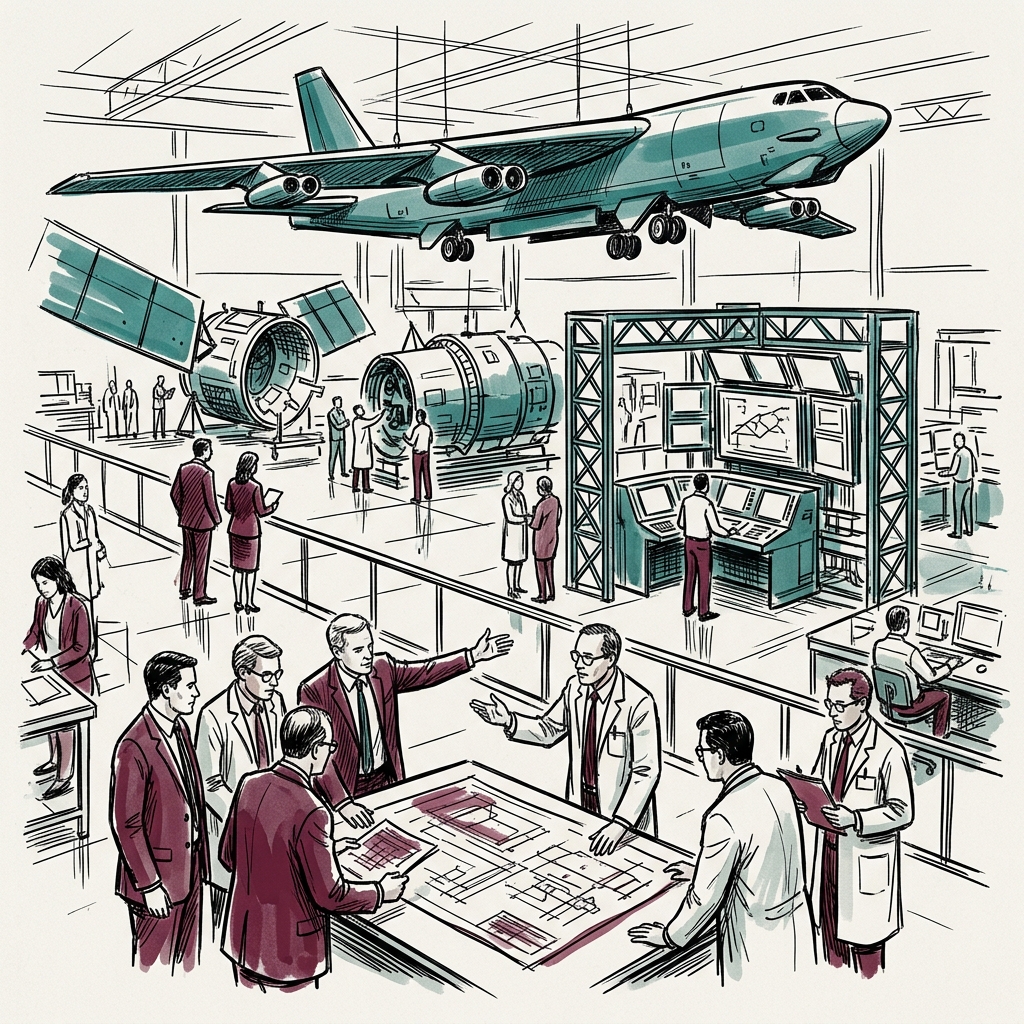
Northrop Grumman
US defence and aerospace corporation building bombers, drones, and missile defence systems.
On 17 June, Northrop Grumman lost the US Air Force's first funded autonomous wingman contracts to Anduril and General Atomics, testing a defence prime whose portfolio spans bombers, surveillance drones and missile defence.
Last refreshed: 22 September 2026 · Appears in 2 active topics
Can a legacy prime beat Anduril's drones on price for the US Air Force CCA contract?
Timeline for Northrop Grumman
Mentioned in: Pentagon orders 120 drones in five weeks
Drones: Industry & DefenceCompeted in CCA source selection and was not awarded production contract
Drones: Industry & Defence: Air Force hands robot fighter to upstartsSet common payload standard for 200,000 FPV drones in the Drone Dominance programme
Drones: Industry & Defence: Drone Dominance Gauntlet opens 8 JuneMentioned in: Two Ukrainian firms enter Pentagon gauntlet
Drones: Industry & DefenceWon $325.5M RangeHawk HALE contract on 15 May and Drone Dominance Common UAS Payload preferred provider status on 18 May
Drones: Industry & Defence: Northrop banks two drone awards in one weekBackground
Northrop Grumman is a US defence and aerospace corporation that builds strategic aircraft, unmanned systems, missile-defence equipment and space systems. Its programme base includes the B-2 Spirit, B-21 Raider and RQ-4 Global Hawk, placing it among the established contractors that supply long-cycle military capabilities.
The company remains relevant because US defence demand spans both exquisite systems and cheaper unmanned equipment. On 15 May, the Army awarded Northrop a contract for RangeHawk, a high-altitude drone derived from the Global Hawk airframe for hypersonic-test tracking. Three days later, the Pentagon selected it as a preferred effects-module supplier for a large drone programme.
Its position rests on systems integration across air, space and missile defence rather than a single product line. The US Space Force included Northrop in the Golden Dome contract pool on 24 April, extending that role into proposed space-based missile-defence work.
Northrop loses the wingman contest
On 17 June, the US Air Force selected Anduril and General Atomics for its first funded autonomous combat-drone wingman contracts. The selection passed over Northrop Grumman, Boeing and Lockheed Martin. The target price was below $30m per aircraft, placing production cost at the centre of a competition long dominated by established aviation primes.
For Northrop, the result narrows its route into the Collaborative Combat Aircraft market while leaving its wider unmanned portfolio intact. The company was also a payload-standard contractor in the Pentagon's Drone Dominance programme, where the department sought equipment for 200,000 drones. That role gives Northrop exposure to high-volume drone procurement even after its autonomous wingman bid failed.
What is Northrop Grumman?
What is the Northrop Grumman YFQ-48A Talon Blue?
How does Northrop Grumman compare to Anduril for the CCA contract?
Is Northrop Grumman involved in the Iran conflict?
Who makes the B-2 Spirit stealth bomber?
What is Northrop Grumman's YFQ-48A Talon Blue drone?
What is Northrop Grumman's role in the Golden Dome programme?
What is the B-21 Raider and how is it different from the B-2?
How did the Iran conflict affect Northrop Grumman's business?
How large is Northrop Grumman compared with Lockheed Martin and Raytheon?
What is Northrop Grumman's role in the Drone Dominance programme?


