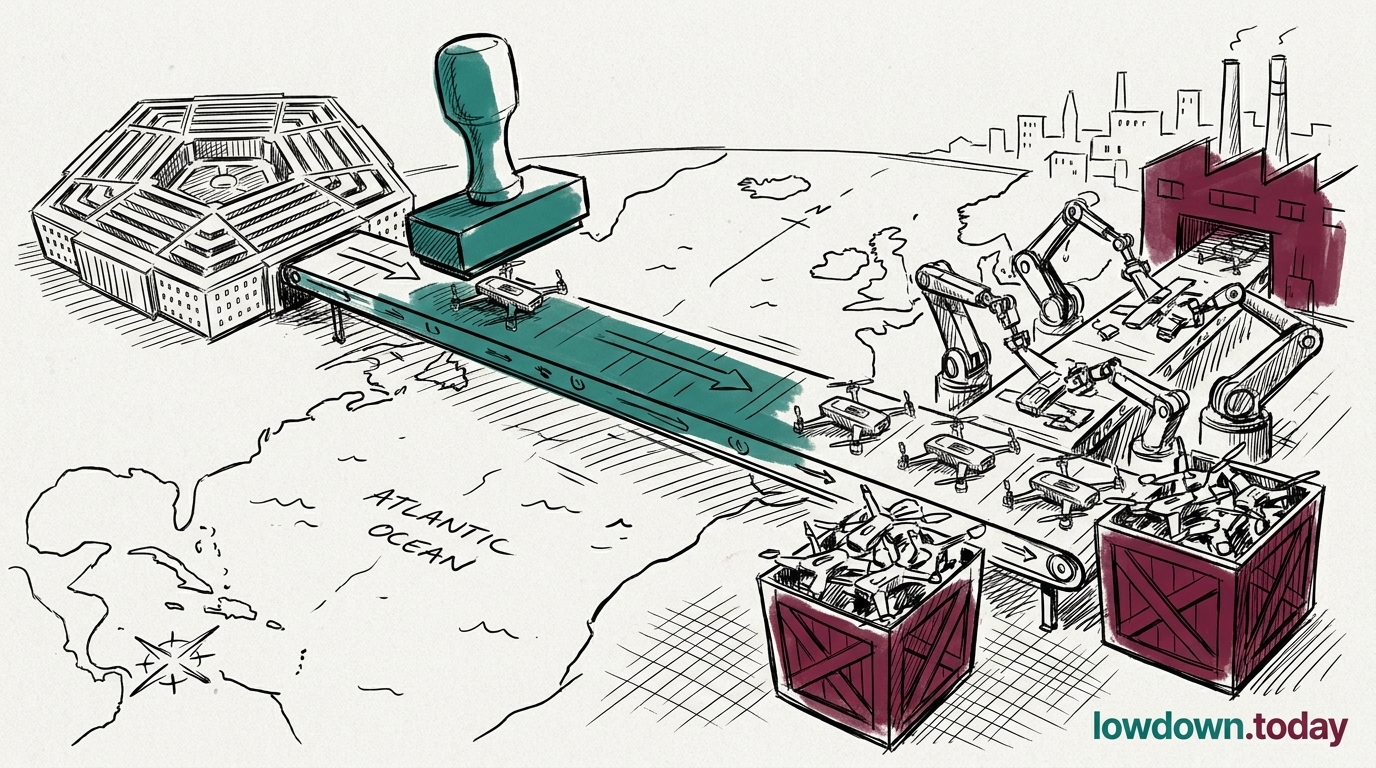
Germany has now awarded more than €840 million across three loitering-munition contracts to three different industrial tiers since late February. Helsing booked an initial €270 million tranche for 4,300 HX-2 units inside a framework potentially worth €2 billion, which the Bundestag's budget committee cut from a €4.3 billion original ceiling. Stark Defence of Berlin won a parallel €270 million initial tranche for 2,200 Virtus units, a VTOL (vertical take-off and landing) loitering munition with a 130-kilometre range, 90-minute endurance and a reusable training mode1. Rheinmetall disclosed on Wednesday 22 April that its FV-014 had taken a multi-billion-euro framework with an initial €300 million call-off for more than 10,000 units; production runs out of a converted Neuss auto plant, with deliveries from the first half of 20272.
The Bundeswehr has earmarked these systems primarily for the German brigade in Lithuania, a NATO Forward Land Forces commitment. That places German procurement across three industrial tiers in parallel: a venture-backed startup (Helsing), a Berlin mid-tier (Stark) and a heritage prime (Rheinmetall). Rheinmetall's award changes the German story most. Until late April, German drone procurement had been startup-led, and the policy debate assumed prime contractors would resist attritable economics. Rheinmetall converting an auto plant for 10,000-unit loitering-munition runs settles that assumption, and the cumulative German order book underwrote the cap table that priced Helsing at $18 billion.
All three programmes are manufactured inside the EU. The cumulative German commitment now sits at roughly the same scale as the UK's £752 million Berlin package for Ukraine, but routed through the Bundeswehr rather than as foreign military assistance, and on a fielding clock measured in months rather than years.




